“Carpenter has made a movie that is both a horror film and a satire, working on multiple levels and leaving you thinking long after the credits roll.”
Roger Ebert
Chicago Sun-Times
 United States
"You think they're people just like you. You're wrong."
User Score
250000 votes
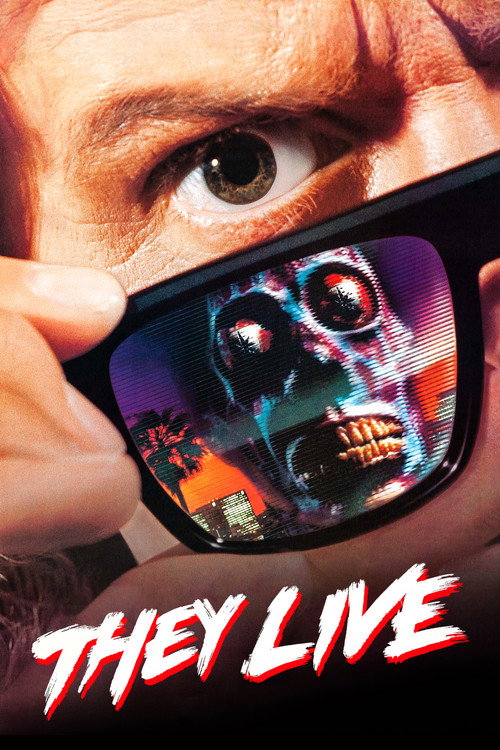
John Carpenter adapted Ray Nelson's short story into a gritty science fiction thriller that arrived in theaters on November 4, 1988. The film stars Roddy Piper as John Nada, a drifter who stumbles upon a pair of sunglasses capable of revealing the true nature of reality. Through these lenses, ordinary citizens appear as skull-faced aliens while billboards display commands to obey and consume. This visual twist anchors a narrative about class warfare and media manipulation set against the backdrop of late-1980s Los Angeles.
Production kept costs low with a budget of four million dollars, yet the film achieved a cult following through its sharp satire and practical effects. Critics initially gave it mixed reviews, though retrospective analysis has elevated its status significantly. Keith David delivers a memorable performance as Frank Armitage, Nada's ally in a world where truth is dangerous. The movie remains a touchstone for discussions regarding consumer culture and political apathy.
Availability and pricing can change. Confirm on the provider's site before purchasing.
John Nada arrives in Los Angeles carrying only a suitcase and a sense of restlessness after being fired from a construction site. He wanders through neighborhoods marked by high unemployment and visible decay, eventually finding shelter among squatters in abandoned buildings. There he meets Frank Armitage, a cynical homeless man who shares Nada's suspicion that something is fundamentally wrong with society. Their bond forms over shared observations of aggressive advertising campaigns and a pervasive pressure to conform.
Nada's life shifts when he discovers a box of sunglasses hidden in an alleyway. Putting them on reveals a shocking alternate reality: most humans are actually grotesque alien entities masquerading as people. The text on advertisements changes from marketing slogans to direct orders like "OBEY" and "CONSUME." These messages serve as subliminal commands designed to keep the human population docile and compliant. Nada realizes that the aliens have already infiltrated every level of government and industry to maintain their control.
Attempting to warn others, Nada distributes the glasses to his fellow squatters. They face immediate hostility from authorities led by Holly Thomsen, a cold and calculating figure who enforces the alien agenda. The group organizes a resistance movement, but they struggle against a system that monitors dissent and eliminates threats. Nada and Frank engage in confrontations with security forces while trying to expose the conspiracy to the wider public. The atmosphere grows increasingly tense as the protagonists realize the aliens are steering humanity toward self-destruction through unchecked consumerism and apathy.
The narrative builds toward a confrontation at a massive corporate headquarters where the resistance plans to distribute the glasses to executives. Nada and Frank infiltrate the building hoping to wake the ruling class to the truth. They face overwhelming opposition from well-armed security teams and the disguised aliens themselves. The stakes escalate as the duo fights to prevent the complete assimilation of humanity. Nada must decide whether to continue fighting despite the odds or accept the crushing weight of an illusion that no one else can see. The story explores the psychological toll of knowing a truth that remains invisible to everyone around you.
Official Trailer
They Live (1988) ORIGINAL TRAILER [HD 1080p]
Critical Consensus
They Live combines sharp social commentary with visceral action. John Carpenter's direction turns a simple sci-fi premise into a biting critique of consumer culture. Roddy Piper delivers a career-defining performance supported by Keith David. While pacing varies, the film's prophetic message about unchecked capitalism resonates deeply with modern audiences.
“Carpenter has made a movie that is both a horror film and a satire, working on multiple levels and leaving you thinking long after the credits roll.”
Roger Ebert
Chicago Sun-Times
“A smart, stylish, and surprisingly funny science fiction thriller that uses its alien invaders to lampoon the excesses of American consumerism.”
Janet Maslin
The New York Times
“Piper brings unique charisma to the role while Carpenter's direction ensures the film remains visually striking and thematically rich.”
Variety Staff
Variety
Roddy Piper
John Nada
Keith David
Frank Armitage
Meg Foster
Holly Thomsen
George 'Buck' Flower
Drifter
Peter Jason
Gilbert
Director
John Carpenter
Writers
Ray Nelson, John Carpenter
Composers
John Carpenter, Alan Howarth
Cinematographer
Gary B. Kibbe
Producer
Larry Franco
Saturn Awards (1989)
Best Science Fiction Film: Nominated
Fangoria Chainsaw Awards (1989)
Best Special Effects: Won
National Film Registry (2008)
Preservation: Inducted
Join the community
fans discussing