“Mr. Shyamalan has made a movie that is beautiful to look at and haunting to hear, but it is also a movie that is deeply flawed in its storytelling and character development.”
A.O. Scott
The New York Times
 United States
"There is no turning back"
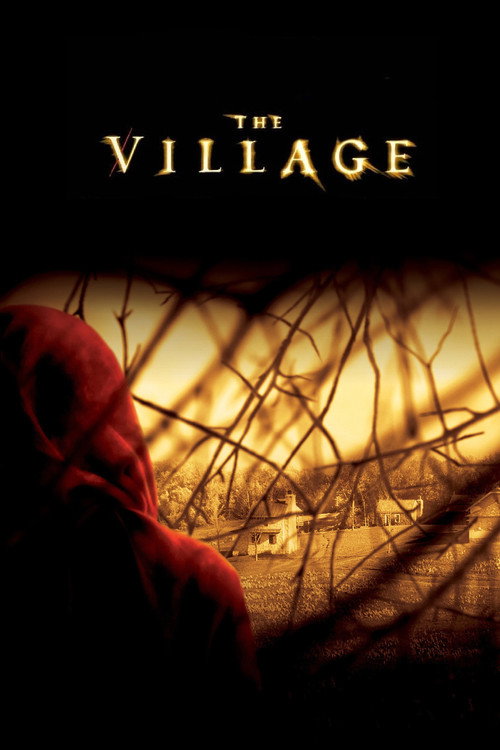
Set in a secluded Pennsylvania community during the late 1890s, this psychological thriller explores a society built on fear and strict isolation. The residents live under the belief that dangerous creatures inhabit the surrounding woods, creatures that are drawn to the color red. A council of elders enforces rigid rules to keep the village safe, including a ban on the color red and a prohibition against leaving the settlement. The narrative follows Ivy Walker, a young woman who can see beyond the physical world despite her blindness, as she navigates a romance with Lucius Hunt while uncovering secrets that challenge the very foundation of their existence.
M. Night Shyamalan directs the film, which stars Bryce Dallas Howard and Joaquin Phoenix alongside William Hurt and Sigourney Weaver. The production utilized practical effects and natural lighting to create an atmosphere of timeless dread. Critics noted the strong performances and atmospheric cinematography by Roger Deakins, though opinions varied regarding the execution of the final twist. The film grossed over $256 million worldwide against a budget of $60 million, establishing itself as a distinct entry in the director's body of work focused on mystery and human psychology.
Stream
Rent
Availability and pricing can change. Confirm on the provider's site before purchasing.
The story unfolds in a small, self-contained hamlet where life has remained unchanged for generations. The villagers wear only earth tones because they believe the creatures lurking in the nearby forest are attracted to the color red. Edward Walker serves as the head elder, guiding his people with wisdom and firmness, while his wife Alice maintains the domestic order. Ivy Walker, the blind daughter of the elder, moves through the village with grace and purpose. She relies on her heightened senses to navigate the world around her and shares a deep bond with Lucius Hunt, the son of another elder named August Nicholson.
Lucius is different from the other men in the village. Though he can see, he pretends to be blind to remain within the social structure and to avoid the pain of the outside world. His condition makes him unstable, prone to sudden outbursts and confusion. When Lucius decides he must find a cure for his eyes or escape the suffocating nature of their lives, he ventures into the forbidden woods. He returns injured and terrified, claiming that the creatures attacked him. This event sends shockwaves through the community, causing panic among the elders who fear the barrier protecting them is failing.
As the tension rises, a new figure emerges to challenge the established order. Noah Percy, a young man obsessed with the truth, begins to investigate the origins of the creatures and the lies told by the elders. He suspects that the monsters are not supernatural but manufactured. His inquiries lead to confrontations that force the villagers to question everything they have been taught about their history and their safety. The line between reality and illusion blurs as the characters grapple with their deepest fears and the secrets that bind them together.
The narrative builds toward a climax where the true nature of the village and its inhabitants is revealed. The film examines themes of control, fear, and the human need for security in a world that often feels hostile. Through its intricate plot and atmospheric setting, the movie invites audiences to consider the cost of living in a constructed reality versus facing the harsh truths of the present day. The journey of Ivy and Lucius becomes a metaphor for breaking free from the constraints imposed by others and finding one's own path forward.
The Village (2004) - Official Trailer
Critical Consensus
Visually stunning and atmospherically rich, the film showcases M. Night Shyamalan's mastery of suspense. While some critics found the plot twists predictable or the execution uneven, the strong performances from Bryce Dallas Howard and Joaquin Phoenix, combined with the haunting score and cinematography, create a compelling experience. It remains a divisive but memorable entry in Shyamalan's filmography, praised for its emotional depth and thematic complexity despite mixed reactions to its narrative structure.
“Mr. Shyamalan has made a movie that is beautiful to look at and haunting to hear, but it is also a movie that is deeply flawed in its storytelling and character development.”
A.O. Scott
The New York Times
“The Village is a film that is so intent on being a puzzle that it forgets to be a story. It is a movie that is more interested in its own cleverness than in its characters.”
Roger Ebert
Chicago Sun-Times
“Shyamalan's 'The Village' is a mesmerizing, if ultimately disappointing, thriller that relies too heavily on its twist ending to carry the weight of its narrative.”
Peter Travers
Rolling Stone
“The Village is a film that is both beautiful and disturbing, a work that manages to be both a period piece and a modern allegory.”
Kenneth Turan
Los Angeles Times
“The Village is a film that is so committed to its own mythology that it loses touch with the audience. It is a movie that is more interested in its own cleverness than in its characters.”
David Edelstein
New York Magazine
Bryce Dallas Howard
Ivy Walker
Joaquin Phoenix
Lucius Hunt
Adrien Brody
Noah Percy
William Hurt
Edward Walker
Sigourney Weaver
Alice Hunt
Brendan Gleeson
August Nicholson
Cherry Jones
Mrs. Clack
Celia Weston
Vivian Percy
John Christopher Jones
Robert Percy
Frank Collison
Victor
Director
M. Night Shyamalan
Writer
M. Night Shyamalan
Composer
James Newton Howard
Cinematographer
Roger Deakins
Producers
Sam Mercer, Scott Rudin, M. Night Shyamalan
Academy Awards (2005)
Best Original Score: Nominated
Golden Globe Awards (2005)
Best Original Score: Nominated
Saturn Awards (2005)
Best Horror Film: Won
Saturn Awards (2005)
Best Actress: Won
MTV Movie Awards (2005)
Best Breakthrough Performance: Nominated
Teen Choice Awards (2005)
Choice Movie Drama/Action Adventure: Won
Join the community
fans discussing