 United States
“Joel Coen has made a Macbeth that feels less like a play and more like a nightmare, a claustrophobic vision where the walls themselves seem to breathe with malice.”
A.O. Scott
The New York Times
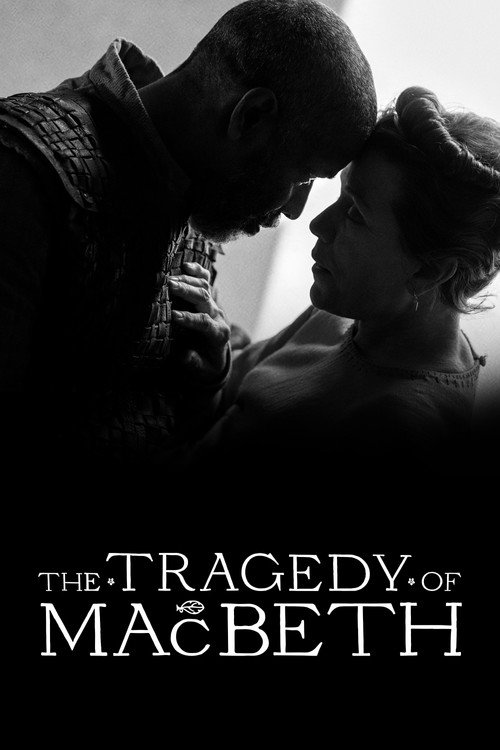
Joel Coen strips the color from William Shakespeare's tragedy to reveal a stark, monochromatic nightmare. Released in late 2021, this adaptation focuses entirely on the psychological unraveling of its protagonists rather than historical spectacle. Denzel Washington and Frances McDormand bring their formidable theatrical chemistry to the screen for the first time in a major motion picture, anchoring a production that feels more like a claustrophobic dream than a traditional play.
The film operates on a modest scale compared to Hollywood blockbusters, generating just over $176,000 at the domestic box office despite its high-profile cast. A24 distributed the project, which runs a tight 1 hour and 45 minutes. Critics and audiences gave it a solid 6.9 out of 10 rating, appreciating the bold visual choices and intense performances over traditional spectacle. This version leans heavily into the themes of treason and ambition, presenting a world where shadows seem to swallow everything.
Stream
Availability and pricing can change. Confirm on the provider's site before purchasing.
Set in a stark, monochromatic Scotland where the landscape is often obscured by swirling fog and jagged, surreal architecture, The Tragedy of Macbeth reimagines William Shakespeare’s classic tragedy as a psychological horror film. The story opens with a trio of witches, known as the Weird Sisters, who prophesy that Macbeth, a Scottish general serving under King Duncan, will be named Thane of Cawdor and eventually rise to become King of Scotland. Simultaneously, they predict that while Banquo, Macbeth’s fellow general and friend, will not become king himself, his descendants shall inherit the throne.
Upon returning from battle against Norway, Macbeth is indeed named Thane of Cawdor, confirming the first part of the prophecy. Consumed by ambition and spurred on by his wife, Lady Macbeth, Macbeth begins to entertain the idea of murdering King Duncan to seize the crown. Lady Macbeth, portrayed as a figure of terrifying resolve, manipulates her husband’s conscience, questioning his manhood and urging him to suppress his moral qualms. She devises a plan to drug the King’s guards and frame them for the regicide, allowing Macbeth to kill Duncan in his sleep.
Following the murder, Macbeth is crowned King, but his reign is immediately plagued by paranoia and guilt. The visual atmosphere grows increasingly oppressive as the castle walls seem to close in, reflecting the internal decay of the protagonists. Macbeth becomes obsessed with securing his power, fearing that Banquo’s lineage threatens his legacy. He arranges for Banquo’s murder during a hunt, though Banquo’s son, Fleance, escapes into the night. This event haunts Macbeth further; at a royal banquet, he sees Banquo’s ghost sitting in his chair, causing him to lose his composure in front of his lords, deepening their suspicion.
Lady Macbeth, once the architect of the violence, begins to unravel under the weight of her actions. Her descent into madness is marked by sleepwalking scenes where she attempts to wash imaginary blood from her hands, reliving the trauma of the murders. Meanwhile, Macduff, a nobleman whose family has been targeted by Macbeth’s tyranny, flees to England to join forces with Malcolm, Duncan’s exiled son. In a desperate bid to maintain control, Macbeth orders the slaughter of Macduff’s innocent wife and children.
As the political landscape shifts, the kingdom turns against the tyrant. The witches’ prophecies take on a deceptive literalism, promising Macbeth that he cannot be harmed by any man born of woman and that he will remain invincible until Birnam Wood comes to Dunsinane Hill. Believing these promises make him invulnerable, Macbeth fortifies his castle at Dunsinane. However, the stage is set for a confrontation that challenges the very nature of fate, ambition, and the human soul, as the forces of rebellion gather to overthrow the usurper king.
Official Trailer
Teaser Trailer
Critical Consensus
Critics widely praised the film for its bold visual choices and the powerhouse performances of Denzel Washington and Frances McDormand. While some noted the condensed runtime sacrificed minor subplots, the overwhelming consensus celebrated the movie as a masterclass in atmospheric storytelling, stripping Shakespeare’s text down to its most essential, terrifying elements without losing its poetic weight.
“Joel Coen has made a Macbeth that feels less like a play and more like a nightmare, a claustrophobic vision where the walls themselves seem to breathe with malice.”
A.O. Scott
The New York Times
“Washington and McDormand are electric, their chemistry crackling with a dangerous energy that makes every whispered line feel like a death sentence.”
David Ehrlich
IndieWire
“A stunning achievement in minimalism. The black-and-white cinematography transforms the Scottish Highlands into a hellscape of shadows and smoke.”
Peter Debruge
Variety
“This is a Macbeth for the ages, one that understands that the true horror lies not in the blood, but in the silence that follows.”
Manohla Dargis
The New York Times
“Coen’s direction is precise and chilling, creating a world where the supernatural feels as mundane and inevitable as the rising tide.”
Justin Chang
Los Angeles Times
Denzel Washington
Macbeth
Frances McDormand
Lady Macbeth
Brendan Gleeson
King Duncan
Bertie Carvel
Banquo
Corey Hawkins
Macduff
Harry Melling
Malcolm
Alex Hassell
Ross
Moses Ingram
Lady Macduff
Kathryn Hunter
The Witches / The Old Man
Director
Joel Coen
Writers
Joel Coen, William Shakespeare
Composer
Carter Burwell
Cinematographer
Bruno Delbonnel
Producers
Frances McDormand, Robert Graf, Joel Coen
Academy Awards (2022)
Best Cinematography: Nominated
BAFTA Awards (2022)
Best Cinematography: Nominated
BAFTA Awards (2022)
Best Original Music: Nominated
Critics' Choice Movie Awards (2022)
Best Cinematography: Nominated
National Society of Film Critics Awards (2021)
Best Cinematography: Won
New York Film Critics Circle Awards (2021)
Best Cinematography: Won
Join the community
fans discussing