“Malick's film is a meditation on war, a spiritual journey that asks profound questions about life, death, and the nature of humanity.”
Roger Ebert
Chicago Sun-Times
 United States
"Every man fights his own war."
Part of a Collection
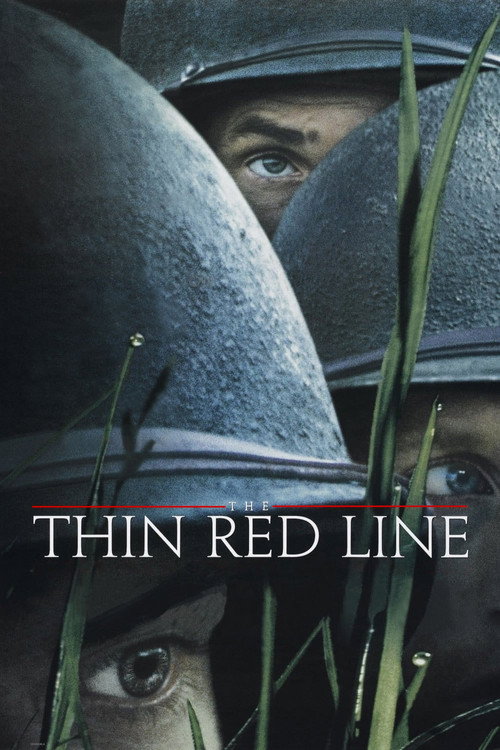
Terrence Malick returned from a twenty-year hiatus with a war film that looked nothing like the genre's conventions. Adapted from James Jones's 1962 novel, the movie drops viewers into the 1942 Battle of Guadalcanal, but the real combat happens inside the minds of the soldiers. Malick traded linear action for drifting voiceovers, shots of wind in the grass, and a profound ambivalence about what it means to kill or be killed.
The production was famously chaotic. Malick shot over a million feet of film, cut a five-hour assembly, and then carved it down to 170 minutes. Several major actors, including Adrien Brody, who was originally cast as a lead, saw their roles reduced to near-cameos. The budget ran to $52 million, and the shoot stretched across Australia's Daintree Rainforest, the Solomon Islands, and a few days in the U.S.
When it premiered in 1998, reactions split sharply. Some critics called it pretentious and meandering; others hailed it as a spiritual masterpiece. It earned seven Academy Award nominations, including Best Picture and Best Director, and won the Golden Bear at Berlin. Over time, its reputation has only grown, and it's now considered one of the most singular American films of the 1990s.
Availability and pricing can change. Confirm on the provider's site before purchasing.
Private Witt (Jim Caviezel) has gone AWOL on a South Pacific island, living among the Melanesian people in a state of almost Edenic peace. When he is captured by Sergeant Welsh (Sean Penn), a cynical and hardened soldier, Witt is returned to his unit, C Company, 1st Battalion, 27th Infantry Regiment. The company is preparing for the invasion of Guadalcanal, where the Japanese have held the island's strategic airfield for months.
Onboard the transport ship, the men are a chorus of anxious voices. Private Bell (Ben Chaplin) remembers his wife back home. Captain Staros (Elias Koteas), a lawyer in civilian life, prays for his men. Colonel Doolittle (Nick Nolte), a career officer with a desperate hunger for glory, pushes for a direct assault on the Japanese stronghold at Hill 210. Staros resists, arguing the attack will be suicide. The tension between the two commanders becomes the film's central conflict.
The landing on Guadalcanal is almost peaceful at first. The soldiers move through tall grass and jungle, past abandoned Japanese camps and native villages. But the enemy is invisible, and fear builds with every step. When the company finally reaches the base of Hill 210, they are pinned down by machine-gun fire. Men die in the first minutes, faces blown off, bodies torn apart. The camera lingers on the wounded, the dead, and the living who must keep moving.
In the lulls between firefights, Malick cuts to nature: a bird perched on a branch, rain falling on leaves, a crocodile sliding into a river. The soldiers' internal monologues question God, fate, and the point of it all. Welsh tells Witt that love and goodness are illusions; Witt counters that there is another world, a world of light. Their philosophical sparring runs underneath the physical ordeal.
The assault on Hill 210 is a nightmare of noise and confusion. Soldiers charge uphill through tall grass, only to be cut down. A flamethrower operator is shot and explodes. A medic tries to save a man whose intestines spill out. The Japanese fight from hidden bunkers, and the Americans must take them one by one with grenades and bayonets. After hours of fighting, the hill is taken, but at a terrible cost.
In the aftermath, Doolittle relieves Staros of command, praising him for his courage but punishing him for his disobedience. The company moves on, deeper into the island. They find a Japanese camp abandoned in haste, meals still warm, a dog left behind. The war continues, but something has broken in the men. They are no longer the same people who landed on the beach.
Official Trailer
Critical Consensus
The Thin Red Line is a daringly philosophical World War II film with an enormous cast of eager stars. It prioritizes introspection and the human experience over conventional action, resulting in a visually stunning and deeply contemplative war film.
“Malick's film is a meditation on war, a spiritual journey that asks profound questions about life, death, and the nature of humanity.”
Roger Ebert
Chicago Sun-Times
“It's a film of forces and ideas that swell towards each other and then ebb away, aligning and conflicting in equal measure.”
Noah Gittell
The New York Times
“The Thin Red Line is an ambitious art film that uses WW2 as a backdrop, focusing on the men forced to live through the hell of war and how it changes them.”
True Myth Media
True Myth Media
“Malick’s soldiers are not carefully devised to represent different demographics or imbued with conflicting philosophies on life. We barely know anything about them that their faces don’t reveal.”
Noah Gittell
The New York Times
Jim Caviezel
Private Witt
Sean Penn
Sergeant Edward Welsh
Nick Nolte
Colonel James Doolittle
Elias Koteas
Captain James Staros
Ben Chaplin
Private Bell
John Cusack
Captain John Gaff
George Clooney
Captain Charles Bosche
John C. Reilly
Corporal Doll
Adrien Brody
Private First Class Bernard 'Buddy' Compson
Woody Harrelson
Sergeant Keck
Director
Terrence Malick
Writers
James Jones, Terrence Malick
Composer
Hans Zimmer
Cinematographer
John Toll
Producers
John Roberdeau, Robert Michael Geisler, Mike Medavoy, John Baldecchi, Terrence Malick
Academy Award (1999)
Best Picture: Nominated
Academy Award (1999)
Best Director: Nominated
Academy Award (1999)
Best Adapted Screenplay: Nominated
Academy Award (1999)
Best Cinematography: Nominated
Academy Award (1999)
Best Film Editing: Nominated
Academy Award (1999)
Best Original Dramatic Score: Nominated
Golden Globe (1999)
Best Motion Picture – Drama: Nominated
Golden Globe (1999)
Best Director: Nominated
Berlin International Film Festival (1999)
Golden Bear: Won
National Society of Film Critics (1999)
Best Film: Won
National Society of Film Critics (1999)
Best Director: Won
National Society of Film Critics (1999)
Best Cinematography: Won
Join the community
fans discussing