 United States


“It is a movie that makes you believe in the power of music to heal and transform, and it does so with a grace and beauty that is unmatched in cinema history.”
Roger Ebert
Chicago Sun-Times
Maria Rainer is a young postulant at Nonnberg Abbey in Salzburg who finds the convent's rigid schedule stifling her spirit. Her superiors recognize that her gift for music and her boundless energy are better suited to a different kind of life. The Abbess sends her to the home of Captain Georg von Trapp, a widowed naval officer raising seven children with military precision since his wife passed away.
Upon arriving at the villa, Maria discovers a household where laughter has been forbidden and the children act out against strict rules. She uses songs and games to break down their defenses while gently challenging the Captain's cold demeanor. As she brings joy back into the home, a romance blossoms between her and the Captain, even as political tensions rise across Europe with the looming threat of Nazi annexation.
Stream
Availability and pricing can change. Confirm on the provider's site before purchasing.
The story begins in the shadowed halls of Nonnberg Abbey where Maria, played by Julie Andrews, struggles to keep up with the daily prayers and chores. Sister Margaretta often sighs at Maria's tendency to wander the hills or sing off-key during mass. When the Mother Abbess sees Maria playing with the nuns' choir, she realizes the girl belongs outside the cloister walls. She assigns Maria to care for the seven von Trapp children: Liesl, Friedrich, Louisa, Kurt, Brigitta, Marta, and Gretl. The Captain, portrayed by Christopher Plummer, expects a governess who can maintain order, not one who turns the house upside down.
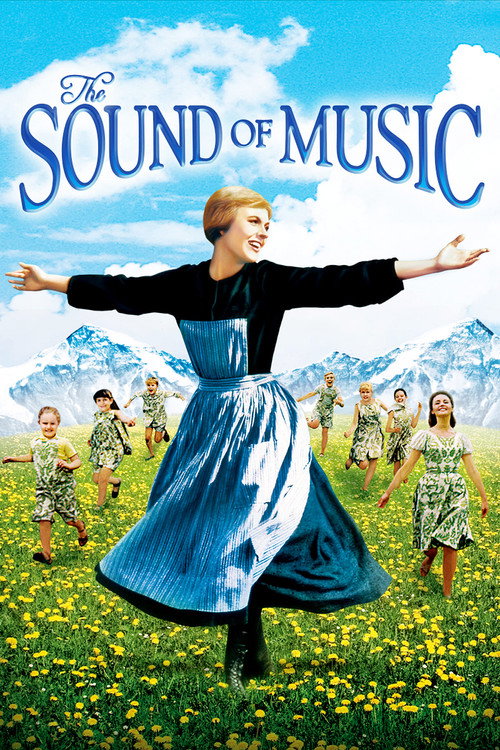
Maria arrives at the family estate to find chaos. The children have rigged a trap to scare away previous governesses, and the Captain treats them like soldiers on parade. He forbids singing and keeps the house in a state of perpetual silence. Maria changes this dynamic immediately. She sews play clothes for the children, takes them on hikes to the mountains, and teaches them to sing. The song "Do-Re-Mi" becomes a turning point as the family learns to harmonize together for the first time in years. The Captain returns from a business trip to find his children dressed in costumes and singing loudly. Instead of anger, he feels a strange sense of relief and pride.
While the family bonds over music, the political situation in Austria deteriorates. The Anschluss looms large, and the Captain receives orders to join the German Navy. He refuses because he cannot serve a regime that opposes his values. This decision puts the entire family at risk. Meanwhile, Baroness Elsa Schraeder, a wealthy woman the Captain had invited to court him, watches as Maria and the Captain grow closer. The Baroness tries to intervene but ultimately steps aside when she sees the genuine connection forming between Maria and the Captain.
The narrative builds toward the annual Salzburg Festival where the von Trapp family plans to perform. Maria and the Captain decide to marry before leaving the country. They hold a private ceremony in the garden, surrounded by the children and the nuns. The wedding is interrupted by news that the Nazis are coming to arrest the Captain for refusing his commission. The family must make a difficult choice about their future. They prepare to flee Austria, knowing they will lose their home and status if caught.
As the family packs their belongings, they face the terrifying reality of crossing the border. The Gestapo tracks them down, leading to a tense chase through the streets of Salzburg. The family hides in the church basement before making a run for it. They reach the mountain pass near the monastery, where they hope to slip into Switzerland. The film ends with the family standing on a hilltop, looking out over the Alps. They have escaped the immediate danger, but their journey into exile has just begun. The final shot leaves the audience wondering how they will survive in a new land without their fortune.
Official International 4K Trailer
Sing-A-Long (Official Trailer)
New 4K Restoration - Official Trailer
Critical Consensus
Critics universally praised The Sound of Music for its stunning visuals, memorable score, and the chemistry between Julie Andrews and Christopher Plummer. While some noted historical inaccuracies regarding the von Trapp family, the film stands as a masterful blend of drama and musical theater, setting a benchmark for the genre with its emotional depth and technical excellence.
“It is a movie that makes you believe in the power of music to heal and transform, and it does so with a grace and beauty that is unmatched in cinema history.”
Roger Ebert
Chicago Sun-Times
“A triumph of production values and storytelling, The Sound of Music is a rare example of a film that manages to be both a crowd-pleaser and a work of art.”
Variety Staff
Variety
“Julie Andrews gives a performance of such charm and sincerity that she becomes the very embodiment of the character she plays, making the film a timeless classic.”
Bosley Crowther
The New York Times
Julie Andrews
Maria Rainer
Christopher Plummer
Captain Georg von Trapp
Eleanor Parker
Baroness Elsa Schraeder
Charmian Carr
Liesl von Trapp
Nicholas Hammond
Friedrich von Trapp
Heather Menzies
Louisa von Trapp
Angela Cartwright
Brigitta von Trapp
Debbie Turner
Marta von Trapp
Kym Karath
Gretl von Trapp
Duane Chase
Kurt von Trapp
Richard Haydn
Max Detweiler
Peggy Wood
Mother Abbess
Director
Robert Wise
Writers
Ernest Lehman, Howard Lindsay, Russel Crouse
Composers
Richard Rodgers, Oscar Hammerstein II, Irwin Kostal
Cinematographer
Ted D. McCord
Producer
Robert Wise
Academy Awards (1966)
Best Picture: Won
Academy Awards (1966)
Best Director: Won
Golden Globe Awards (1966)
Best Motion Picture – Musical or Comedy: Won
Grammy Awards (1966)
Best Soundtrack Album: Won
Join the community
fans discussing