 United States
“Mr. Burger has made a movie that is both a period piece and a timeless fable, a film that invites us to believe in the magic of cinema itself.”
A.O. Scott
The New York Times
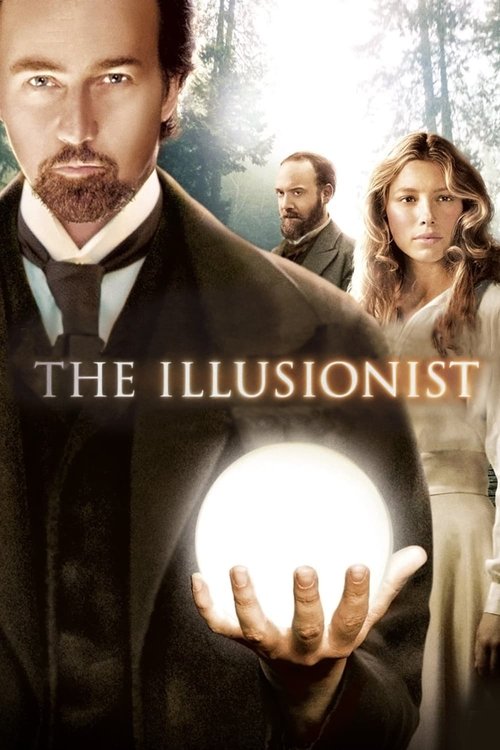
Vienna, 1898. A city where gaslight flickers against the backdrop of an empire crumbling under its own weight. Eisenheim returns to this world not as a beggar but as a master of the impossible, drawing crowds who pay fortunes just to witness him make objects vanish and spirits appear. His act challenges the rigid logic of the aristocracy, forcing them to confront the limits of their understanding.
The arrival of Crown Prince Leopold changes everything. He sees Eisenheim not as entertainment but as a rival for the heart of Sophie von Teschen, his own fiancée. This romantic triangle ignites a conflict that threatens to tear apart the social fabric of the court. Inspector Uhl, tasked with exposing the magician as a fraud, finds himself trapped in a web of deception where every clue leads deeper into mystery rather than toward a simple truth.
Stream
Availability and pricing can change. Confirm on the provider's site before purchasing.
The story opens in Vienna during the late 19th century, a time when industrial progress clashes with old-world traditions. Eisenheim, a man of humble origins, has returned to the capital after years away to perform magic that defies explanation. His first major show at the Burgtheater draws the attention of everyone from commoners to the highest nobility. The audience watches in stunned silence as he makes coins disappear from thin air and seemingly communicates with the dead. These feats are not just tricks; they are carefully constructed experiences designed to make people believe in something greater than themselves.
Sophie von Teschen sits in the front row, her eyes fixed on the stage. She once loved Eisenheim before duty separated them, and seeing him now stirs feelings she thought were long buried. Crown Prince Leopold notices her distraction immediately. As the heir to the Austro-Hungarian throne, Leopold cannot tolerate any threat to his authority or his engagement. He views Eisenheim's growing popularity as a direct challenge to the monarchy and orders Inspector Uhl to investigate the magician's background and methods.
Uhl begins digging into Eisenheim's past, uncovering details about his childhood friendship with Sophie and his sudden rise to fame. The investigation reveals that Eisenheim possesses no supernatural powers, yet his illusions remain impenetrable. He uses psychology, misdirection, and technology available at the time to create effects that look like miracles. Each performance becomes more daring, targeting the Prince directly and humiliating him in public. The tension escalates as Eisenheim stages a séance where he summons the ghost of a woman who supposedly died years ago, leaving the court shaken and superstitious.
Inspector Uhl grows increasingly frustrated by his inability to catch Eisenheim in a lie. The detective represents the cold, hard logic of the state, while Eisenheim embodies the power of belief and imagination. Their clash mirrors the broader struggle between the old aristocracy and the rising forces of modernity. Sophie finds herself torn between her duty to the Prince and her enduring love for the magician. She knows that staying with Leopold means surrendering her freedom, but leaving could mean losing the only man she truly loves.
The film builds toward a series of high-stakes performances where Eisenheim pushes the boundaries of what is possible. He manipulates the perceptions of the entire court, making them question reality itself. The line between illusion and truth blurs completely as the narrative moves closer to its conclusion. Every trick serves a purpose beyond mere entertainment; each one is a move in a larger game of survival and resistance against oppression. The audience is left wondering if Eisenheim is truly a wizard or simply a genius of deception who has mastered the art of controlling minds.
As the final act approaches, the stakes become personal. Eisenheim must decide whether to flee the city or stand his ground against the full force of the crown. The story explores themes of class struggle, the nature of belief, and the tragic consequences of love when pitted against political power. The film keeps viewers guessing until the very last moment, challenging them to determine what is real and what is merely a trick of the light.
The Illusionist (2006) ORIGINAL TRAILER [HD 1080p]
Critical Consensus
Critics praise the film for its atmospheric storytelling, stunning visuals, and Edward Norton's charismatic performance. The movie successfully blends fantasy with historical drama, creating a sense of wonder without relying on cheap tricks. While some reviewers found the pacing slow, the consensus remains that it is an engrossing mystery that respects the intelligence of its audience.
“Mr. Burger has made a movie that is both a period piece and a timeless fable, a film that invites us to believe in the magic of cinema itself.”
A.O. Scott
The New York Times
“The Illusionist is a beautiful, moody, and intelligent film that respects the intelligence of its audience. It is a rare treat to see a movie that treats magic with such seriousness and respect.”
Roger Ebert
Chicago Sun-Times
“Neil Burger's 'The Illusionist' is a spellbinding masterpiece. Edward Norton delivers a career-best performance, and the film's visual splendor is nothing short of breathtaking.”
Peter Travers
Rolling Stone
Edward Norton
Eisenheim
Paul Giamatti
Inspector Uhl
Jessica Biel
Sophie von Teschen
Rufus Sewell
Crown Prince Leopold
Eddie Marsan
Josef Fischer
Aaron Taylor-Johnson
Young Eisenheim
Eleanor Tomlinson
Young Sophie
Director
Neil Burger
Writers
Neil Burger, Steven Millhauser
Composer
Philip Glass
Cinematographer
Dick Pope
Producers
Cathy Schulman, Brian Koppelman, Michael London, Bob Yari, David Levien
Saturn Awards (2007)
Best Fantasy Film: Won
Saturn Awards (2007)
Best Actor: Nominated
BAFTA Awards (2007)
Best Cinematography: Nominated
Visual Effects Society Awards (2007)
Outstanding Visual Effects in a Motion Picture: Nominated
Join the community
fans discussing