“The film is a dark, ambitious work that pushes the boundaries of what a Disney animated feature can be, with a villain so chilling he rivals any in the studio's history.”
Janet Maslin
The New York Times
 United States
"One man's dream defies a city's prejudice."
Part of a Collection
The Hunchback of Notre Dame Collection
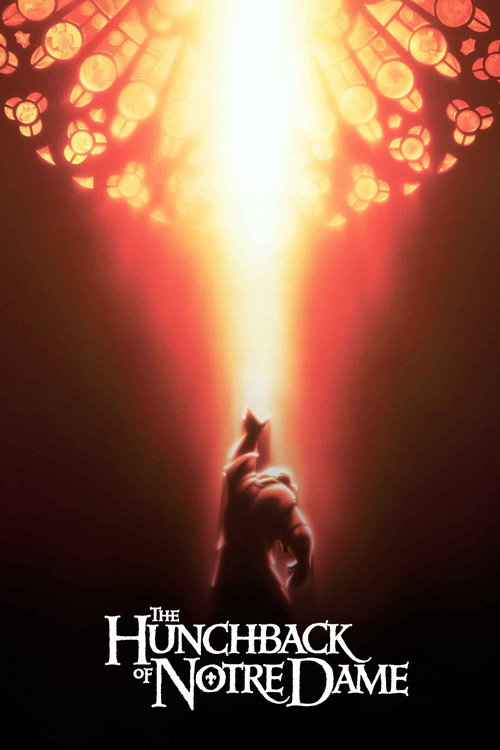
In 1996, Walt Disney Feature Animation released what remains its most audacious film. The Hunchback of Notre Dame cost $100 million to produce and grossed $325 million worldwide, but its real legacy is artistic. Directors Gary Trousdale and Kirk Wise took Victor Hugo's 1831 novel and turned it into a musical animated feature that confronts religious hypocrisy, lust, and genocide, themes no G-rated film had touched before.
Tom Hulce voices Quasimodo, the deformed bell-ringer confined to Notre Dame's towers. Demi Moore plays Esmeralda, a Romani dancer who defies the mob. Kevin Kline is Captain Phoebus, a soldier with a conscience. But the film's most unforgettable performance comes from Tony Jay as Judge Claude Frollo, a villain whose internal torment is laid bare in the song Hellfire. Alan Menken's score, with lyrics by Stephen Schwartz, blends Gregorian chant with Broadway bombast. The animation team spent weeks studying the real Notre Dame Cathedral, producing over 1,000 architectural drawings.
The film polarized critics. Some praised its ambition; others found the comic gargoyles at odds with Hugo's darkness. But over time, The Hunchback of Notre Dame has been reevaluated as a misunderstood masterpiece, one that proved animation could tackle serious moral questions without losing its audience.
Availability and pricing can change. Confirm on the provider's site before purchasing.
Fifteen-century Paris. A group of Romani people try to enter the city, but Judge Claude Frollo, the Minister of Justice, stops them. One Romani woman flees with her deformed infant. Frollo catches her at the steps of Notre Dame Cathedral. She falls, and he accidentally causes her death. The Archdeacon confronts Frollo, accusing him of murder. Frollo, terrified of damnation, agrees to raise the child inside the cathedral as penance. He names the boy Quasimodo.
Twenty years later, Quasimodo has grown into a kind, isolated young man. He lives in the bell towers, his only friends three stone gargoyles, Victor, Hugo, and Laverne, who come to life in his imagination. They urge him to attend the Festival of Fools. Despite Frollo's orders never to leave, Quasimodo sneaks out. At the festival, he is crowned King of Fools for his grotesque appearance, then humiliated by the crowd.
Esmeralda, a spirited Romani dancer, steps in to protect him. She defies the mob. Captain Phoebus, a noble soldier in Frollo's guard, also intervenes and orders the crowd to disperse. Esmeralda escapes using her magic, but Quasimodo is grateful to her.
Frollo becomes obsessed with Esmeralda, torn between his religious piety and his lust. He orders a city-wide manhunt, using Quasimodo's knowledge of secret passages to track her. Quasimodo hides Esmeralda in the cathedral. She discovers his kind heart and teaches him about the outside world. She also confronts Frollo, publicly shaming him for his hypocrisy.
Frollo's obsession grows. He begins burning down houses in his search for Esmeralda. Phoebus refuses to follow orders, so Frollo sentences him to death. Esmeralda saves Phoebus and brings him to Notre Dame. The three outcasts, Quasimodo, Esmeralda, and Phoebus, form an unlikely alliance. Quasimodo falls in love with Esmeralda, but she develops feelings for Phoebus.
Frollo discovers their hiding place and launches an assault on the cathedral. The gargoyles encourage Quasimodo to fight for what he believes in. Frollo's army storms the sanctuary to capture Esmeralda and execute her for witchcraft.
The Hunchback of Notre Dame - 1996 Theatrical Trailer (35mm 4K)
Critical Consensus
A visually stunning and musically ambitious Disney adaptation that tackles mature themes of prejudice and religious hypocrisy, though some critics found its dark subject matter at odds with the studio's family-friendly brand.
“The film is a dark, ambitious work that pushes the boundaries of what a Disney animated feature can be, with a villain so chilling he rivals any in the studio's history.”
Janet Maslin
The New York Times
“The Hunchback of Notre Dame is a movie of great beauty and power, but it's also one of the most somber and frightening of the Disney animated features.”
Roger Ebert
Chicago Sun-Times
“A visually spectacular and emotionally powerful adaptation that brings Victor Hugo's classic to life with stunning animation and a memorable score.”
Todd McCarthy
Variety
“The movie is a magnificent achievement in animation, with a depth and complexity that rewards adult viewers while still entertaining children.”
Peter Stack
San Francisco Chronicle
“A film of considerable ambition that succeeds more often than it fails, thanks to its stunning visual design and Alan Menken's soaring score.”
Kenneth Turan
Los Angeles Times
Tom Hulce
Quasimodo (voice)
Demi Moore
Esmeralda (voice)
Kevin Kline
Phoebus (voice)
Tony Jay
Judge Claude Frollo (voice)
Charles Kimbrough
Gargoyle Victor (voice)
Mary Wickes
Gargoyle Laverne (voice)
Jason Alexander
Gargoyle Hugo (voice)
Paul Kandel
Clopin (voice)
Mary Kay Bergman
Quasimodo's Mother (voice)
David Ogden Stiers
Archdeacon (voice)
Gary Trousdale
The Old Heretic (voice)
Corey Burton
Brutish Guard / Additional Voices (voice)
Directors
Gary Trousdale, Kirk Wise
Writers
Victor Hugo, Irene Mecchi, Tab Murphy, Jonathan Roberts, Bob Tzudiker
Composer
Alan Menken
Producer
Don Hahn
Academy Awards (1997)
Best Music, Original Musical or Comedy Score: Nominated
Academy Awards (1997)
Best Music, Original Song: Nominated
Golden Globe Awards (1997)
Best Original Score: Nominated
Golden Globe Awards (1997)
Best Original Song: Nominated
Annie Awards (1997)
Best Individual Achievement in Animation: Won
Annie Awards (1997)
Best Individual Achievement in Storyboarding: Won
Annie Awards (1997)
Best Animated Feature: Nominated
Satellite Awards (1997)
Best Motion Picture - Animated or Mixed Media: Nominated
Kids' Choice Awards (1997)
Favorite Movie: Nominated
Join the community
fans discussing