“Francis Ford Coppola's 'The Godfather'... is a long, violent, grimly beautiful film that... is one of the most brutal and moving chronicles of American life ever designed within the limits of popular entertainment.”
Vincent Canby
The New York Times
 United States
"An offer you can't refuse."
Part of a Collection
The Godfather Collection
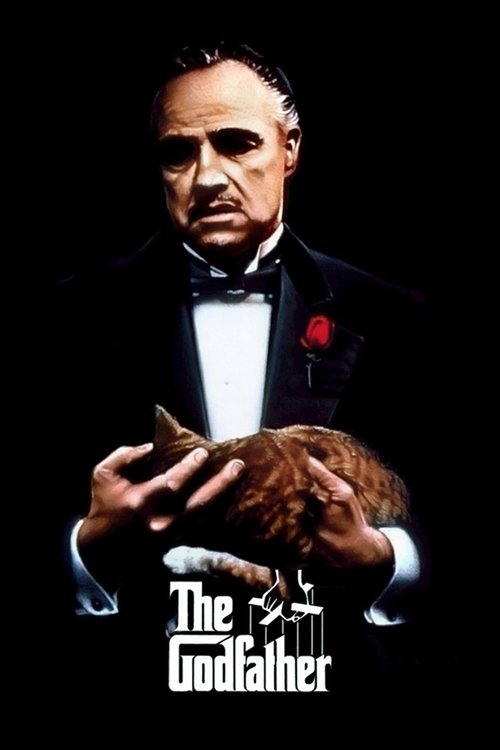
Francis Ford Coppola's The Godfather arrived in theaters in March 1972 and immediately changed American cinema. Based on Mario Puzo's best-selling novel, the film follows the Corleone crime family through the late 1940s and early 1950s. At its center is Don Vito Corleone, played by Marlon Brando, a powerful Mafia patriarch who runs his empire from the study of his Long Island estate. The story tracks his youngest son Michael, a decorated World War II Marine who initially wants nothing to do with the family business but gets pulled in after an assassination attempt on his father.
Coppola shot the film on location in New York City's Little Italy and in the Sicilian hill towns of Savoca and Forza d'Agrò. Cinematographer Gordon Willis, later nicknamed the Prince of Darkness for his shadowy lighting style, gave the film a look that felt both operatic and documentary-like. The score by Nino Rota, with its haunting waltz theme, became almost as famous as the film itself. Paramount Pictures originally saw the project as just another gangster picture, but Coppola fought to cast relatively unknown actors like Al Pacino and to keep the period setting and Italian-American authenticity that made the novel resonate.
The film earned eleven Academy Award nominations and won three, including Best Picture. Brando won Best Actor but famously refused the award, sending Sacheen Littlefeather in his place to protest Hollywood's treatment of Native Americans. The Godfather's influence ripples through every crime drama that followed, from The Sopranos to Goodfellas, and its lines like I'm gonna make him an offer he can't refuse have become part of the language.
Stream
Paramount+
Rent
Amazon Prime Video
Availability and pricing can change. Confirm on the provider's site before purchasing.
The film opens on the day of Connie Corleone's wedding to Carlo Rizzi in the summer of 1945. Don Vito Corleone holds court in his study, granting favors to friends and supplicants while the celebration rages outside. Among those seeking his help is Amerigo Bonasera, a mortician who wants the Don to punish the men who assaulted his daughter. The Don agrees but reminds Bonasera that someday he may ask for a favor in return.
Meanwhile, Michael Corleone arrives with his girlfriend Kay Adams. He tells her stories about his family, making light of their criminal connections, but Kay is uneasy. Michael's older brother Sonny is hot-tempered and impulsive, while the middle brother Fredo is weaker and less involved. The family consigliere Tom Hagen, an adopted Irish orphan raised by the Corleones, handles legal and diplomatic matters.
The central conflict ignites when Virgil Sollozzo, a drug trafficker backed by the rival Tattaglia family, proposes that the Corleones invest in his heroin operation. Don Vito refuses, citing moral objections and the danger of narcotics. Sollozzo then orchestrates an assassination attempt on the Don, who is shot in the street and left for dead. With Vito hospitalized, Sonny takes control and vows revenge. The family discovers that the corrupt police captain McCluskey is in Sollozzo's pocket.
Michael volunteers to kill both Sollozzo and McCluskey. In a tense scene at a Bronx restaurant, Michael retrieves a gun hidden in the bathroom and shoots both men at close range. He then flees to Sicily, where he lives in hiding and falls in love with a local woman named Apollonia. Back in New York, the war escalates. Sonny's brutality and lack of diplomacy lead to a trap at the Long Beach causeway, where rival gunmen murder him in a hail of bullets.
Don Vito, now recovered but broken by Sonny's death, brokers a peace with the Five Families. He secures Michael's safe return from Sicily, but Apollonia is killed by a car bomb intended for Michael. Michael returns to New York hardened and cold. He marries Kay, who has waited for him, and slowly takes over the family business. The Don retires, and Michael begins planning a move to Las Vegas to legitimize the Corleone empire, but he knows he must first eliminate all his enemies.
50th Anniversary Trailer
Original Trailer
Critical Consensus
A sweeping and powerful epic of crime and family, The Godfather is a masterful achievement in filmmaking, boasting iconic performances, a brilliant script, and Coppola's assured direction. It remains a near-perfect film that has profoundly influenced cinema and popular culture.
“Francis Ford Coppola's 'The Godfather'... is a long, violent, grimly beautiful film that... is one of the most brutal and moving chronicles of American life ever designed within the limits of popular entertainment.”
Vincent Canby
The New York Times
“The Godfather is a film of magnificent entertainment and great emotional power... It is a film that, like its title character, commands respect.”
Roger Ebert
Chicago Sun-Times
“The Godfather is a popular melodrama that is also a work of art... It has the kind of emotional force that makes people gasp.”
Pauline Kael
The New Yorker
“The Godfather is a stunning, brutal, beautiful film... It is a major work of art, a landmark in the history of American cinema.”
Charles Champlin
Los Angeles Times
Marlon Brando
Don Vito Corleone
Al Pacino
Michael Corleone
James Caan
Sonny Corleone
Robert Duvall
Tom Hagen
Richard S. Castellano
Pete Clemenza
Diane Keaton
Kay Adams
Talia Shire
Connie Corleone Rizzi
Gianni Russo
Carlo Rizzi
Sterling Hayden
Captain McCluskey
John Marley
Jack Woltz
Richard Conte
Emilio Barzini
Al Lettieri
Virgil Sollozzo
Abe Vigoda
Sal Tessio
John Cazale
Fredo Corleone
Director
Francis Ford Coppola
Writers
Mario Puzo, Francis Ford Coppola, Robert Towne
Composer
Nino Rota
Cinematographer
Gordon Willis
Producers
Albert S. Ruddy, Francis Ford Coppola, Robert Evans
Academy Award for Best Picture (1973)
Best Picture: Won
Academy Award for Best Actor (1973)
Best Actor: Won
Academy Award for Best Adapted Screenplay (1973)
Best Adapted Screenplay: Won
Academy Award for Best Director (1973)
Best Director: Nominated
Academy Award for Best Supporting Actor (1973)
Best Supporting Actor: Nominated
Golden Globe for Best Motion Picture – Drama (1973)
Best Motion Picture – Drama: Won
Golden Globe for Best Director (1973)
Best Director: Won
Golden Globe for Best Actor – Drama (1973)
Best Actor – Drama: Won
BAFTA Award for Best Original Music (1973)
Best Original Music: Won
Join the community
fans discussing