“Bertolucci has made a film that is both a celebration and a warning about the dangers of living in a dream world. It is a beautiful, disturbing, and unforgettable experience.”
Roger Ebert
Chicago Sun-Times
 United Kingdom
"Together nothing is impossible. Together nothing is forbidden."
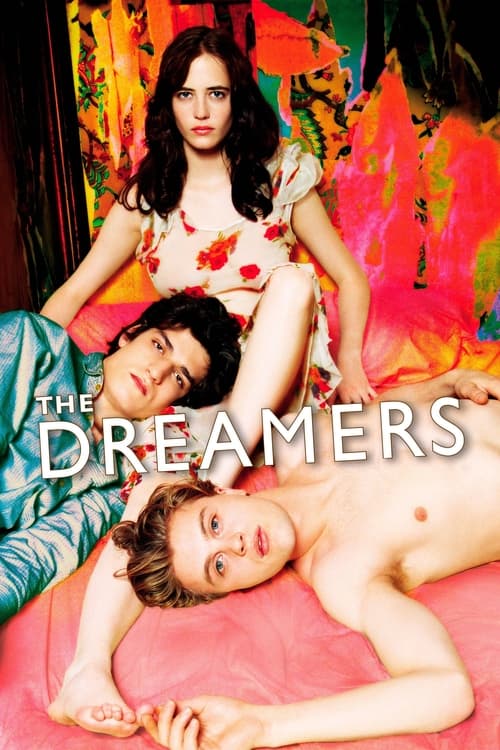
Paris in May 1968 burns with revolutionary fire, yet inside a specific apartment in the Latin Quarter, time seems to stand still. Bernardo Bertolucci constructs a sealed universe where political upheaval and personal liberation collide within the walls of a single flat. The story centers on Matthew Thorne, an American film student from Texas who arrives in France seeking cultural immersion but finds himself trapped in a fever dream of his own making.
Matthew's life shifts instantly when he moves into a spacious residence occupied by Isabelle and her twin brother Theo. These two charismatic students treat him as a curious outsider initially, a "Yankee" they can educate on European art and politics. Their isolationist world quickly expands to include him, creating an intense bond built on watching classic Hollywood films, debating philosophy, and engaging in elaborate role-playing games that blur reality and fantasy.
Availability and pricing can change. Confirm on the provider's site before purchasing.
The narrative unfolds over several weeks as the trio forms an insular community detached from the chaos erupting outside their windows. They spend their days and nights consuming cinema, treating the screen as a mirror for their own lives. Matthew, Isabelle, and Theo reenact scenes from A Streetcar Named Desire, The Third Man, and La Dolce Vita, often stepping out of character only to immediately slip back into the roles they have assigned themselves. This shared obsession with movies becomes the primary lens through which they interpret their existence, allowing them to ignore the barricades going up on the streets below.
As the weeks progress, the dynamic between the three shifts dramatically from platonic friendship to a complex, sexually charged triangle. Matthew finds himself torn between the fiery, provocative Isabelle and the brooding, protective Theo. The film explores themes of forbidden desire and sibling intimacy while the outside world descends into violence. Barricades go up, police clashes erupt, and the French government faces potential collapse, yet the trio remains largely oblivious, constructing a cocoon of hedonism and intellectual escapism.
The central conflict arises from the tension between this insulated bubble and the encroaching reality of the revolution. As protests intensify and violence spreads, the boundaries of the siblings' relationship become increasingly ambiguous. The film delves into the psychological state of the characters as they navigate their own internal revolutions, questioning the nature of love, family, and identity. Matthew struggles to maintain his moral compass while being seduced by the twins' lifestyle, leading to moments of intense emotional and physical confrontation. The narrative builds toward a crescendo where the personal stakes of the love triangle mirror the societal stakes of the revolution, culminating in a moment of crisis that threatens to shatter the fragile equilibrium of their shared existence.
The story serves as a meditation on youth, idealism, and the destructive power of obsession. It captures the feverish energy of a generation caught between the innocence of childhood and the harsh realities of adulthood. The film does not offer easy answers or clear resolutions, instead leaving the audience to grapple with the consequences of living entirely within one's own mind while the world crumbles around you. The visual splendor of the cinematography enhances this sense of detachment, painting the apartment as a sanctuary that is both beautiful and suffocating.
UK 4K Blu-ray Trailer
Official Trailer
Critical Consensus
Critics generally praised The Dreamers for its visual splendor, atmospheric direction, and the breakout performances of Eva Green and Michael Pitt. While some reviewers found the film's exploration of taboo subjects excessive or self-indulgent, many acknowledged it as a visually stunning and emotionally resonant period piece that captures the feverish energy of 1968 Paris. The film is often noted for its ability to balance eroticism with intellectual discourse, though opinions remain divided on its narrative depth.
“Bertolucci has made a film that is both a celebration and a warning about the dangers of living in a dream world. It is a beautiful, disturbing, and unforgettable experience.”
Roger Ebert
Chicago Sun-Times
“Eva Green is a revelation, a star born in the fire of this film. Her performance is electric, raw, and utterly captivating. She is the heart and soul of The Dreamers.”
Peter Travers
Rolling Stone
“Bertolucci's latest is a lush, sensual, and sometimes suffocating journey into the minds of three young people lost in a sea of their own making. It is a film that demands to be seen, even if it leaves you breathless.”
A.O. Scott
The New York Times
“While the film's explicit content may alienate some viewers, Bertolucci's mastery of tone and atmosphere creates a unique cinematic experience that lingers long after the credits roll.”
Todd McCarthy
Variety
“The Dreamers is a film that is as much about the history of cinema as it is about the history of the 1960s. It is a love letter to the medium, albeit a twisted and dangerous one.”
David Edelstein
Slate
Michael Pitt
Matthew Thorne
Eva Green
Isabelle Thorne
Louis Garrel
Theo Thorne
Anna Chancellor
Mother
Robin Renucci
Father
Jean-Pierre Kalfon
Jean-Pierre Kalfon
Jean-Pierre Léaud
Jean-Pierre Léaud
Director
Bernardo Bertolucci
Writer
Gilbert Adair
Composer
Angelo Badalamenti
Cinematographer
Fabio Cianchetti
Producers
Jeremy Thomas, Bernardo Bertolucci, Alain Sarde
Venice Film Festival (2003)
Golden Lion: Nominated
BAFTA Awards (2004)
Best Original Screenplay: Nominated
Satellite Awards (2003)
Best Actress in a Motion Picture – Drama: Nominated
European Film Awards (2003)
Best Cinematographer: Nominated
Gotham Awards (2003)
Breakthrough Performer: Nominated
Independent Spirit Awards (2004)
Best Foreign Film: Nominated
Join the community
fans discussing