“Shudder creature feature has bite.”
RogerEbert.com
RogerEbert.com
 United Kingdom
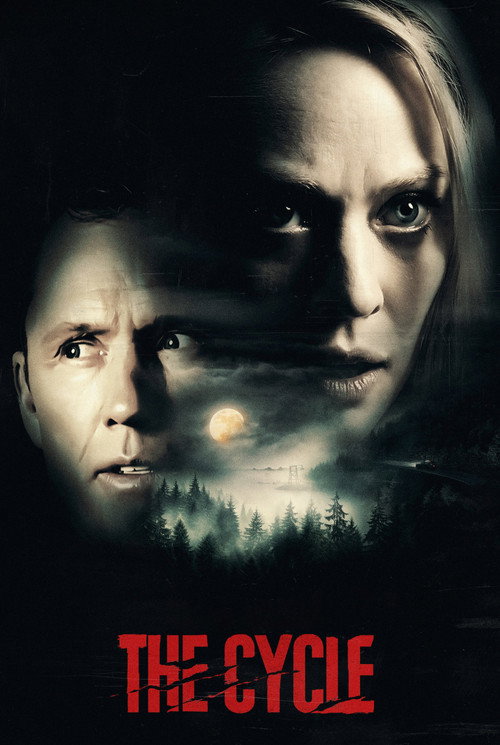
"Thirty-six years buried. One body won't stay quiet."
The Cycle is a 2026 American-British co-production that deliberately mashes three genres together: a family drama, a police procedural, and a creature feature. Directed by Jordan Downey, who co-wrote the screenplay with his regular cinematographer Kevin Stewart, it stars Deborah Ann Woll as a forensic anthropologist whose long-missing father's body resurfaces at a horrific crime scene 36 years after he vanished. The film's marketing and much of its early coverage kept the monster element under wraps, but by its October 2026 release the cat, or rather the wolf, was out of the bag: The Cycle is a werewolf movie that saves its supernatural carnage for the third act, at which point it goes wild with practical effects.
It premiered at Fantastic Fest, where Woll, Jeffrey Donovan, Will Hochman, and Downey did press, and it runs 1 hour 51 minutes. The tagline sets the tone: "Thirty-six years buried. One body won't stay quiet." The reported box office of just $5,431 is consistent with a very limited theatrical footprint rather than a wide release, and the Shudder-branded trailer points to a streaming home on AMC's horror platform.
Downey built the film through Tea Shop Productions alongside Buffalo 8 and BondIt Media Capital, with Michael W. Downey, James Harris, and Mark Lane producing. Nick Soole composed the score. The tone sits where police procedurals meet family horror: autopsy rooms, evidence bags, and the slow rot of a secret kept too long. Early viewer response, a 7.5 out of 10 across 25 votes on IMDb, is a small sample, but it suggests the people who found it connected with what Downey was doing.
Stream
Shudder
Availability and pricing can change. Confirm on the provider's site before purchasing.
Meg (Deborah Ann Woll) is a forensic anthropologist, a scientist who reads bones the way detectives read crime scenes. Her professional life is built on the orderly interpretation of the dead, which makes it a bitter irony that her own father walked out of her life 36 years ago and was never found. She has spent her adult life in the long shadow of that disappearance, and the film establishes early that she has made a kind of peace with never knowing: the not-knowing has become its own structure, a wall she leans on.
That wall comes down when a body turns up at the scene of a horrific crime, and the body is identified as her father. He has been missing for thirty-six years, yet here he is, present at a fresh and brutal murder scene. The premise is deliberately impossible, and the film leans into the dissonance: a man who has been gone for nearly four decades cannot be at a crime scene, and yet the evidence says he is. Meg, whose entire training is in coaxing truth out of remains, is forced to apply her expertise to the one case she never wanted: her own family.
The film then unfolds as a dual-track procedural. On one track, Meg works the forensic angle, moving through autopsy rooms, evidence bags, and bone fragments, the slow forensic grind of establishing identity and cause of death, trying to reconcile the physical facts of her father's remains with the impossible circumstances of their discovery. On the other, she works the human angle, revisiting the people and places of her childhood and her father's life, trying to reconstruct the man she half-remembers and the secrets he kept. The supporting cast fills out both tracks: Marks (Jeffrey Donovan), a police officer embedded in the investigation; Joni (Gretchen Corbett), a figure from the family's past; Lenny (Jack Doolan); Ian (Will Hochman); Fran (Dana Millican); Daniel (Phillip Andre Botello); Frank (Don Keith Opper); Lou Bishop (Carl W. Crudup); Katie (Danika Golombek); Ratterman (Jeb Berrier); and Peter (David Myers Gregory).
The central conflict is not simply who killed her father but something stranger and more uncomfortable: whether Meg actually wants the truth. The film's own logline frames it as a choice, the daughter left behind has to decide whether she wants the truth badly enough to dig it up. As she digs, the investigation stops behaving like a cold case and starts behaving like something else. Details don't add up. The timeline of her father's disappearance resists every rational explanation. And the deeper Meg goes, the more the film's genre skin begins to shift, the police procedural starts to rot from the inside, autopsy rooms giving way to something older and less scientific.
The tone throughout sits exactly where the film wants it: the clinical chill of an evidence room married to the slow rot of a family secret kept too long. Downey and Stewart's script withholds the monster, literally and figuratively, for most of the runtime, letting the mystery and the grief carry the first two acts before the third act cashes in everything the film has been building. The film's horror is rooted in the most mundane horror of all: the parent who left, and what they left behind.
Official Trailer
Teaser Trailer
Critical Consensus
Reviewers broadly agree that The Cycle is a smart genre hybrid whose procedural and family-drama halves are elevated by Deborah Ann Woll's grounded lead performance, and whose third-act werewolf reveal is paid off with standout practical effects. Skeptics found the slow-burn first two acts testing and the creature payoff late, but most praised the emotional resonance beneath the monster movie surface.
Deborah Ann Woll
Meg
Jeffrey Donovan
Marks
Gretchen Corbett
Joni
Jack Doolan
Lenny
Will Hochman
Ian
Dana Millican
Fran
Phillip Andre Botello
Daniel
Don Keith Opper
Frank
Carl W. Crudup
Lou Bishop
Danika Golombek
Katie
Jeb Berrier
Ratterman
David Myers Gregory
Peter
Director
Jordan Downey
Writers
Jordan Downey, Kevin Stewart
Composer
Nick Soole
Cinematographer
Kevin Stewart
Producers
Michael W. Downey, James Harris, Mark Lane
Join the community
fans discussing