“Ferrara has made a vampire movie that is less about the monster and more about the man who becomes one, a study in the psychology of addiction that is both horrifying and fascinating.”
Roger Ebert
Chicago Sun-Times
 United States
"Darkness feeds the mind. Blood feeds the body."
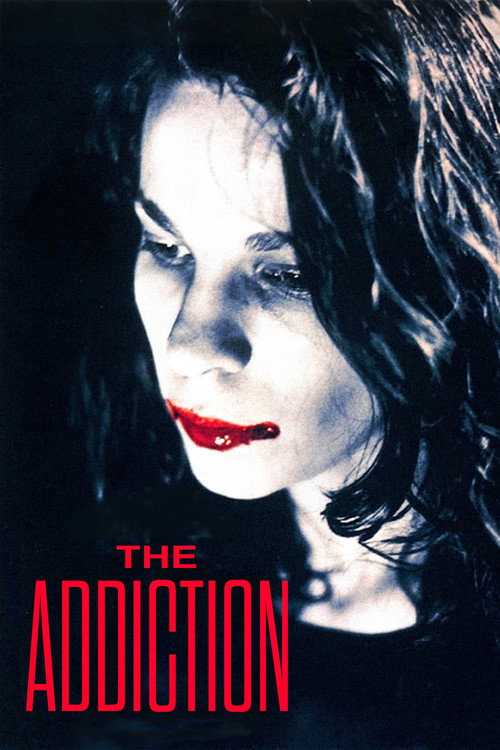
Abel Ferrara's The Addiction transforms the vampire myth into a grim study of intellectual despair and physical dependency. Released in 1995, this black-and-white drama follows Kathleen Conklin, a doctoral student whose life unravels after she encounters Peina, a charismatic philosopher who introduces her to the nocturnal world. The film stars Lili Taylor as the struggling academic and Christopher Walken as the enigmatic mentor who feeds her both knowledge and blood. Annabella Sciorra and Edie Falco join the cast in supporting roles that ground the supernatural elements in gritty reality.
Produced on a modest budget by Fast Films, the movie earned just over $300,000 at the box office, reflecting its niche appeal among horror and art-house audiences. Despite the low financial return, the project secured a solid rating of 6.486 out of 10 from its small but dedicated viewer base. Ferrara blends genres seamlessly, creating a tone that feels more like a philosophical debate set against New York City shadows than a traditional monster flick. The film stands apart as a unique entry in the vampire canon, focusing less on gore and more on the psychological toll of addiction.
Availability and pricing can change. Confirm on the provider's site before purchasing.
Kathleen Conklin walks the shadow-drenched streets of 1990s New York City as a dedicated doctoral student in philosophy at Columbia University. Her days are filled with rigorous debates and deep dives into existentialist thought, particularly the works of Schopenhauer and Nietzsche. That routine shatters when she is attacked on a subway platform by a mysterious figure named Peina. This encounter leaves her drained and transformed, waking her up to a terrifying new reality where she has become a vampire. Unlike traditional lore that focuses on glamour or seduction, Kathleen's infection manifests as a visceral, crushing addiction. She experiences an overwhelming, uncontrollable thirst for human blood that mirrors the physical and psychological withdrawal symptoms of a heroin addict.
The film immediately establishes its central metaphor: vampirism is not a supernatural curse but a disease of dependency. Kathleen struggles to maintain her dignity and academic integrity while fighting the urge to hunt. Her internal conflict is exacerbated by the philosophical weight of her condition; she begins to view the act of feeding not just as survival, but as a moral imperative rooted in a twisted interpretation of "survival of the fittest" and the necessity of eliminating the weak to preserve the strong. She rationalizes her hunger through complex intellectual frameworks that justify predation as a form of justice.
Peina acts as a mentor figure, introducing Kathleen to a secret society of vampires who have long inhabited the city's underbelly. These individuals include a former nun turned vampire named Jean and other intellectuals who engage in high-minded debates about the nature of evil, the value of human life, and the inevitability of their own fate. They argue that their existence is a natural order, a necessary correction to humanity's perceived moral decay. Kathleen finds herself drawn into their circle, where the lines between predator and philosopher blur. The narrative follows her descent as she attempts to rationalize her hunger, eventually deciding that killing those she deems "unworthy" of life is a form of justice rather than a crime.
As Kathleen's addiction deepens, her relationships with her peers and family begin to fracture. She isolates herself from her non-vampiric friends, viewing them as prey rather than people. The film explores the tension between her remaining humanity and her growing monstrousness through a series of intense dialogues and gritty, black-and-white cinematography that emphasizes the grimy texture of the city. The central conflict remains internal: can Kathleen resist the pull of the bloodlust, or will she fully succumb to the philosophy of the predators? As she moves closer to the edge, the film builds toward a confrontation with her own conscience and the realization that the "cure" she seeks may be impossible. The story serves as a harrowing examination of how addiction can consume not just the body, but the soul, turning a brilliant mind into a vessel for destruction.
Official Trailer
Original Trailer
Critical Consensus
Ferrara's The Addiction is a visually striking and intellectually ambitious horror film that uses the vampire myth to explore themes of addiction and existential despair. While some critics found the dialogue overly dense, the film is praised for Lili Taylor's intense performance and Christopher Walken's chilling presence, making it a standout entry in the art-house horror genre.
“Ferrara has made a vampire movie that is less about the monster and more about the man who becomes one, a study in the psychology of addiction that is both horrifying and fascinating.”
Roger Ebert
Chicago Sun-Times
“A cerebral and stylish horror film that succeeds in transforming the vampire trope into a potent metaphor for drug dependency, anchored by Lili Taylor's raw and vulnerable performance.”
Todd McCarthy
Variety
“Abel Ferrara's 'The Addiction' is a dark, intellectual exercise that uses the vampire myth to dissect the nature of evil and the human condition, though its heavy-handed philosophy sometimes outweighs the horror elements.”
Janet Maslin
The New York Times
“Walken delivers a mesmerizing performance as the enigmatic Peina, guiding the audience through a labyrinth of ideas that feel as dangerous as the blood they crave.”
Peter Bradshaw
The Guardian
Lili Taylor
Kathleen Conklin
Christopher Walken
Peina
Annabella Sciorra
Casanova
Edie Falco
Jean
Paul Calderon
Professor
Fredro Starr
Black
Kathryn Erbe
Anthropology Student
Michael Imperioli
Missionary
Director
Abel Ferrara
Writer
Nicholas St. John
Composer
Joe Delia
Cinematographer
Ken Kelsch
Producers
Fernando Sulichin, Denis Hann
Independent Spirit Awards (1996)
Best Female Lead: Nominated
Saturn Awards (1996)
Best Horror Film: Nominated
Sitges Film Festival (1995)
Audience Award: Won
Fantasia International Film Festival (1995)
Best Feature Film: Nominated
Los Angeles Film Critics Association (1996)
Best Cinematography: Nominated
Join the community
fans discussing