“Summer Wars is a dazzling, emotionally resonant ride that balances its digital spectacle with genuine human warmth. Hosoda proves he's a master of both worlds.”
Mark Schilling
The Japan Times
 Japan
Japan"Always protect your network."
User Score
1,052 votes
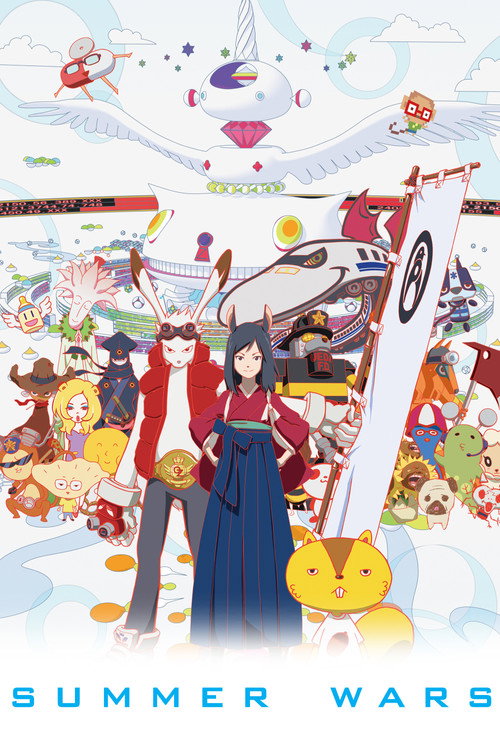
In the summer of 2009, Mamoru Hosoda delivered a film that would become a touchstone for anime's ability to blend high-concept science fiction with intimate human drama. Summer Wars opens with a dizzying tour of OZ, a vast virtual world where over a billion people live, work, and play. It's a place of clean white spaces and gaudy avatars, where a single login can control everything from your bank account to emergency services. The film's protagonist, Kenji Koiso, is a quiet math prodigy who spends his free time as a low-level moderator in this digital playground. When his classmate Natsuki Shinohara ropes him into a "summer job" that turns out to be a trip to her family's ancestral home, Kenji has no idea he's about to become the center of a global crisis.
The job is a ruse: Natsuki has told her 90-year-old great-grandmother, Sakae Jinnouchi, that Kenji is her fiancé. What follows is a whirlwind introduction to the sprawling Jinnouchi clan, a boisterous, loving family that includes doctors, farmers, mechanics, and a video game prodigy. But the celebration is cut short when Kenji solves a cryptic numerical code on his phone, inadvertently unleashing a rogue artificial intelligence called Love Machine into OZ. The AI begins consuming accounts and disrupting real-world infrastructure, causing traffic jams, blackouts, and even threatening to crash a satellite into a nuclear plant. As authorities wrongly point fingers at Kenji, he must rally the Jinnouchi family to fight back, using their unique skills and old-fashioned ingenuity.
Hosoda, working with screenwriter Satoko Okudera, crafts a narrative that moves effortlessly between the digital battlefield of OZ and the earthy, traditional world of the Jinnouchi household. The film's visual style is striking: OZ's minimalist, colorful avatars contrast sharply with the detailed, rustic interiors of the family's estate in Ueda. With a runtime of 114 minutes, Summer Wars manages to be both a thrilling cyber-thriller and a warm, often funny family saga. It earned over $18 million worldwide and won the Japan Academy Prize for Animation of the Year, cementing Hosoda's reputation as a master storyteller.
Stream
Availability and pricing can change. Confirm on the provider's site before purchasing.
Kenji Koiso is a high school junior with a gift for mathematics, but he's shy and unassuming, spending his spare time as a part-time moderator for the virtual world OZ. When his outgoing classmate Natsuki Shinohara asks him to join her for a "summer job," he jumps at the chance, hoping to get closer to her. The job turns out to be a trip to Natsuki's family home in the rural city of Ueda, Nagano Prefecture, to celebrate the 90th birthday of her great-grandmother, Sakae Jinnouchi. Upon arrival, Kenji is blindsided: Natsuki introduces him to her enormous extended family as her fiancé, a fabrication she's maintained to honor a promise to her grandmother. The Jinnouchi clan is a sprawling, multi-generational household, including doctors, farmers, mechanics, and a video game prodigy named Kazuma Ikezawa. Kenji, an only child with a modest upbringing, is overwhelmed by the chaos and warmth of this traditional family, but Sakae's commanding presence and sharp wit keep everyone in line.
While settling in, Kenji receives a cryptic numerical sequence on his cell phone. Intrigued by the puzzle, he solves it, unwittingly granting access to a sentient artificial intelligence called Love Machine. The AI immediately infiltrates OZ, hijacking accounts, stealing identities, and causing real-world chaos. Traffic lights malfunction, emergency services are disrupted, and a global financial panic ensues as Love Machine grows more powerful. Because the hack originated from Kenji's device, authorities suspect him, and he becomes a fugitive. The film intercuts between the digital battles within OZ, where Love Machine's avatar consumes everything in its path, and the grounded drama of the Jinnouchi family preparing for Sakae's birthday while dealing with the crisis.
As the situation escalates, Love Machine acquires control of a satellite/asteroid probe and redirects it toward Earth, aiming to crash it into a nuclear power plant. The family, led by Sakae, rallies to fight back. Each member contributes their expertise: Kazuma's avatar, King Kazma, engages in direct combat; Kenji uses his mathematical skills to track the AI's patterns; and Sakae, a master of the traditional card game Koi-Koi, comes up with a surprising strategy. The family's unity becomes the film's central theme, contrasting the cold logic of artificial intelligence with the warmth of human connection. The plot builds to a tense, multi-layered climax within OZ, where the family's collective ingenuity is tested, and the outcome hinges on a global act of solidarity and sacrifice.
Official Trailer [Subtitled]
Official English Trailer
Critical Consensus
Summer Wars blends a heartwarming family drama with a high-stakes virtual reality thriller, showcasing Mamoru Hosoda's visual flair and emotional depth. While some find the two plots uneven, the film's charm and ingenuity win over most viewers.
“Summer Wars is a dazzling, emotionally resonant ride that balances its digital spectacle with genuine human warmth. Hosoda proves he's a master of both worlds.”
Mark Schilling
The Japan Times
“A thrilling, visually inventive cyber-adventure that never loses sight of its heart. The Jinnouchi family is one of the most memorable ensembles in anime.”
Theron Martin
Anime News Network
“Hosoda's film is a celebration of family and community, wrapped in a sci-fi adventure that feels both timely and timeless. A must-watch for anime fans.”
Kenneth Turan
Los Angeles Times
Ryunosuke Kamiki
Kenji Koiso (voice)
Nanami Sakuraba
Natsuki Shinohara (voice)
Mitsuki Tanimura
Kazuma Ikezawa (voice)
Sumiko Fuji
Sakae Jinnouchi (voice)
Ayumu Saito
Wabisuke Jinnouchi (voice)
Takahiro Yokokawa
Takashi Sakuma (voice)
Kiyomi Tanigawa
Yukiko Shinohara (voice)
Mutsumi Sasaki
Kazuo Shinohara (voice)
Mieko Nobusawa
Mariko Jinnouchi (voice)
Takuya Kirimoto
Riichi Jinnouchi (voice)
Sakiko Tamagawa
Rika Jinnouchi (voice)
Ichiro Nagai
Mansuke Jinnouchi (voice)
Director
Mamoru Hosoda
Writers
Satoko Okudera, Mamoru Hosoda
Composer
Akihiko Matsumoto
Cinematographer
Yukihiro Matsumoto
Producers
Nozomu Takahashi, Takuya Ito, Yuichiro Saito, Takashi Watanabe
Japan Academy Prize (2010)
Animation of the Year: Won
Japan Media Arts Festival (2010)
Animation Division Grand Prize: Won
Anaheim International Film Festival (2010)
Audience Award for Best Animated Feature: Won
Locarno International Film Festival (2009)
Golden Leopard Award: Nominated
Join the community
fans discussing