“Stallone and Parton have no chemistry whatsoever, and the movie suffers from a fundamental misunderstanding of both characters and the genre it attempts to blend.”
Roger Ebert
Chicago Sun-Times
 United States
"A country queen bets everything on turning a New York cabbie into a singing sensation."
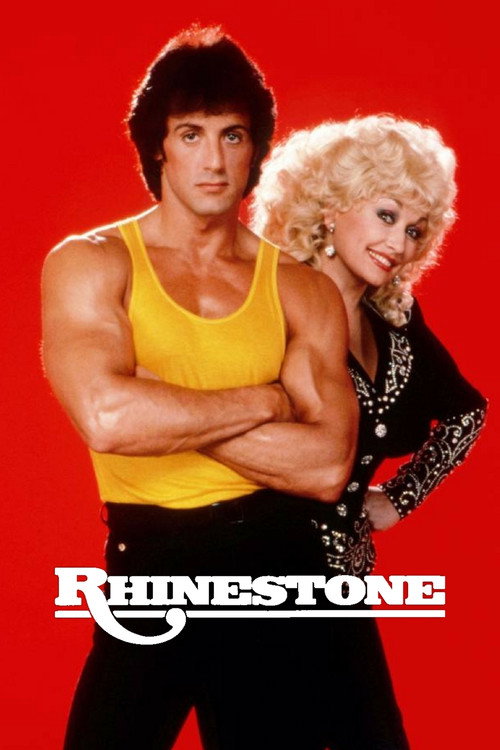
Bob Clark directed Rhinestone, a 1984 musical comedy that paired Sylvester Stallone with Dolly Parton in an unlikely pairing designed to bridge the gap between rock-hard action stars and country music royalty. The film follows Jake Ferris, a legendary Nashville singer who makes a bold wager about her ability to transform anyone into a star. To prove her point, she targets Nick, a cynical New York City cab driver with zero singing talent but plenty of attitude.
The project carried a substantial $28 million budget from 20th Century Fox, aiming for massive commercial success despite its modest box office return of roughly $21.4 million. Critics largely panned the movie, which currently holds a low rating near 4.9 out of 10 based on user votes. The production faced significant challenges behind the scenes, with reports of tension between the leads and a script that struggled to balance comedy with musical performance.
Availability and pricing can change. Confirm on the provider's site before purchasing.
In the rain-slicked streets of New York City, Nick is a hard-drinking cab driver who finds comfort in the predictable rhythm of his meter and the concrete chaos around him. He has no patience for sentimentality or the artificial world of show business, viewing life through a lens of gritty realism. His routine shatters when he picks up Jake Ferris, a legendary country music star known as much for her booming career as her unyielding pride. Jake is not just a performer; she is a woman with a specific wager that defines her character and challenges the entire industry.
Jake claims she can take any person, regardless of their background, and turn them into a singing sensation within three months. The music world laughs at this notion, dismissing it as impossible given the specialized nature of vocal performance. Undeterred by the skepticism, Jake sets her sights on Nick while he drives her cab. Despite his immediate resistance and total lack of musical inclination, she decides he is her project. The story shifts gears as Jake transports Nick from the neon-soaked urban environment to the rustic landscapes of Tennessee.
They settle into a small, ramshackle farm run by Jake's father, Noah, whose gentle wisdom contrasts sharply with Nick's abrasive exterior. The narrative focuses on the grueling process of training Nick to sing and perform. This journey is filled with comedic friction as Nick struggles with lyrics, melody, and the absurdity of his new persona. He often resorts to street-smart defenses to cope with the pressure, creating a dynamic where two vastly different worlds collide.
As weeks pass, the relationship between the two evolves. Jake begins to see the vulnerability beneath Nick's tough shell, while Nick starts to appreciate the authenticity behind Jake's music. They face obstacles including Freddie Ugo, a rival promoter who wants to sabotage Jake's reputation. Ugo represents the cutthroat side of the industry that Nick initially admires but eventually learns to reject. Meanwhile, Jake confronts her own fears about relying on image versus genuine artistic ability, a theme highlighted during the songwriting process where they begin to collaborate.
The plot builds toward a critical live performance that determines the success of the wager. The stakes are incredibly high for Jake, as losing would mean admitting defeat to the industry and potentially ending her momentum. For Nick, stepping onto a stage terrifies him, forcing him to overcome deep insecurities. The film explores themes of redemption and the power of belief as the bond between the cab driver and the country queen deepens. Their transformation and the emotional growth occurring under public scrutiny drive the narrative forward without revealing the final outcome of their big night.
Rhinestone (1984) Trailer
Critical Consensus
Critics universally panned Rhinestone for its forced chemistry between Stallone and Parton, weak script, and awkward blending of genres. Many felt the film squandered the potential of its stars, resulting in a tedious experience that failed to deliver either genuine comedy or compelling musical numbers. The direction by Bob Clark was criticized for lacking the charm found in his other works.
“Stallone and Parton have no chemistry whatsoever, and the movie suffers from a fundamental misunderstanding of both characters and the genre it attempts to blend.”
Roger Ebert
Chicago Sun-Times
“A clumsy attempt to bridge the gap between action cinema and country music, Rhinestone is a bore that fails to utilize the talents of its leads effectively.”
Variety Staff
Variety
“Bob Clark's direction is stilted, and the script offers little more than predictable gags and a plot that moves at a glacial pace.”
Vincent Canby
The New York Times
“Dolly Parton shines in her musical numbers, but she is let down by a script that treats her character like a prop rather than a fully realized person.”
Charles Champlin
Los Angeles Times
Sylvester Stallone
Nick
Dolly Parton
Jake Ferris
Richard Farnsworth
Noah Ferris
Ron Leibman
Freddie Ugo
Tim Thomerson
Barnett Kale
Director
Bob Clark
Writers
Phil Alden Robinson, Sylvester Stallone
Composer
Dolly Parton
Cinematographer
Timothy Galfas
Producers
Marvin Worth, Howard Smith
Golden Raspberry Awards (1985)
Worst Actor: Won
Golden Raspberry Awards (1985)
Worst Actress: Won
Golden Raspberry Awards (1985)
Worst Director: Won
Golden Raspberry Awards (1985)
Worst Screenplay: Won
Grammy Awards (1985)
Best Country Vocal Performance, Female: Nominated
Join the community
fans discussing