 Taiwan
“Mr. Tsai's film has a hypnotic, almost documentary-like quality that makes the characters' aimless wanderings through Taipei's neon-lit streets seem like a journey through a spiritual wasteland.”
Stephen Holden
The New York Times
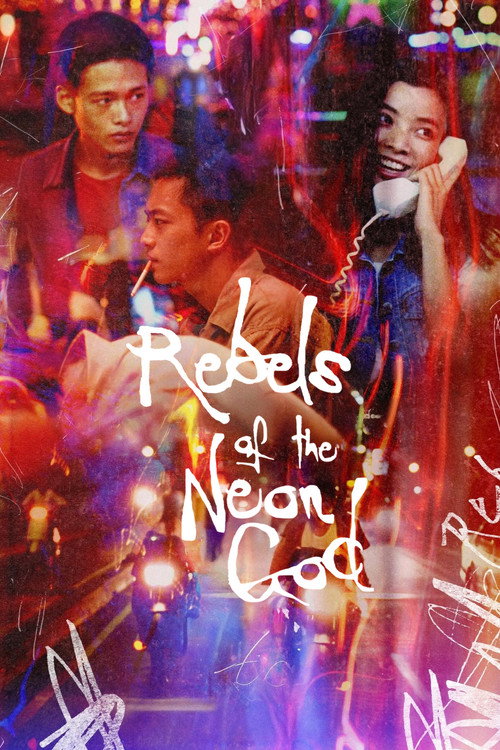
Tsai Ming-liang's debut feature is a hypnotic, rain-soaked portrait of Taipei's disaffected youth, a film that announces a major cinematic talent with its uncompromising vision of urban alienation. Set in the neon-lit streets of mid-1990s Taipei, the movie follows four lost souls whose lives intersect through petty crimes and chance encounters, all captured in long, static takes that create a suffocating atmosphere of existential despair.
The film centers on Hsiao-kang (Lee Kang-sheng), a withdrawn teenager working at a video arcade and living with his struggling parents in a cramped, flooded apartment. His life becomes entangled with Ah-tze (Chen Chao-jung), a charismatic but aimless drifter who survives by breaking into cars and stealing from phone booths. When Ah-tze vandalizes Hsiao-kang's father's taxi, Hsiao-kang begins a silent, obsessive surveillance of the perpetrator, tailing him through Taipei's labyrinthine streets without ever confronting him directly.
Made on a shoestring budget of approximately $400,000 from Central Motion Picture Corporation, the film drew from Tsai's own experiences as a young man in Taipei and featured Lee Kang-sheng, whom Tsai discovered working at a real video arcade. The constant rain was both real and manufactured using fire hoses, creating a melancholic, immersive atmosphere that has become a hallmark of Tsai's style. Though largely ignored in Taiwan upon release, the film has gained cult status internationally and was restored by the Criterion Collection in 2015.
Stream
The Criterion Channel
Rent
Apple TV+
$3.99
Amazon Prime Video
$3.99
YouTube
$3.99
Buy
Apple TV+
$9.99
Amazon Prime Video
$9.99
Free with ads
Kanopy
Availability and pricing can change. Confirm on the provider's site before purchasing.
Hsiao-kang is a listless teenager who spends his days working at a video arcade in Taipei's Ximending district and his nights in a cramped apartment with his parents. His father drives a taxi, struggling to make ends meet, while his mother consults fortune tellers and burns paper money in superstitious rituals to ward off bad luck. The family's building is plagued by a broken elevator and frequent flooding, mirroring the decay that seeps into every corner of their lives.
Meanwhile, Ah-tze drifts through the city with his friend Ah-ping, surviving by breaking into cars, stealing change from phone booths, and committing petty thefts. Ah-tze carries a grudge against his former boss at a video arcade who fired him, and he spends his nights roaming the streets, occasionally visiting his girlfriend Ah-kuei, who works at a pool hall. Ah-kuei grows increasingly frustrated with Ah-tze's irresponsibility and lack of ambition, but she remains drawn to his restless energy.
One night, Ah-tze and Ah-ping vandalize a taxi parked on a dark street, smashing its windshield and slashing its tires. The taxi belongs to Hsiao-kang's father, and the crime plunges the family deeper into financial distress. Hsiao-kang, who has been passively observing the world around him, becomes fixated on finding the perpetrators. He begins tailing Ah-tze through Taipei's neon-lit streets, following him to pool halls, night markets, and rundown apartments. This obsession gives Hsiao-kang a rare sense of purpose, but his pursuit remains voyeuristic and ambiguous. He never confronts Ah-tze directly, instead watching from a distance, his blank face betraying no emotion.
As Hsiao-kang's surveillance intensifies, the film interweaves the parallel lives of its characters with long, static takes of urban decay: broken vending machines, flooded sidewalks, flickering neon signs. Hsiao-kang's home life deteriorates as his parents argue about money and his mother's rituals fail to bring relief. Ah-tze and Ah-ping continue their petty crimes, culminating in a break-in at the arcade where Hsiao-kang works. The two young men circle each other in a dance of unseen connection, their paths crossing in the city's anonymous spaces without ever truly meeting.
The film builds toward a confrontation that forces each character to face their own isolation. Ah-kuei reaches a breaking point with Ah-tze, realizing he will never change. Hsiao-kang's obsession reaches a fever pitch as he closes in on Ah-tze. The city itself becomes a character, its rain-soaked streets and neon glow indifferent to the struggles of those who inhabit them. The climax erupts in sudden violence, a shocking act that collapses the distance between pursuer and pursued, leaving both young men bleeding and exhausted on the ground. In the aftermath, there is no redemption, no resolution, only the hollow echo of a rebellion that was never truly a rebellion at all.
Official US Trailer
US Trailer
Critical Consensus
Tsai Ming-liang's debut feature is a hypnotic, melancholic portrait of urban alienation that announces a major cinematic talent. With its long takes, minimal dialogue, and rain-soaked Taipei streets, the film creates a suffocating atmosphere of existential despair. While deliberately slow-paced and challenging, Rebels of the Neon God rewards patient viewers with its uncompromising vision of youth adrift in a neon-lit void.
“Mr. Tsai's film has a hypnotic, almost documentary-like quality that makes the characters' aimless wanderings through Taipei's neon-lit streets seem like a journey through a spiritual wasteland.”
Stephen Holden
The New York Times
“A remarkably assured debut that captures the restlessness of disaffected youth with a cool, detached gaze reminiscent of early Jim Jarmusch, filtered through a distinctly Taiwanese sensibility.”
David Rooney
Variety
“Tsai Ming-liang's first feature is a stunning piece of urban anthropology, mapping the psychic terrain of Taipei's lost generation with the precision of a sociologist and the eye of a poet.”
Jonathan Rosenbaum
Chicago Reader
“In its long, rain-streaked takes and its fascination with the detritus of modern life, Rebels of the Neon God announces a filmmaker who understands that the most radical rebellion is simply paying attention.”
Chuck Stephens
The Village Voice
“Lee Kang-sheng's performance as the alienated Hsiao-kang is a revelation—he conveys volumes through stillness, his face a blank screen onto which the audience projects its own anxieties.”
Derek Elley
Variety
Lee Kang-sheng
Hsiao-kang
Chen Chao-jung
Ah-tze
Wang Yu-wen
Ah-kuei
Jen Chang-bin
Ah-ping
Miao Tian
Hsiao-kang's Father
Lu Yi-ching
Hsiao-kang's Mother
Director
Tsai Ming-liang
Writer
Tsai Ming-liang
Composer
Huang Shu-jun
Cinematographer
Liao Pen-jung
Producers
Jiang Feng-Chyt, Hsu Li-Kong
Golden Horse Film Festival (1994)
Best Feature Film: Nominated
Golden Horse Film Festival (1994)
Best Director: Nominated
Golden Horse Film Festival (1994)
Best Original Screenplay: Nominated
Golden Horse Film Festival (1994)
Best Cinematography: Nominated
Golden Horse Film Festival (1994)
Best Sound Effects: Nominated
Tokyo International Film Festival (1994)
Tokyo Grand Prix: Nominated
Singapore International Film Festival (1995)
Best Asian Feature Film: Won
International Film Festival Rotterdam (1996)
KNF Award (Special Mention): Won
Join the community
fans discussing