 United Kingdom
“A $36 million how-to movie about the raising of the Titanic... the most expensive, most elaborate, most solemnly silly adventure film of the year.”
Vincent Canby
The New York Times
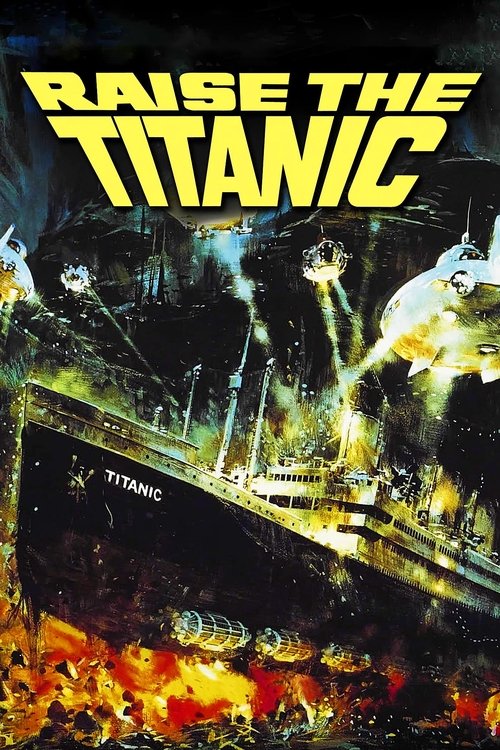
In the summer of 1980, moviegoers were promised the impossible: a full-scale Titanic rising from the deep, orchestrated by a cast of Hollywood heavyweights. Director Jerry Jameson's adaptation of Clive Cussler's bestseller had everything a blockbuster needed, a $36 million budget, John Barry's sweeping score, and a plot involving Cold War intrigue and a rare mineral called byzanium. But when the film hit theaters on August 1, it sank faster than the ship itself, grossing just $7 million domestically. The failure was so catastrophic that it effectively torpedoed ITC Entertainment's theatrical ambitions, turning the production into a cautionary tale about runaway budgets and misplaced faith in spectacle.
The story follows Admiral James Sandecker (Jason Robards) and his top-secret agency NUMA as they hatch an audacious plan: raise the Titanic from 12,000 feet below the North Atlantic to recover the byzanium, a mineral vital to American defense. Dirk Pitt (Richard Jordan), a maverick salvage expert, is recruited to lead the mission, joined by a team that includes scientist Gene Seagram (David Selby), journalist Dana Archibald (Anne Archer), and British intelligence officer John Bigalow (Alec Guinness). The Soviets, led by Captain Prevlov (Bo Brundin), are determined to stop them. What unfolds is a slow-burn adventure that spends most of its runtime on technical logistics and underwater espionage, building to a climax that would leave audiences baffled and critics sharpening their knives.
Despite its commercial disaster, Raise the Titanic has carved out a peculiar legacy. It remains a fascinating time capsule of late-70s filmmaking excess, a pre-discovery fantasy about the world's most famous shipwreck. The film's failure also paved the way for James Cameron's 1997 epic, which proved that a Titanic movie could be both critically and commercially triumphant. Today, the film is a cult curiosity, celebrated for its earnest absurdity, its lavish production values, and a score that far outshines the movie it accompanies.
Availability and pricing can change. Confirm on the provider's site before purchasing.
In the tense final years of the Cold War, the United States and the Soviet Union are locked in a high-stakes arms race. The key to military superiority lies in a rare mineral called byzanium, which has unique properties essential for advanced weapons systems. The only known significant deposit was being transported aboard the RMS Titanic when it sank in 1912, making the wreck the most valuable salvage target in history.
Admiral James Sandecker, head of the top-secret National Underwater and Marine Agency (NUMA), conceives an audacious plan: raise the entire Titanic from its resting place 12,000 feet below the North Atlantic. He recruits Dirk Pitt, a brilliant but unconventional deep-sea salvage expert, to lead the operation. Pitt is initially skeptical of the mission's feasibility, but the geopolitical stakes compel him to accept the challenge.
The mission requires assembling a massive international team of engineers, naval experts, and salvage specialists. Key figures include Dr. Gene Seagram, a scientist whose knowledge of the mineral's properties is crucial; Dana Archibald, a determined journalist who becomes entangled in the mission and develops a relationship with Pitt; and John Bigalow, a British intelligence officer who harbors personal connections to the Titanic's history and offers critical information about the ship's layout and the vault where the mineral was stored.
Complicating matters, the Soviet Union has learned of the American plan and dispatches its own covert operation under Captain Prevlov. The Russians attempt to sabotage the American effort, leading to a cat-and-mouse game of espionage and counter-espionage beneath the waves. Meanwhile, the logistical challenges mount: the Titanic's hull has deteriorated over nearly seven decades underwater, the pressure at such depths is immense, and the technology required for such an unprecedented salvage operation is untested.
The team develops innovative techniques to raise the ship, including inflatable pontoons and specialized lifting equipment. Master Chief Vinnie Walker provides the working-class expertise essential to the operation, while Admiral Kemper and Captain Joe Burke represent the military hierarchy overseeing the mission. As the operation progresses, the team faces a series of technical setbacks, near-disasters, and Soviet interference that threaten to derail the entire endeavor.
The narrative builds toward the climactic moment when the massive ship, long considered unsalvageable, begins its slow ascent from the ocean floor, a spectacle that forms the centerpiece of the film's visual effects. The tension lies not only in the physical challenge of lifting the 46,000-ton vessel but also in the political and personal ramifications of what the team will find when they finally reach the cargo hold. The stage is set for a final act that reveals the mission's ultimate purpose and consequences, which go far beyond the simple recovery of a mineral.
Imprint Blu-ray Trailer
Raise the Titanic (1980) Original Trailer [FHD]
Critical Consensus
A monumentally expensive misfire, Raise the Titanic squanders its impressive premise and A-list cast on a plodding, effects-heavy adventure that lacks the thrilling momentum of Cussler's source novel. Despite John Barry's sweeping score and some impressive model work, the film's glacial pacing, wooden performances, and anticlimactic twist sink it beneath the waves of its own ambition.
“A $36 million how-to movie about the raising of the Titanic... the most expensive, most elaborate, most solemnly silly adventure film of the year.”
Vincent Canby
The New York Times
“The movie's climax is so anticlimactic that it seems almost perverse... a film that spends two hours building up to a punchline that isn't funny.”
Roger Ebert
Chicago Sun-Times
“A $36 million bore... The special effects are the only stars, and even they can't save this from being a lugubrious, overlong exercise in misplaced ambition.”
Variety Staff
Variety
“The film is so dull that even the sinking of the Titanic would be an improvement... a textbook example of how money can't buy excitement.”
Gene Siskel
Chicago Tribune
“John Barry's score is the only element that rises above the material... the film's finale is a cosmic joke that leaves the audience feeling cheated.”
Kevin Thomas
Los Angeles Times
Jason Robards
Admiral James Sandecker
Richard Jordan
Dirk Pitt
David Selby
Dr. Gene Seagram
Anne Archer
Dana Archibald
Alec Guinness
John Bigalow
Bo Brundin
Captain Prevlov
M. Emmet Walsh
Master Chief Vinnie Walker
J.D. Cannon
Captain Joe Burke
Norman Bartold
Admiral Kemper
Elya Baskin
Marganin
Dirk Blocker
Merker
Robert Broyles
Willis
Director
Jerry Jameson
Writers
Adam Kennedy, Eric Hughes, Clive Cussler
Composer
John Barry
Cinematographer
Matthew F. Leonetti
Producers
William Frye, Lew Grade
Golden Raspberry Awards (1981)
Worst Picture: Nominated
Golden Raspberry Awards (1981)
Worst Director: Nominated
Golden Raspberry Awards (1981)
Worst Supporting Actor: Nominated
Join the community
fans discussing