 Turkey
Part of a Collection
Rafadan Tayfa Collection
Overview
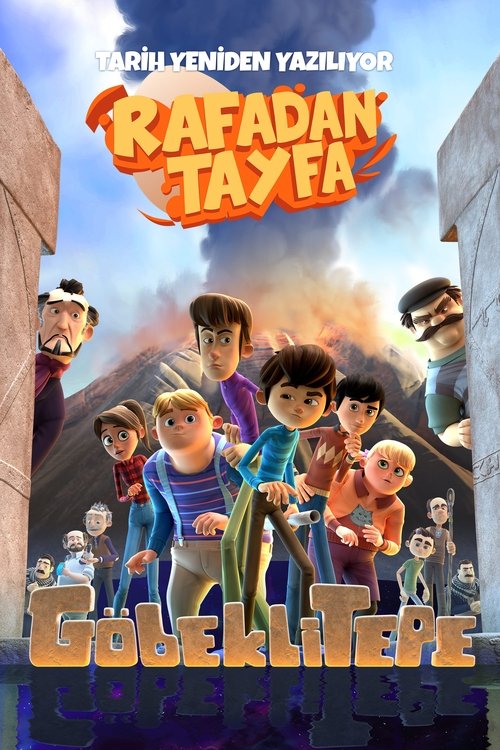
Turkish theaters received Rafadan Tayfa: Göbeklitepe on December 27, 2019, the second feature-length outing for the children's circle first assembled on TRT Çocuk. Director İsmail Fidan moves the action from an ordinary Istanbul neighborhood to the excavation site at Göbeklitepe near Şanlıurfa, a location that had spent the preceding years collecting headlines of its own. The production came from ISF Film, with Ozan Çivit handling the screenplay.
The premise turns on a copper tray mailed north by Akın's friend Veysi, a resident of Şanlıurfa, followed by a phone call that ends mid-sentence. Akın, voiced by Şirin Giobbi, and the rest of the group travel southeast to find out what Veysi has stumbled into, and the film folds smugglers, encoded clues and a speculative science-fiction thread into the familiar neighborhood comedy. Levent Kol, Yağmur Sergen, Hakan Coşar, Emine Sergen Kazbek and Aysın Işımer return to their series roles; Altay Çapan, İsmet Numanoğlu and Serdar Özap supply the adult eccentricities.
Box office came to roughly $10 million worldwide, a solid return for a domestic animated release and enough to place the film among the more visible Turkish animation openings of its year. Runtime is listed at 84 minutes on some storefronts and 89 on others. IMDb sits near 5.2 from a small vote pool, and Rotten Tomatoes carries no aggregate score for the title.
Where to Watch
Rent
Availability and pricing can change. Confirm on the provider's site before purchasing.
PlotSpoiler-free
The Istanbul neighborhood where the Tayfa live runs on routine. Akın keeps the group pointed in roughly the right direction; Hayri supplies momentum where planning is absent; Kamil supplies ballast; Mert supplies trouble; Hale and Sevim supply the good sense the boys periodically misplace. Around them the elders go about their business: Kazım Amca with his habitual grumbling, Kuşçu Baba with his birds, Başkan Amca with the avuncular authority of a man who has never quite been told no. The twins Rıza and Ziya bicker on schedule.
Then a parcel arrives. Veysi, an old friend of Akın's who lives in Şanlıurfa close to the Göbeklitepe dig, has sent a copper tray. Akın turns it over, examines the markings, and cannot make it resolve into anything useful. Before he can work it out, the telephone rings. Veysi is frightened. Someone is after him, he says, and the line cuts off. Akın tries again and gets nothing.
The decision to go follows quickly, because the alternative is waiting, and waiting is not what this group does. The trip takes them out of the city and into the flat country around Şanlıurfa, where the excavation has drawn tourists, scholars and, as it turns out, less reputable visitors. The tray, they begin to understand, is not a souvenir. It carries a pattern, and the pattern is a key to something.
Their arrival does not go unnoticed. Men with an interest in the tray and in whatever it locates are already in the area, and they are not inclined to share. The Tayfa's first encounters with these figures establish the shape of the film: the children know less than the villains but move faster, and the adults in the group are more hindrance than help. Kazım Amca's suspicions land wide of the mark; Kuşçu Baba's birds cause at least one diversion nobody planned; Başkan Amca's attempts at diplomacy go roughly as expected. A recurring stranger calling himself Gutu Gutu Yumguru drifts through the proceedings, offering comedy of a kind the younger viewers take at face value.
The middle stretch turns into a chase through clues. The tray's markings connect to the iconography of the site, and each partial reading sends the group to a new place: a workshop, a market, a stretch of the dig itself. The smugglers close in at intervals, and the film separates the children from one another long enough to make the eventual regrouping matter. The science-fiction element surfaces gradually rather than all at once. Göbeklitepe, the film suggests, is not only an archaeological site; something about it does not fit the standard account, and the smugglers believe the tray will lead them to it.
What the children have that the villains do not is a working knowledge of one another. Hayri's recklessness has already caused problems and will cause more, but it also gets them through gaps the careful approach would not. Kamil's steadiness holds when the others panic. Hale and Sevim notice what the boys walk past. Akın assembles the pieces, slowly, and the film keeps its central puzzle in view without letting it overwhelm the jokes. The tone stays within family bounds: mild peril, broad slapstick, and a running pride in the site at the center of the story.
By the final stretch the group is back together and moving toward the confrontation the whole film has been building. The tray has one more reading to give, and the villains are close enough to take it if the children hesitate. The synopsis stops here, before the climax and its resolution.
Ending ExplainedSpoilers
Critical Reception
Critical Consensus
Professional coverage outside Turkey is close to nonexistent, and neither Rotten Tomatoes nor Metacritic publishes an aggregate. The available audience data, chiefly a modest IMDb sample near 5.2, points to a film that serves its established viewership without converting outsiders. Turkish commentary tends to praise the franchise's ambition and the choice of subject more than the execution.
Top Cast
Şirin Giobbi
Akın (voice)
Levent Kol
Hayri (voice)
Yağmur Sergen
Kamil (voice)
Hakan Coşar
Mert (voice)
Emine Sergen Kazbek
Hale (voice)
Aysın Işımer
Sevim (voice)
Altay Çapan
Kazım Amca (voice)
İsmet Numanoğlu
Kuşçu Baba (voice)
Serdar Özap
Başkan Amca (voice)
Oytun Yücel
Veysi (voice)
Alp Pazarlı
Gutu Gutu Yumguru (voice)
Hakan Bozbey
Rıza & Ziya (voice)
Crew
Director
İsmail Fidan
Writer
Ozan Çivit
Producer
ISF Film
Keywords
Sources
Facts
- Status
- Released
- Original Language
- TR
- Revenue
- $10,000,000
- Director
- İsmail Fidan
- Production
- ISF Film
- Release Date
- December 27, 2019 (Turkey)
- Runtime
- 84–89 minutes (varies by listing)
- Franchise
- Second Rafadan Tayfa theatrical feature, after Dehliz Macerası (2018)
- Premiere
- Gala held in Şanlıurfa in late December 2019
Join the community
fans discussing