“A dazzlingly original and savagely funny crime film that crackles with energy and invention.”
Todd McCarthy
Variety
 United States
"Just because you are a character doesn't mean you have character."
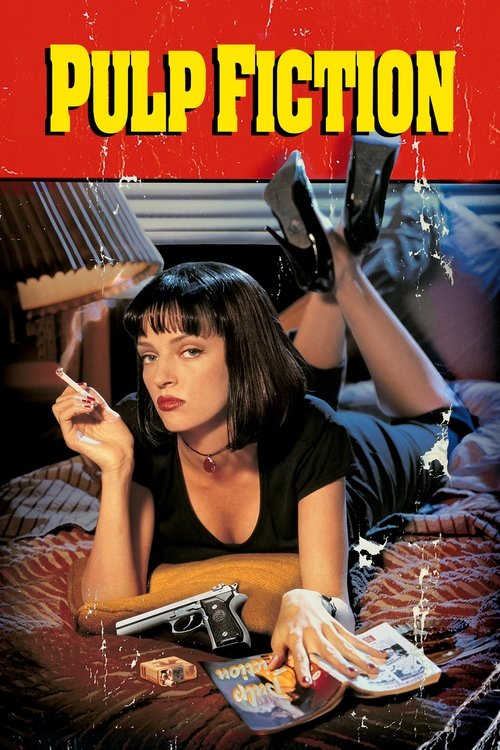
Quentin Tarantino's Pulp Fiction exploded onto screens in 1994, instantly redefining what independent cinema could achieve. Shot on a modest $8 million budget, the film went on to gross nearly $214 million worldwide, becoming the first Miramax release to cross $100 million domestically. Its non-linear narrative, whip-smart dialogue, and eclectic soundtrack turned it into a cultural phenomenon that continues to influence filmmakers decades later.
The story weaves together three interconnected tales set in the Los Angeles criminal underworld. A pair of philosophical hitmen, a boxer on the run, and a gangster's wife with a taste for danger all cross paths in ways that feel both random and fated. Tarantino, who co-wrote the script with Roger Avary, structures the film like a literary anthology, jumping back and forth in time to reveal how each character's choices ripple outward.
Beyond its narrative audacity, Pulp Fiction revived John Travolta's career, made Samuel L. Jackson a household name, and introduced Uma Thurman's Mia Wallace as an instant icon. The film won the Palme d'Or at Cannes and earned seven Academy Award nominations, including Best Picture. It was selected for preservation in the National Film Registry in 2013, cementing its status as a landmark of American cinema.
Availability and pricing can change. Confirm on the provider's site before purchasing.
Two hitmen, Vincent Vega and Jules Winnfield, drive through Los Angeles discussing the nuances of fast food in Europe. They are on their way to retrieve a mysterious briefcase for their boss, crime lord Marsellus Wallace. The conversation is interrupted when Jules delivers a chilling Bible passage before executing a young man who has failed to return the briefcase. After the job, Vincent confides in Jules that Marsellus has asked him to take his wife Mia out for the evening while he is away. Vincent is nervous because he has heard stories about Mia's dangerous reputation.
Meanwhile, in a diner, a couple known as Pumpkin and Honey Bunny decide to rob the establishment, setting off a chain of events that will echo throughout the film. The narrative then jumps to a different time: boxer Butch Coolidge is being paid by Marsellus to throw a fight. Butch agrees, but we learn he plans to double-cross the gangster. That night, Vincent buys heroin from his dealer Lance and shoots up before picking up Mia. At a retro-themed restaurant called Jack Rabbit Slim's, Vincent and Mia share a meal and participate in a twist contest, dancing to Chuck Berry's "You Never Can Tell." Back at Mia's house, she finds Vincent's heroin in his coat pocket and snorts it, believing it to be cocaine. She overdoses, collapsing with a needle in her chest. Vincent rushes her to Lance's house, where they stab her in the heart with a syringe of adrenaline, reviving her. They agree to keep the incident secret from Marsellus.
The story then jumps back to before Butch's fight. As a child, Butch receives a gold watch from his father's war buddy, Captain Koons, who explains the watch has been passed down through generations. Butch cherishes the watch. On the night of the fight, Butch knocks out his opponent, killing him, and escapes in a taxi with his girlfriend Fabienne. They plan to flee the city, but Fabienne forgets to pack the gold watch. Butch returns to his apartment to retrieve it, knowing Vincent is waiting there to kill him. Butch finds Vincent's gun on the kitchen counter and shoots him dead. While driving away, Butch encounters Marsellus at a crosswalk. Butch runs him over, but Marsellus shoots back, and both end up in a pawn shop. They are captured by the owner and his friend Zed, who take them to a basement to be sexually assaulted. Butch manages to escape his bonds and frees Marsellus, who shoots Zed. Marsellus tells Butch they are even, but Butch must leave Los Angeles forever and never speak of what happened. Butch escapes on Zed's motorcycle with Fabienne.
Earlier that day, Jules and Vincent are driving after retrieving the briefcase when Vincent accidentally shoots Marvin in the face. They take the car to Jules's friend Jimmie's house, where Jimmie demands they clean up before his wife comes home. Marsellus sends Winston Wolfe, a professional cleaner, to handle the situation. The Wolf efficiently directs them to clean the car and dispose of the body. Jules and Vincent then go to a diner to eat breakfast. Jules tells Vincent he is quitting the hitman life, having seen what he believes is divine intervention during the earlier shooting at the apartment. Vincent dismisses the idea. Suddenly, Pumpkin and Honey Bunny begin robbing the diner. Jules calmly confronts Pumpkin, recites the Ezekiel passage again, but this time as a reflection on his own redemption. He gives Pumpkin his wallet and lets the couple leave. Jules and Vincent leave the diner, with Jules having chosen a new path.
Official Trailer
Pulp Fiction (1994) Official Trailer - Samuel L. Jackson, John Travolta Movie HD
Critical Consensus
Pulp Fiction is a landmark of independent cinema, celebrated for its audacious non-linear narrative, sharp dialogue, and stylish blend of crime, dark humor, and pop culture references. Its intricate plotting and unforgettable characters redefined modern filmmaking.
“A dazzlingly original and savagely funny crime film that crackles with energy and invention.”
Todd McCarthy
Variety
“Tarantino's masterpiece is a jigsaw puzzle of profane brilliance, a violent, hilarious, and endlessly quotable meditation on fate and pop culture.”
David Fear
Rolling Stone
“It's a film that dares to be different, and in doing so, creates a whole new language for cinema.”
Peter Travers
Rolling Stone
“Pulp Fiction is a masterclass in storytelling, a film that manages to be both incredibly entertaining and profoundly thought-provoking.”
Richard Roeper
Chicago Sun-Times
John Travolta
Vincent Vega
Samuel L. Jackson
Jules Winnfield
Uma Thurman
Mia Wallace
Bruce Willis
Butch Coolidge
Ving Rhames
Marsellus Wallace
Harvey Keitel
Winston Wolfe
Eric Stoltz
Lance
Tim Roth
Pumpkin
Amanda Plummer
Honey Bunny
Maria de Medeiros
Fabienne
Quentin Tarantino
Jimmie Dimmick
Christopher Walken
Captain Koons
Director
Quentin Tarantino
Writers
Quentin Tarantino, Roger Avary
Cinematographer
Andrzej Sekula
Producer
Lawrence Bender
Academy Awards (1995)
Best Original Screenplay: Won
Academy Awards (1995)
Best Picture: Nominated
Cannes Film Festival (1994)
Palme d'Or: Won
Golden Globe Awards (1995)
Best Screenplay: Won
BAFTA Awards (1995)
Best Original Screenplay: Won
Join the community
fans discussing