 Japan
Japan“Princess Mononoke is a great achievement and a landmark of animation. It is not a cartoon but a feature film that uses animation to tell a story of epic scope and emotional depth.”
Roger Ebert
Chicago Sun-Times
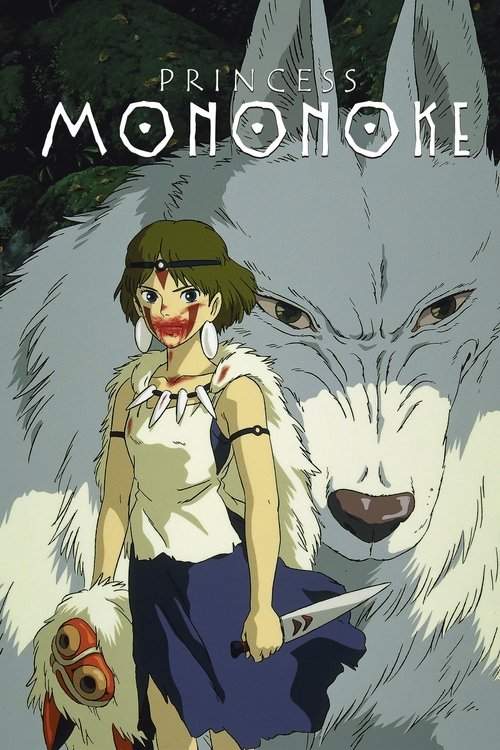
Set in Japan's late Muromachi period, Princess Mononoke follows Ashitaka, a young Emishi prince cursed by a demonized boar god. Exiled from his village, he journeys west to find the forest spirit that can lift the curse. His path leads him to Iron Town, a fortress-like settlement ruled by the formidable Lady Eboshi, who is clear-cutting the forest to fuel her iron furnaces. The forest itself is protected by San, a feral young woman raised by wolves, who fights to defend her home from human encroachment.
The film was Studio Ghibli's most expensive production at the time, with a budget of ¥2.35 billion. It became the highest-grossing film in Japanese history upon release, drawing 12 million viewers in its first five months. Hayao Miyazaki wrote and directed this epic, with a score by Joe Hisaishi that blends traditional Japanese instruments with Western orchestral arrangements.
Princess Mononoke broke new ground for animation, winning the Japan Academy Prize for Picture of the Year and proving that animated films could tackle mature themes with moral complexity. Its nuanced portrayal of environmental conflict, rejecting simple heroes and villains, has influenced filmmakers worldwide and remains urgently relevant today.
Availability and pricing can change. Confirm on the provider's site before purchasing.
During Japan's Muromachi period, a great boar god transformed into a demon of writhing black tentacles attacks an Emishi village. The young prince Ashitaka kills the creature, but its touch leaves a cursed mark on his arm that grants superhuman strength while slowly killing him. The village wise woman reveals the curse came from a ball of iron embedded in the boar's body, a product of a distant land to the west. Ashitaka must leave his home forever and seek a cure from the forest spirit who gave the boar its life. He cuts his hair in a ritual of exile and rides westward on his red elk, Yakul.
Along his journey, Ashitaka encounters a world in turmoil. He saves two men from drowning and learns of Iron Town, a mining settlement ruled by Lady Eboshi. The town is a haven for outcasts: former prostitutes, lepers who forge weapons, and social rejects. Eboshi has built her prosperity by clear-cutting forests to fuel her iron furnaces, and she arms her workers with rifles to kill the forest gods who oppose her expansion. The forest itself is ruled by the Shishigami, the Deer God, a mysterious creature with the body of a deer, the face of a human, and the power to bring life and death.
Protecting the forest is San, a young woman raised by the wolf goddess Moro. San hates humans for their destruction of her home. She attacks Iron Town, attempting to kill Eboshi, and earns the name Princess Mononoke, meaning spirit or monster. Ashitaka is caught between these two irreconcilable forces. He rescues two Iron Town workers from a wolf attack, and San bites him, but he refuses to fight her. When a wounded boar god attacks Iron Town, Ashitaka uses his cursed strength to stop it, causing his curse to spread further. The townspeople are awed and frightened by his power. Eboshi, learning that Ashitaka seeks the Deer God, reveals her plan to kill the forest spirit itself.
The central conflict escalates as Ashitaka, now more deeply cursed, seeks the Deer God for a cure while trying to prevent all-out war. He allies with neither side, instead advocating for coexistence. The forest gods include the wolf clan, the boar clan led by the ancient Okkoto, and the ape-like creatures who worship the Deer God. Meanwhile, a cunning monk named Jigo works for the emperor, who desires the Deer God's head for its immortality-granting powers. Ashitaka learns that both San and Eboshi have valid reasons for their actions: San loves the forest as her family, and Eboshi protects her people from a hostile world. The story builds toward a confrontation at the Deer God's sacred pool, where all parties converge with their own agendas for the forest spirit.
4K Restoration Official Trailer
Official Trailer [Subtitled]
Ghibli Fest 2023 Trailer
Critical Consensus
Princess Mononoke is a sprawling, visually stunning epic that explores the complex relationship between humanity and nature with nuance and depth. Miyazaki's masterpiece features morally gray characters, breathtaking animation, and a powerful score that elevates it beyond typical animated fare.
“Princess Mononoke is a great achievement and a landmark of animation. It is not a cartoon but a feature film that uses animation to tell a story of epic scope and emotional depth.”
Roger Ebert
Chicago Sun-Times
“A visually stunning, emotionally complex epic that challenges the notion of what an animated film can be. Miyazaki creates a world of breathtaking beauty and moral ambiguity.”
Janet Maslin
The New York Times
“A spectacular, beautifully drawn fantasy adventure that ranks with the best of Disney's animated features in its ambition and execution. The action sequences are breathtaking.”
Todd McCarthy
Variety
“Miyazaki's masterpiece is a dark, violent, and profoundly moving meditation on the conflict between progress and tradition, humanity and nature. It leaves you breathless.”
Peter Bradshaw
The Guardian
“A towering achievement in animation that combines mythic storytelling with urgent environmental themes. The film's moral complexity sets it apart from any animated film before or since.”
David Rooney
The Hollywood Reporter
Yoji Matsuda
Ashitaka (voice)
Yuriko Ishida
San / Kaya (voice)
Yuko Tanaka
Eboshi Gozen (voice)
Kaoru Kobayashi
Jigo (voice)
Masahiko Nishimura
Kouroku (voice)
Tsunehiko Kamijō
Gonza (voice)
Akihiro Miwa
Moro (voice)
Mitsuko Mori
Hii-sama (voice)
Hisaya Morishige
Emperor's Chief of Affairs (voice)
Sumi Shimamoto
Toki (voice)
Tetsu Watanabe
Wild Dog (voice)
Makoto Satō
Tatari God / Nago (voice)
Director
Hayao Miyazaki
Writer
Hayao Miyazaki
Composer
Joe Hisaishi
Cinematographer
Atsushi Okui
Producer
Toshio Suzuki
Japan Academy Prize (1998)
Picture of the Year: Won
Mainichi Film Awards (1998)
Best Film: Won
Mainichi Film Awards (1998)
Best Animation Film: Won
Tokyo Anime Awards (1998)
Best Film: Won
Annie Awards (2000)
Best Animated Feature: Nominated
Annie Awards (2000)
Best Directing in an Animated Feature: Nominated
Annie Awards (2000)
Best Writing in an Animated Feature: Nominated
Online Film Critics Society Awards (1999)
Best Animated Film: Nominated
Join the community
fans discussing