“Robert Redford's directorial debut is a masterpiece of restraint. He handles the subject matter with such delicacy and respect that the film becomes a profound meditation on grief.”
Roger Ebert
Chicago Sun-Times

 United States
"Everything is in its proper place... except the past."
User Score
150000 votes
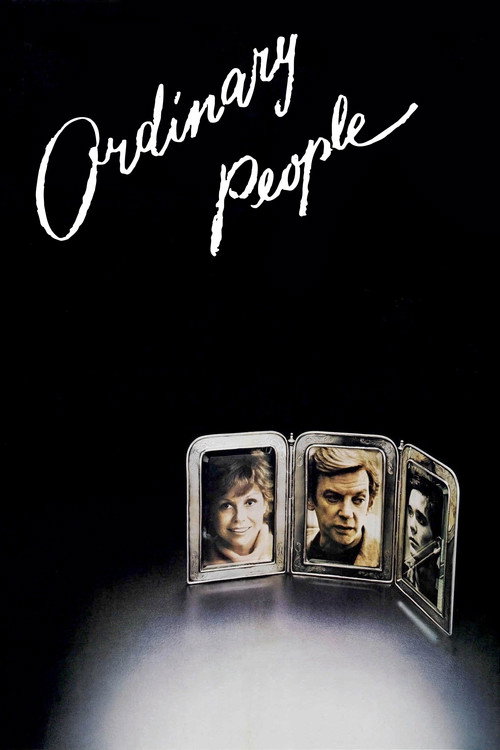
Robert Redford's directorial debut Ordinary People steps away from typical Hollywood spectacle to examine a middle-class family in Chicago unraveling after a tragedy. Released in September 1980, this drama cost six million dollars to produce and eventually grossed nearly fifty-five million at the box office. The film stars Donald Sutherland as Calvin Jarrett, Mary Tyler Moore as his wife Beth, and Timothy Hutton as their surviving son Conrad. Judd Hirsch rounds out the core cast as Dr. Berger, the therapist who guides Conrad through his recovery.
The narrative arrives at a time when American cinema was beginning to tackle domestic trauma with unflinching honesty. Redford adapted Judith Guest's novel into a screenplay that prioritized emotional realism over melodrama. The production team chose real locations in Lake Forest and Winnetka, Illinois, to ground the story in an authentic suburban setting. This commitment to visual truth helped the film resonate with audiences who saw their own hidden struggles reflected on screen.
Availability and pricing can change. Confirm on the provider's site before purchasing.
The story opens in the affluent suburb of Lake Forest, Illinois, where the Jarrett family presents a picture of stability that masks deep fractures. Calvin works as an accountant while Beth manages the household with rigid perfectionism. Their world shattered two years prior when their older son, Buck, drowned in a sailing accident. While the family mourns publicly, the private reality is far more fractured. Conrad, the surviving son, has been unable to cope with the loss and the guilt of having survived. He attempts suicide by overdosing on pills and cutting his wrists, leading to a hospitalization that serves as the catalyst for the film's exploration of grief and mental health.
Upon his release, Conrad returns home to a household where emotional communication has ceased. His mother, Beth, retreats into a cold facade of normalcy. She cannot bear to look at Conrad or speak of Buck, effectively erasing him from the family dynamic while punishing the survivor. Calvin, desperate to reconnect with his son, encourages Conrad to seek professional help. This leads Conrad to Dr. Joseph Berger, a compassionate psychiatrist who becomes a crucial figure in Conrad's recovery. Through therapy sessions, Conrad begins to confront the trauma he has been suppressing, slowly unraveling the layers of guilt and anger that have consumed him.
As Conrad grows stronger under Dr. Berger's guidance, he begins to challenge the status quo of his home life. He starts to question his mother's behavior and the unspoken rules that govern the family. The tension escalates when Conrad decides to invite his girlfriend, Jeannine, to dinner, a move that Beth finds unacceptable due to her inability to handle any deviation from her idealized vision of the family. The film meticulously builds toward a breaking point, exploring themes of parental expectations, the toxicity of repressed emotion, and the difficulty of healing after a profound loss. The narrative focuses on the slow, painful process of Conrad learning to live with his guilt and the potential for the family to either tear itself apart completely or find a way to heal.
The pressure cooker atmosphere intensifies as Conrad gains confidence. He begins to see his mother not just as a grieving widow but as someone actively avoiding the pain of reality. The dinner party scene looms as the inevitable collision between Conrad's new openness and Beth's rigid control. The story leaves the audience anticipating whether the fragile threads holding the Jarretts together will snap under the weight of their secrets or if they can finally face the truth of their brokenness. Every interaction feels heavy with unspoken history, forcing viewers to witness the delicate dance of a family trying to survive without falling apart.
Ordinary People (1980) 35mm film trailer, flat hard matte, 1440p
Critical Consensus
Redford's directorial debut delivers a deeply moving examination of grief and family dysfunction through restrained storytelling. The film avoids melodrama in favor of raw, authentic performances, particularly from Mary Tyler Moore and Timothy Hutton. It creates a haunting portrait of a family struggling to heal from the unspeakable loss of a child.
“Robert Redford's directorial debut is a masterpiece of restraint. He handles the subject matter with such delicacy and respect that the film becomes a profound meditation on grief.”
Roger Ebert
Chicago Sun-Times
“A remarkable first effort... Mary Tyler Moore gives a performance of such terrifying intensity that it is hard to believe she is acting. The film is a triumph of direction and writing.”
Vincent Canby
The New York Times
“Redford has made a film that is both intimate and universal. The script by Alvin Sargent is sharp and unsparing, and the actors deliver performances that are nothing short of miraculous.”
Pauline Kael
The New Yorker
“A stunning achievement... Redford's direction is assured and sensitive, capturing the nuances of family dynamics with precision. The film is a powerful reminder of the cost of repression.”
Variety Staff
Variety
Donald Sutherland
Calvin Jarrett
Mary Tyler Moore
Beth Jarrett
Timothy Hutton
Conrad Jarrett
Judd Hirsch
Dr. Joseph Berger
M. Emmet Walsh
Swim Coach
Elizabeth McGovern
Jeannine Pratt
Dinah Manoff
Karen
Fredric Lehne
Lazenby
James B. Sikking
Ray Hanley
Basil Hoffman
Sloan
Director
Robert Redford
Writers
Alvin Sargent, Judith Guest
Composer
Marvin Hamlisch
Cinematographer
John Bailey
Producer
Ronald L. Schwary
Academy Awards (1981)
Best Picture: Won
Academy Awards (1981)
Best Director: Won
Academy Awards (1981)
Best Supporting Actor: Won
Academy Awards (1981)
Best Adapted Screenplay: Won
Golden Globe Awards (1981)
Best Motion Picture – Drama: Won
Golden Globe Awards (1981)
Best Director: Won
BAFTA Awards (1981)
Best Film: Won
Join the community
fans discussing