 Turkey
“A long, beautiful and demanding film… Mr. Ceylan turns a police procedural into a meditation on mortality, bureaucracy and the stories men tell themselves.”
Manohla Dargis
The New York Times
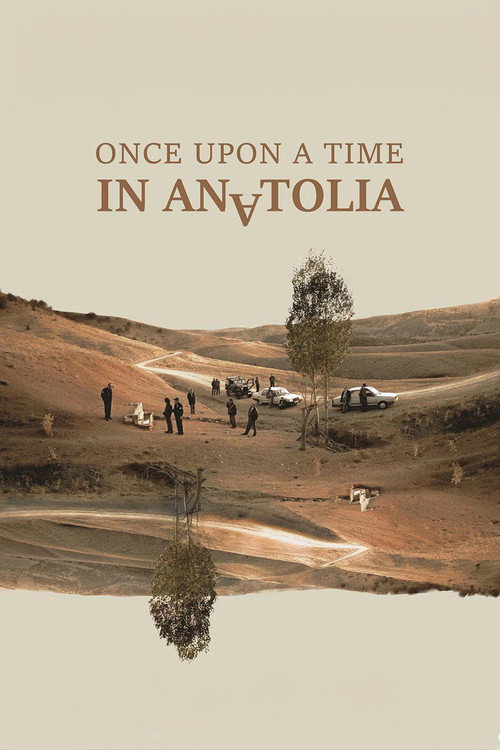
Nuri Bilge Ceylan's Once Upon a Time in Anatolia begins with a simple errand: a confessed killer must lead a police detail to the shallow grave where he buried his victim. What follows is anything but simple. Over one long night, a convoy of cars crawls across the moonlit steppes outside a small Anatolian town, and the search becomes a slow-burning study of the men doing the searching. Ceylan, working from a script he wrote with Ebru Ceylan and Ercan Kesal, turns a procedural into a meditation on bureaucracy, guilt, and the stories people tell themselves to keep going.
The cast is a who's who of Turkish cinema. Muhammet Uzuner plays Doktor Cemal, the exhausted physician along for the ride; Yılmaz Erdoğan is Komiser Naci, the police commissioner who runs the operation with a mix of bluster and fatigue; Taner Birsel is Savcı Nusret, the prosecutor who treats the night as an inconvenience; and Ahmet Mümtaz Taylan is Şoför Arap Ali, the driver whose chatter fills the silence. Fırat Tanış and Ercan Kesal round out the group as the suspect Kenan and a village muhtar who hosts a surreal late-night meal.
Shot by Gökhan Tiryaki in long, patient takes, the film is less a whodunit than a why-dunit, and its tone moves between deadpan humor and quiet dread. It shared the Grand Prix at Cannes in 2011 and was Turkey's submission for the Academy Awards. The box office was modest, just over $138,000 in reported receipts, but the film's reputation has grown steadily since its release. It is a crime drama in the loosest sense, closer in spirit to Chekhov than to CSI.
Availability and pricing can change. Confirm on the provider's site before purchasing.
A murder has been confessed to, and the confessed killer, Kenan, is being driven around the countryside by a convoy of police, gendarmes and officials to point out where he and his brother buried the body. The problem is that Kenan, drunk on the night of the killing, cannot remember the spot. He recognizes a tree, a fountain, a bend in the road, and each time the convoy stops, the grave turns out not to be there.
The core group is small and sharply drawn. Savcı Nusret is the prosecutor, a well-dressed, self-satisfied man who treats the night as an irritating interruption to his evening and fills the car with anecdotes about his own cleverness. Komiser Naci is the police commissioner, a weary, blustering man who runs the operation with theatrical authority and growing frustration, needling the suspect and the doctor alike. Doktor Cemal is the town physician, drafted into the expedition to certify the body, a quiet, observant widower who becomes the film's moral center and its audience surrogate. Şoför Arap Ali drives one of the cars and supplies a running stream of complaints and folk wisdom.
As the night wears on, the search becomes a portrait of a bureaucracy in motion: men in cheap suits and overcoats standing in headlights on empty steppes, smoking, bickering, eating, waiting. Ceylan alternates long, wide, moonlit landscape shots with intimate car-interior conversations, so that the film's real subject gradually shifts from the missing body to the men looking for it, their vanities, their small corruptions, their griefs. A late-night stop at a village introduces the muhtar, who hosts the convoy for a meal in a house where the power has failed; his daughter Cemile serves the men by candlelight, and the moment, beautiful and faintly eerie, becomes the film's most famous image. The doctor is visibly moved; the prosecutor and commissioner are not, or pretend not to be.
By dawn the convoy has still not found the grave, and the film's central tension, whether the body will be found, and what finding it will mean, has been thoroughly displaced by the accumulated weight of the night's conversations. The film's first half is thus a long, patient, often very funny night journey; its second half moves into the daylight of the autopsy and the aftermath, where the procedural machinery finally does its work and the film's buried themes surface.
Official Trailer
Critical Consensus
Ceylan's Once Upon a Time in Anatolia is widely regarded as a masterpiece of slow cinema, a patient, beautifully photographed procedural that uses a night-long search for a body to examine the vanities, guilt and small mercies of ordinary men. Critics praise its Chekhovian dialogue, Gökhan Tiryaki's moonlit cinematography and its refusal of conventional resolution, while a minority find its 157-minute runtime and deliberate pace taxing.
“A long, beautiful and demanding film… Mr. Ceylan turns a police procedural into a meditation on mortality, bureaucracy and the stories men tell themselves.”
Manohla Dargis
The New York Times
“Possessed of a mysterious grandeur… a film of long, patient takes and quiet, accumulating power.”
Peter Bradshaw
The Guardian
“A richly absorbing, exquisitely shot procedural that gradually reveals itself as a meditation on guilt and conscience.”
Justin Chang
Variety
“A masterful, slow-burn epic… Ceylan's most accomplished work to date.”
Eric Kohn
IndieWire
“Ranked among the best films of the 2010s, praised for its moral seriousness and formal rigor.”
Reverse Shot
Reverse Shot
Director
Nuri Bilge Ceylan
Writers
Ercan Kesal, Nuri Bilge Ceylan, Ebru Ceylan
Cinematographer
Gökhan Tiryaki
Producers
Zeynep Ozbatur Atakan, Can Yılmaz, Nuri Bilge Ceylan
Cannes Film Festival (2011)
Grand Prix: Won
Cannes Film Festival (2011)
Palme d'Or: Nominated
European Film Awards (2011)
Best Director: Nominated
European Film Awards (2011)
Best Screenwriter: Nominated
European Film Awards (2011)
Best Cinematographer: Nominated
Antalya Golden Orange Film Festival (2011)
Best Film: Won
Antalya Golden Orange Film Festival (2011)
Best Director: Won
Antalya Golden Orange Film Festival (2011)
Best Screenplay: Won
Antalya Golden Orange Film Festival (2011)
Best Cinematography: Won
Antalya Golden Orange Film Festival (2011)
Best Supporting Actor: Won
Asia Pacific Screen Awards (2011)
Best Feature Film: Nominated
Turkish Film Critics Association (SİYAD) (2012)
Best Film: Won
Turkish Film Critics Association (SİYAD) (2012)
Best Director: Won
Turkish Film Critics Association (SİYAD) (2012)
Best Screenplay: Won
Academy Awards (2012)
Best Foreign Language Film: Submitted
Join the community
fans discussing