“The film is a Homeric journey through Mississippi during the Depression, or rather, through all of the images of that time and place that have been trickling down through pop culture ever since.”
Roger Ebert
RogerEbert.com
 United States
"Three fugitives. One treasure. No clue."
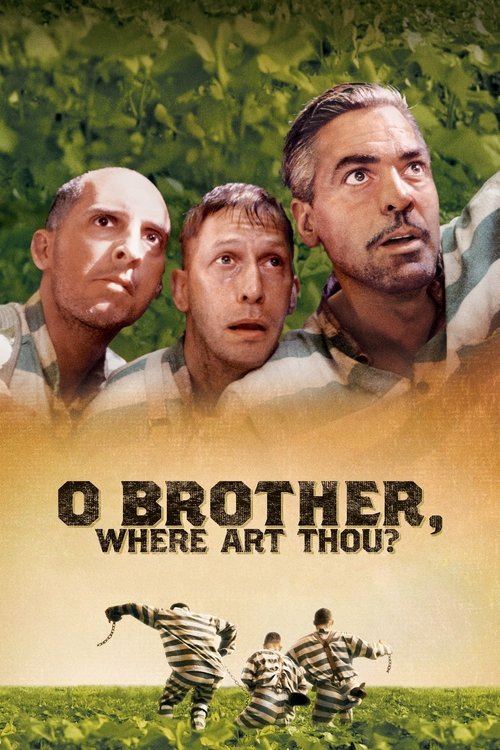
In 1937 Mississippi, three convicts escape a chain gang and set off to find a hidden treasure before a valley is flooded for a hydroelectric dam. Joel Coen directs this loose adaptation of Homer's The Odyssey, transposed to the American South during the Great Depression. George Clooney plays Ulysses Everett McGill, a pomade-obsessed schemer who claims to have buried $1.2 million near his home. John Turturro and Tim Blake Nelson play his fellow fugitives, Pete and Delmar, whose simple faith and superstition contrast with Everett's slick rationalism.
The film is built around a series of episodic encounters with characters drawn from myth and American folklore: a blind prophet on a handcar, three seductive Sirens, a one-eyed Bible salesman, and the manic bank robber Baby Face Nelson. The Coens shot the film with a deliberately desaturated color palette, achieved through a digital bleach-bypass process, giving the Mississippi landscape a baked, sepia-toned look. The soundtrack, produced by T Bone Burnett, became a phenomenon, winning the Grammy for Album of the Year and sparking a revival of bluegrass and old-time music.
With a budget of $26 million, the film grossed $71.9 million worldwide. It was nominated for the Palme d'Or at Cannes and won a Grammy for its soundtrack. Roger Deakins' cinematography earned a BAFTA nomination. The film's title is borrowed from Preston Sturges' 1941 comedy Sullivan's Travels, in which a director wants to make a serious drama called O Brother, Where Art Thou? about the Depression.
Stream
Netflix
Amazon Prime Video
Rent
Apple TV
$3.99
Buy
Apple TV
$9.99
Availability and pricing can change. Confirm on the provider's site before purchasing.
Three convicts in gray uniforms and shackles work a Mississippi chain gang in 1937. Everett, Pete, and Delmar escape by jumping onto a moving railcar. Everett claims he stashed $1.2 million from an armored car robbery near his home in the valley of the new Arkabutla Dam, which will be flooded in four days. He convinces the others to join him, promising a share of the loot.
They meet a blind prophet on a handcar who tells them their journey will lead to a fortune, but not the one they seek. At Pete's cousin Wash's farm, they remove their shackles, but Wash betrays them to Sheriff Cooley, a relentless lawman with a hound. The trio escapes a burning barn with help from Wash's young son.
On the road, Pete and Delmar are baptized by a riverside revival preacher. They emerge from the water joyful and cleansed, but Everett scoffs at their faith. Soon after, they encounter three women washing clothes by the river. The women charm the men with music and whiskey; Pete follows them into the woods and vanishes. Delmar believes Pete has been turned into a toad.
Everett and Delmar meet Tommy Johnson, a blues guitarist who claims he sold his soul to the devil at a crossroads to learn to play. They travel together and stumble into a radio station, where they record a song as the Soggy Bottom Boys. The recording becomes a hit, though they remain unaware of their fame.
The trio encounters Big Dan Teague, a one-eyed Bible salesman who robs them after a picnic. They later meet Baby Face Nelson, who forces them to help him rob a bank. Nelson dies in a shootout with police. Tommy is captured by the Ku Klux Klan, and the others rescue him by crashing a Klan rally, using a burning cross as a battering ram.
Everett's driving motivation is to reunite with his wife Penny, who has told their seven daughters that their father was hit by a train. She plans to marry Vernon Waldrip, a suitor Everett despises. The story builds toward a political rally where Governor Pappy O'Daniel faces reformist challenger Homer Stokes. The Soggy Bottom Boys' music becomes a wild card, and the fugitives decide to attend the rally disguised as a band.
Trailer
Trailer
Critical Consensus
The Coen brothers' loose adaptation of Homer's Odyssey set in Depression-era Mississippi is a visually stunning, musically infectious romp. While some critics found its episodic structure uneven, the film's blend of slapstick comedy, Southern Gothic atmosphere, and a Grammy-winning soundtrack creates a singularly charming and enduring Americana fable.
“The film is a Homeric journey through Mississippi during the Depression, or rather, through all of the images of that time and place that have been trickling down through pop culture ever since.”
Roger Ebert
RogerEbert.com
“The Coen brothers have created a world that is both familiar and strange, a place where the fantastical and the mundane coexist in perfect harmony.”
Paul Clinton
CNN
“The Coens pour on the comic invention, but it's the music that gives the film its soul. T Bone Burnett's soundtrack is a revelation.”
Peter Travers
Rolling Stone
“The Coen brothers' most sunnily entertaining movie, a Depression-era picaresque that's as much a celebration of American vernacular music as it is a comedy.”
Lisa Schwarzbaum
Entertainment Weekly
“A rambunctious, wildly uneven but often hilarious musical road movie that ransacks American pop culture with the same gleeful irreverence as the Coens' earlier films.”
Stephen Holden
The New York Times
George Clooney
Ulysses Everett McGill
John Turturro
Pete Hogwallop
Tim Blake Nelson
Delmar O'Donnell
John Goodman
Big Dan Teague
Holly Hunter
Penny McGill
Chris Thomas King
Tommy Johnson
Charles Durning
Governor Menelaus 'Pappy' O'Daniel
Del Pentecost
Junior O'Daniel
Michael Badalucco
George 'Baby Face' Nelson
Wayne Duvall
Homer Stokes
Daniel von Bargen
Sheriff Cooley
Ray McKinnon
Vernon T. Waldrip
Stephen Root
Radio Station Man
Frank Collison
Wash Hogwallop
Director
Joel Coen
Writers
Joel Coen, Ethan Coen, Homer
Composer
T Bone Burnett
Cinematographer
Roger Deakins
Producer
Ethan Coen
Grammy Awards (2002)
Album of the Year: Won
Grammy Awards (2002)
Best Compilation Soundtrack Album for a Motion Picture: Won
Golden Globe Awards (2002)
Best Actor – Motion Picture Musical or Comedy: Nominated
Cannes Film Festival (2001)
Palme d'Or: Nominated
BAFTA Awards (2002)
Best Cinematography: Nominated
BAFTA Awards (2002)
Best Costume Design: Nominated
BAFTA Awards (2002)
Best Production Design: Nominated
BAFTA Awards (2002)
Best Original Film Score: Nominated
BAFTA Awards (2002)
Best Sound: Nominated
Join the community
fans discussing