“A dazzling, dizzying work of art that defies easy categorization. Lynch has created a film that is both a love letter to Hollywood and a scathing critique of its illusions.”
A.O. Scott
The New York Times
 United States
"A love story in the city of dreams."
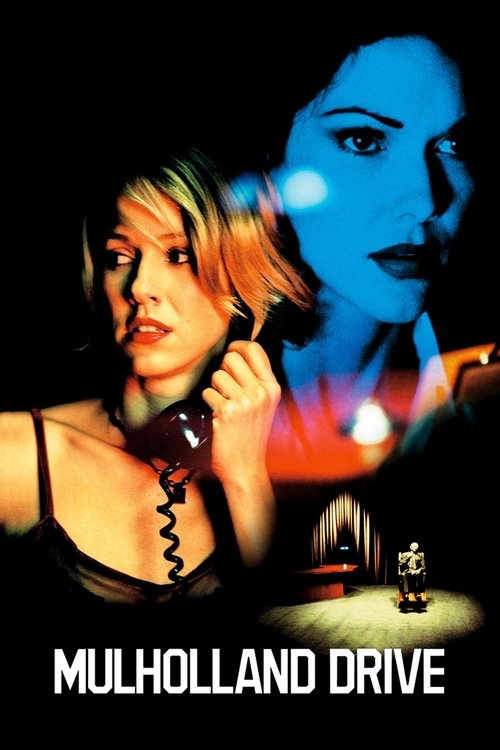
David Lynch's Mulholland Drive began life as a pilot for an ABC television series. The network passed on it in 1999, and Lynch did something unusual: he shot additional footage, restructured the existing material, and turned a dead pilot into a self-contained feature. The result premiered at Cannes on May 16, 2001, and took home Best Director. It arrived in US theaters that October through Universal Focus.
The film opens on a limousine gliding down Mulholland Drive at night, a car crash, and a woman stumbling away from the wreckage with no memory of who she is. She hides in an apartment belonging to a working actress and is found the next morning by the actress's niece, Betty Elms, fresh off a plane from Deep River, Ontario, with a head full of Hollywood dreams. Naomi Watts plays Betty. Laura Harring plays the amnesiac, who takes the name Rita from a Gilda poster on the wall.
From there the movie spirals through a hitman botching a job, a film director named Adam Kesher being strong-armed by mob money, a diner scene at Winkie's that has become one of the most analyzed sequences in modern cinema, and a blue key and a blue box that sit at the center of everything. Lynch shot it for about $15 million, and it grossed just over $20 million worldwide. The Criterion Collection released a 4K restoration in 2015. Twenty-five years on, it still gets argued about at film schools, in podcasts, and on message boards the way few films of its era do.
Availability and pricing can change. Confirm on the provider's site before purchasing.
A black limousine turns off Mulholland Drive in the middle of the night. Inside, a woman in a dark dress sits with two men when the driver stops, pulls a gun, and orders her out. A pair of drag racers slam into the car before she can comply. She staggers from the wreckage, dazed and bleeding, and makes her way down the hill into Los Angeles. She has no name she can recall. She slips into an apartment, hides behind a piece of furniture, and falls asleep.
Betty Elms lands at LAX the next morning. She is bright, polite, and almost aggressively optimistic, a small-town girl from Deep River, Ontario, with a suitcase full of audition outfits and a plan. Her aunt Ruth has lent her the apartment at the complex run by a woman named Coco. Betty walks in, finds a stranger in the shower, and instead of calling the police decides to help. The woman has no ID except a purse full of cash and a blue key. On the wall hangs a poster for Gilda, and the woman picks the name Rita from it.
Betty and Rita spend the next stretch of the film trying to recover Rita's memory. They visit a diner called Winkie's, where a man named Dan tells a friend about a recurring nightmare involving a figure behind the restaurant. They go to a rundown apartment on Sierra Bonita and find a woman's body decomposing in the bedroom. Rita's memory starts to surface in flashes, and the two women grow close in a way that moves past friendship. A blue box appears in Rita's bag, and the key fits it. Rita opens it at the end of the first act, and the film drops out from under the audience.
Running alongside this is the story of Adam Kesher, a director whose new picture is being hijacked. Two men from a production company called Castigliane Brothers show up at his office with a headshot of a blonde actress and a demand that she be cast. Adam refuses. That night he comes home to find his wife in bed with another man, gets beaten by a cowboy in a corral, and loses his house, his bank accounts, and his access to his own movie. He ends up broke and humiliated, sitting in a diner with a hitman he barely knows.
Other threads drift through the film. A bungling hitman shoots a man, a woman, and a janitor in a high-rise office and keeps messing up the job. A detective named McKnight questions witnesses about the crash. A singer named Rebekah Del Rio performs a Spanish-language version of Roy Orbison's "Crying" at Club Silencio, collapses mid-song, and the voice keeps going, exposing the whole thing as a recording. Betty and Rita watch, sobbing, and then the blue box appears again. This time Betty opens it. The camera pushes into the box, and the dream ends.
Trailer in 4K
Trailer
Official StudioCanal Trailer
Critical Consensus
Critics almost universally placed Mulholland Drive among the best films of 2001, and the reputation has only grown. The puzzle structure, Watts's dual performance, and Badalamenti's score keep drawing new viewers. Audiences are split between people who find it hypnotic and people who find it impenetrable, but the Tomatometer sits comfortably in the low 90s and the Metascore in the high 80s.
“A dazzling, dizzying work of art that defies easy categorization. Lynch has created a film that is both a love letter to Hollywood and a scathing critique of its illusions.”
A.O. Scott
The New York Times
“One of the most ambitious and rewarding films of the year. Lynch has crafted a puzzle that is both beautiful and terrifying, a film that demands to be seen and reseen.”
Roger Ebert
Chicago Sun-Times
“A visual feast and a narrative marvel. Lynch has pushed the boundaries of cinema, creating a film that is as much a dream as it is a nightmare.”
Peter Travers
Rolling Stone
“A stunning achievement that showcases Lynch's unique vision and storytelling prowess. Mulholland Drive is a film that will be discussed and analyzed for years to come.”
Kenneth Turan
Los Angeles Times
“A mesmerizing and enigmatic work that captures the essence of Hollywood's dark underbelly. Lynch has created a film that is both a tribute and a warning.”
Manohla Dargis
The Guardian
Director
David Lynch
Writer
David Lynch
Composer
Angelo Badalamenti
Cinematographer
Peter Deming
Producers
Alain Sarde, Neal Edelstein, Tony Krantz, Michael Polaire, Mary Sweeney
Academy Awards (2002)
Best Director: Nominated
Academy Awards (2002)
Best Actress: Nominated
Cannes Film Festival (2001)
Best Director: Won
Golden Globe Awards (2002)
Best Motion Picture - Drama: Nominated
Golden Globe Awards (2002)
Best Director: Nominated
Golden Globe Awards (2002)
Best Actress - Drama: Nominated
BAFTA Awards (2002)
Best Film Not in the English Language: Nominated
BAFTA Awards (2002)
Best Direction: Nominated
BAFTA Awards (2002)
Best Actress in a Leading Role: Nominated
National Society of Film Critics (2002)
Best Director: Won
National Society of Film Critics (2002)
Best Actress: Won
Los Angeles Film Critics Association (2001)
Best Director: Won
Los Angeles Film Critics Association (2001)
Best Actress: Won
Join the community
fans discussing