 United Arab Emirates
“Carnahan's film is a visceral, street-level account of the fight against ISIS, one that refuses to look away from the horror while finding unexpected humanity in the men who chose to stand and fight.”
Peter Debruge
Variety
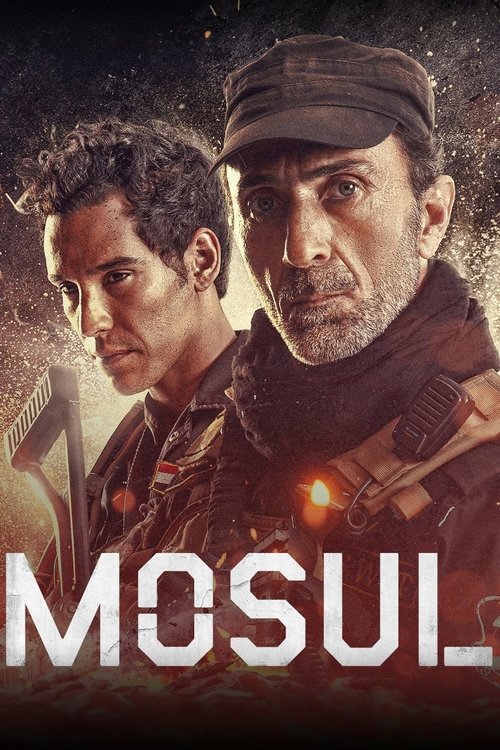
In 2016, as ISIS tightened its grip on Mosul, a small band of police officers refused to surrender. Their story, told in Matthew Michael Carnahan's war drama Mosul, follows the Nineveh SWAT team as they fight a desperate guerrilla campaign to reclaim their city from the extremists who had overrun it. The film, based on a 2017 New York Times article by Luke Mogelson, brings a rare Iraqi perspective to the screen, with a mostly Middle Eastern cast led by Suhail Dabbach as the weary commander Jasem and Adam Bessa as a young recruit named Kawa.
Carnahan, making his directorial debut after writing films like The Kingdom and Deepwater Horizon, shot the movie on location in Morocco, with a budget reported around $20 million. The production, backed by Joe and Anthony Russo's AGBO, favors gritty realism over Hollywood gloss, using handheld cameras and natural light to immerse viewers in the chaos of urban combat. The film premiered at the Venice Film Festival in 2019 before landing on Netflix, where it found a wider audience. Critics praised its tense action sequences and its refusal to paint either side in broad strokes, though some noted the story's narrow focus. With a 6.7 rating on TMDB, Mosul stands as a tense, humanizing look at a conflict often reduced to headlines.
Stream
Availability and pricing can change. Confirm on the provider's site before purchasing.
The film drops us into the middle of a firefight in the streets of Mosul, 2016. Kawa, a young police officer, is pinned down with his patrol when ISIS fighters surround them. Just as the extremists move in for the kill, a heavily armed unit appears and mows them down. These men are the Nineveh SWAT team, an elite police force that has stayed behind to fight after the Iraqi army collapsed. Their leader, Jasem, is a battle-hardened veteran with a quiet intensity. He saves Kawa's life and, seeing the young man has nowhere else to go, reluctantly lets him join the unit.
What follows is a series of missions that take the squad deeper into enemy territory. They clear buildings, rescue civilians from execution sites, and ambush convoys. The team is a mix of backgrounds: Waleed, a medic who carries a quiet dignity; Colonel Kaveh Afsahani, an Iranian officer who brings tactical expertise; Amir, young and eager; Hooka, a chain-smoking veteran; and Kamal, among others. Each man has lost something to ISIS, and their bond is forged in shared trauma. As they push forward, they encounter the harsh realities of occupation: mass graves, booby-trapped homes, and the constant threat of informants. The squad is wary of the Iraqi Army, which they see as corrupt and ineffective, and they operate with a ruthless efficiency that blurs the line between soldier and vigilante.
The narrative is driven by the tension between the external war and the internal struggles of the men. Jasem carries a personal mission: he is hunting a specific ISIS commander responsible for atrocities in his neighborhood. This vendetta begins to color the unit's decisions, and Kawa starts to question whether they are fighting for liberation or revenge. The film also explores the squad's relationship with the civilian population, who view them with a mix of hope and suspicion. Through quiet conversations about family, faith, and the future of Iraq, the men reveal their humanity amidst the chaos.
Mosul | Official Trailer | Netflix
Critical Consensus
Critics praised Mosul for its gritty, immersive realism and its refusal to simplify the Iraq War into a binary of good versus evil. The film's decision to tell the story from an Iraqi perspective, with a mostly Middle Eastern cast speaking Arabic, was widely lauded as a refreshing departure from typical Hollywood war films. While some critics noted the narrative's narrow focus and lack of broader geopolitical context, the consensus held that Mosul is a tense, humanizing, and technically impressive war drama that honors its real-life subjects.
“Carnahan's film is a visceral, street-level account of the fight against ISIS, one that refuses to look away from the horror while finding unexpected humanity in the men who chose to stand and fight.”
Peter Debruge
Variety
“A lean, mean war movie that substitutes spectacle for squalor and heroics for survival, 'Mosul' is a bracing reminder that the most compelling combat films are often the ones that show how war actually feels.”
Todd McCarthy
The Hollywood Reporter
“This is not a movie about victory; it's a movie about endurance. Carnahan and his cast create a portrait of men who have lost everything except each other, and that's what makes the film so devastating.”
Matt Zoller Seitz
RogerEbert.com
“The rare war film that feels like it was made by people who understand that the enemy is not a monolith, 'Mosul' is a gripping and sorrowful tribute to the Iraqis who fought back.”
David Ehrlich
IndieWire
“The film's power comes from its specificity, the faces, the streets, the language, and from its refusal to turn tragedy into entertainment.”
Manohla Dargis
The New York Times
Suhail Dabbach
Jasem
Adam Bessa
Kawa
Is'haq Elias
Waleed
Waleed Elgadi
Colonel Kaveh Afsahani
Hayat Kamille
Hayat
Mohimen Mahbuba
Amir
Thaer Al-Shayei
Hooka
Ben Affan
Qutaiba Abdelhaq
Kamal
Abbas Abdulghani
Home Owner
Ahmed Adel
Ahmed
Mohamed Attougui
Akram
Director
Matthew Michael Carnahan
Writer
Matthew Michael Carnahan
Composer
Henry Jackman
Cinematographer
Mauro Fiore
Producers
Mike Larocca, Jeremy Steckler, Dawn Ostroff, Joe Russo, Anthony Russo
Join the community
fans discussing