 United States
“Moonstruck is a great big beautiful valentine of a movie, an intoxicating romantic comedy set beneath the biggest, brightest Christmas moon you ever saw.”
Rita Kempley
The Washington Post
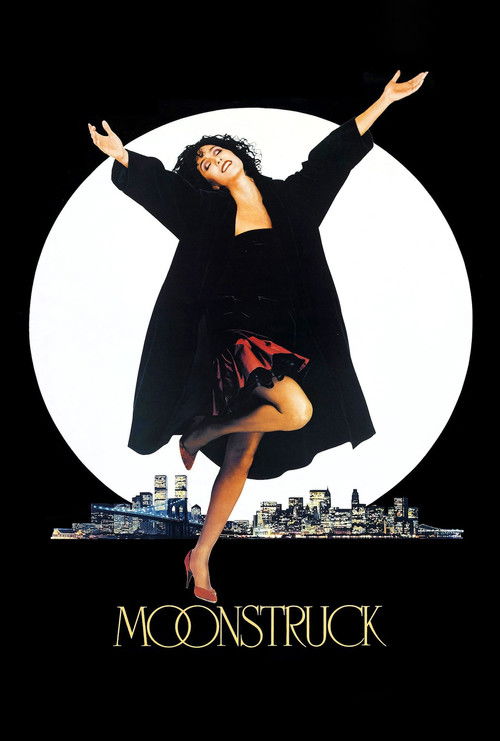
Set in a snow-dusted Brooklyn Heights during a luminous winter week, Moonstruck follows 37-year-old widow Loretta Castorini, a pragmatic bookkeeper who has become deeply superstitious after her first husband was killed by a bus. When her boyfriend Johnny Cammareri proposes, she accepts not out of passion but because she believes it is time to do things the proper way. But Johnny must rush to Sicily because his mother is dying, and he asks Loretta to personally invite his estranged brother Ronny to the wedding.
Loretta finds Ronny working in a bakery, a man consumed by bitterness and rage. He lost his hand in a bread-slicing machine accident, an event he blames entirely on Johnny. Despite her intentions to simply deliver the invitation, Loretta is pulled into Ronny's orbit. He is everything Johnny is not: volatile, emotional, and intensely passionate. Their encounter sets off a chain of romantic complications that extend beyond their own situation, affecting Loretta's parents and the entire Castorini family.
Directed by Norman Jewison and written by John Patrick Shanley, who based the script on his own Italian-American upbringing, the film earned three Academy Awards, including Best Actress for Cher and Best Supporting Actress for Olympia Dukakis. With its operatic score by Dick Hyman and a memorable turn by Nicolas Cage, Moonstruck became a cultural touchstone, celebrated for its unsentimental yet warm-hearted take on love and family.
Stream
Max
Hulu
Rent
Availability and pricing can change. Confirm on the provider's site before purchasing.
Loretta Castorini, a 37-year-old widow, lives with her parents and grandfather in a Brooklyn Heights brownstone. She works as a bookkeeper and has become deeply superstitious after her first husband was hit by a bus. When her boyfriend Johnny Cammareri, a sweet but childish man, proposes, she accepts not out of love but because she believes it is time. She insists on doing everything the proper way this time, including a formal wedding.
Immediately after the proposal, Johnny receives word that his mother is dying in Sicily and must leave that night. Before departing, he makes Loretta promise to personally invite his estranged younger brother Ronny to the wedding. Ronny, who works as a baker, has not spoken to Johnny in five years. When Loretta tracks him down at his bakery, she discovers a man consumed by rage. Ronny reveals that he lost his hand in a bread-slicing machine accident, which he blames entirely on Johnny. Since the accident, his fiancée left him, and he has been living a bitter, isolated existence.
Despite her intentions to simply deliver the invitation, Loretta finds herself drawn to Ronny. He is passionate, volatile, and unapologetically intense. After a dramatic confrontation, the two end up spending the night together, setting off a chain of romantic complications. Ronny insists that love is messy and destructive, that people are not meant to be perfect but to ruin themselves and break their hearts. He persuades Loretta to accompany him to the opera, Puccini's La Bohème at the Metropolitan Opera, where she undergoes a profound emotional awakening.
Meanwhile, Loretta's mother Rose suspects her husband Cosmo is having an affair. Rose begins questioning the nature of love and fidelity, leading her to a chance encounter with a college professor named Perry, who regularly gets drinks thrown in his face by much younger women. Cosmo is indeed seeing a woman named Mona on the side, though he remains devoted to his family in his own way. Loretta's grandfather wanders through the household with his five small dogs, offering cryptic observations about love and the moon.
The central conflict builds as Loretta tries to navigate her growing feelings for Ronny while maintaining her engagement to Johnny, who is expected back from Sicily soon. The story builds toward a climactic morning when Johnny returns, and all the characters must confront their secrets and choices around the Castorini family breakfast table.
Official Trailer
Critical Consensus
Moonstruck is a great big beautiful valentine of a movie, an intoxicating romantic comedy that balances operatic passion with earthy family comedy. Cher and Nicolas Cage generate extraordinary chemistry, while John Patrick Shanley's witty, heartfelt script and Norman Jewison's direction create a timeless love story that feels both magical and deeply human.
“Moonstruck is a great big beautiful valentine of a movie, an intoxicating romantic comedy set beneath the biggest, brightest Christmas moon you ever saw.”
Rita Kempley
The Washington Post
“The movie is a valentine, but it's also a smart, funny, and surprisingly touching look at love and marriage in an extended Italian-American family.”
Roger Ebert
Chicago Sun-Times
“The charm of this ending is its suggestion that, for any work of fiction to feel like life, it must admit that some things simply happen. 'Love,' as one character reminds another, 'is merely a madness.'”
The New Yorker
The New Yorker
“Cher gives her best performance to date, finding both humor and pathos in a woman who thinks she knows what she wants until passion intervenes.”
Variety
Variety
“Norman Jewison has crafted a romantic comedy that actually earns its emotions, with Shanley's dialogue crackling with wit and unexpected depth.”
The Hollywood Reporter
The Hollywood Reporter
Cher
Loretta Castorini
Nicolas Cage
Ronny Cammareri
Vincent Gardenia
Cosmo Castorini
Olympia Dukakis
Rose Castorini
Danny Aiello
Mr. Johnny Cammareri
Julie Bovasso
Rita Cappomaggi
John Mahoney
Perry
Louis Guss
Raymond Capomaggi
Feodor Chaliapin Jr.
Old Man (Grandfather)
Anita Gillette
Mona
Leonardo Cimino
Felix
Paula Trueman
Lucy
Director
Norman Jewison
Writer
John Patrick Shanley
Composer
Dick Hyman
Cinematographer
David Watkin
Producers
Patrick J. Palmer, Norman Jewison
Academy Award for Best Actress (1988)
Best Actress: Won
Academy Award for Best Supporting Actress (1988)
Best Supporting Actress: Won
Academy Award for Best Original Screenplay (1988)
Best Original Screenplay: Won
Academy Award for Best Picture (1988)
Best Picture: Nominated
Academy Award for Best Supporting Actor (1988)
Best Supporting Actor: Nominated
Academy Award for Best Director (1988)
Best Director: Nominated
Golden Globe for Best Actress in a Motion Picture – Musical or Comedy (1988)
Best Actress – Musical or Comedy: Won
Golden Globe for Best Motion Picture – Musical or Comedy (1988)
Best Motion Picture – Musical or Comedy: Nominated
Golden Globe for Best Supporting Actress (1988)
Best Supporting Actress: Nominated
Golden Globe for Best Supporting Actor (1988)
Best Supporting Actor: Nominated
Writers Guild of America Award for Best Screenplay Written Directly for the Screen (1988)
Best Screenplay: Won
Join the community
fans discussing