“A dazzling piece of science fiction that manages to be both intellectually stimulating and viscerally exciting.”
Roger Ebert
Chicago Sun-Times
 United States
"Everybody runs."
User Score
850000 votes
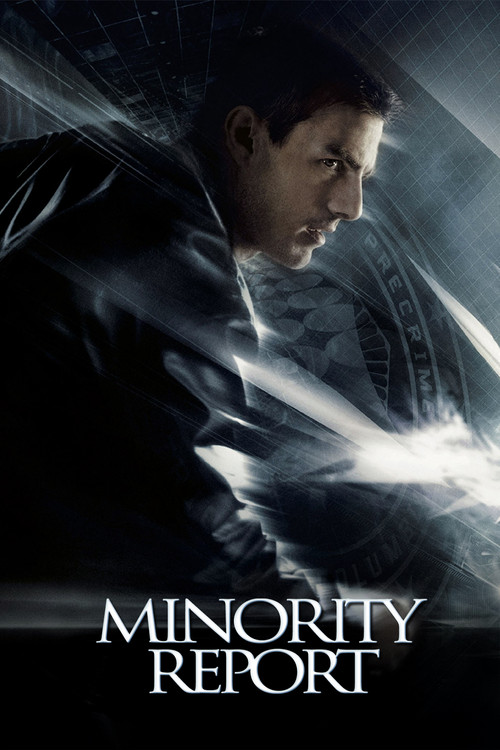
Set in Washington D.C. during the year 2054, this film explores a society where crime has been virtually eliminated through a program called Precrime. Chief John Anderton leads an elite unit that uses three psychic beings to predict murders before they happen. The system boasts a perfect record of zero false positives for six years, earning Anderton immense public adoration and political protection from Director Lamar Burgess.
The narrative shifts when Anderton receives a vision of his own future committing a murder he has not planned. Accused of a crime he hasn't committed, he is forced to go on the run while evading his former colleagues. As he flees through high-tech streets, he begins to suspect that Precrime is not as infallible as it claims.
Availability and pricing can change. Confirm on the provider's site before purchasing.
In the year 2054, Washington D.C. operates under the Precrime initiative, a police department led by Chief John Anderton that arrests individuals for murders they have not yet committed. The system relies on three PreCogs named Agatha, Arthur, and Artemis, who exist in suspended animation within a dark facility. These psychic beings provide visions of future crimes, allowing police to intervene and save victims. Under Anderton's leadership, the program maintains a flawless record with no false positives since its inception six years prior. This success has made Anderton a celebrated figure, protected politically by Director Lamar Burgess.
Everything changes when Anderton sees a vision of himself strangling a man named Leo Crow. He has no memory of planning this act, nor does he intend to commit it. The hunter becomes the hunted as the Precrime team turns against him. His former protégé, Danny Witwer, arrives to arrest him, forcing Anderton into a desperate flight across the city. He utilizes advanced technology like gesture-controlled interfaces and flying vehicles to evade capture while trying to understand how the system could possibly be wrong about him.
Anderton seeks out Dr. Iris Hineman, a retired scientist who helped develop the original precognition technology, and her estranged husband Solomon Eddie. They explain the concept of a minority report, a rare instance where the PreCogs disagree on a prediction. The Oracle computer usually suppresses these dissenting views to maintain the illusion of certainty. As Anderton investigates, he uncovers personal connections to the case; the victim in his vision, Leo Crow, was the father of a child whose disappearance years ago drove Anderton to create Precrime in the first place.
The investigation reveals a deep conspiracy involving the very foundations of the Precrime program. Someone within the hierarchy is manipulating the PreCogs' visions to eliminate threats to the system's existence. Anderton races against time to prove his innocence and expose the corruption before the predicted time of his death arrives. The story builds tension through intense chases and psychological games between Anderton and Witwer, exploring the moral dilemma of whether free will can exist in a world where the future appears already written.
As the predicted moment approaches, Anderton realizes that the system is not infallible. He discovers that the PreCogs are kept in a state of suspended animation, their visions fed into a massive computer system. The more he digs, the clearer it becomes that the predictions are being manipulated to serve specific agendas. The narrative culminates in a race to the exact location and time of the predicted murder, forcing Anderton to confront the possibility that his fate is sealed unless he can find the truth hidden within the cracks of the system.
Official Trailer
Teaser Trailer
Behind the Scenes
Critical Consensus
The film blends complex philosophical questions about free will with breathtaking visual spectacle. Spielberg delivers a tightly wound narrative anchored by Tom Cruise's performance, creating a dystopian world that feels both terrifyingly plausible and visually stunning. Its exploration of surveillance and determinism remains relevant.
“A dazzling piece of science fiction that manages to be both intellectually stimulating and viscerally exciting.”
Roger Ebert
Chicago Sun-Times
“Spielberg has crafted a film that is not only a thrilling mystery but also a profound meditation on the nature of free will.”
A.O. Scott
The New York Times
“A triumph of imagination and technical skill, with a story that keeps you guessing until the very last frame.”
Peter Travers
Rolling Stone
“Visually arresting and narratively sophisticated, Minority Report is a rare example of a blockbuster that respects its audience's intelligence.”
Todd McCarthy
Variety
“A sleek, stylish, and deeply thought-provoking thriller that showcases Spielberg at the top of his game.”
Owen Gleiberman
Entertainment Weekly
Tom Cruise
Chief John Anderton
Colin Farrell
Danny Witwer
Samantha Morton
Agatha
Max von Sydow
Director Lamar Burgess
Lois Smith
Dr. Iris Hineman
Peter Stormare
Dr. Solomon Eddie
Tim Blake Nelson
Gideon
Steve Harris
Jad
Kathryn Morris
Lara Clarke
Mike Binder
Leo Crow
Director
Steven Spielberg
Writers
Scott Frank, Jon Cohen
Composer
John Williams
Cinematographer
Janusz Kamiński
Producers
Jan de Bont, Walter F. Parkes, Gerald R. Molen, Bonnie Curtis
Academy Awards (2003)
Best Sound Editing: Nominated
Academy Awards (2003)
Best Sound Mixing: Nominated
BAFTA Awards (2003)
Best Achievement in Special Visual Effects: Nominated
Saturn Awards (2003)
Best Science Fiction Film: Won
Saturn Awards (2003)
Best Director: Won
Saturn Awards (2003)
Best Supporting Actress: Won
Hugo Awards (2003)
Best Dramatic Presentation: Nominated
Visual Effects Society Awards (2003)
Outstanding Visual Effects in a Motion Picture: Won
Join the community
fans discussing