“A plodding Korean martial-arts romance that substitutes melodrama for momentum, 'Memories of the Sword' is a handsome but heavy-footed period piece.”
Maggie Lee
Variety
 South Korea
"Three swords, one fate, and a debt paid in blood."
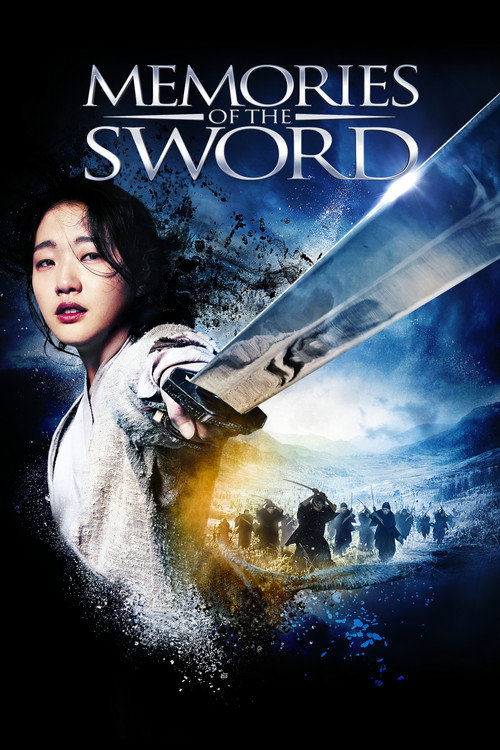
Set in the waning years of the Goryeo Dynasty, this South Korean historical action drama centers on a young woman's quest for vengeance after her mother is betrayed and killed. Directed by Park Heung-sik, the film stars Kim Go-eun as Hong-yi, a spirited swordsman-in-training, alongside Lee Byung-hun as Yu-baek, the powerful warrior responsible for her mother's downfall, and Jeon Do-yeon as Sul-rang, a skilled fighter with her own complicated past. Bae Soo-bin appears as Poong-chun, a loyal ally, and Lee Jun-ho as Yull, adding depth to the tangled web of loyalties.
Produced by Lotte Entertainment and TPS Company, with cinematography by Kim Byung-seo and a score by Mowg, the film combines gritty swordplay with a somber, rain-soaked atmosphere. Released on August 13, 2015, it runs just over two hours and carries a grim, dreary tone that sets it apart from more flamboyant martial arts epics. While it didn't break box office records, it earned a modest 6.6 rating from user votes, reflecting a mixed reception that praised performances but critiqued pacing. Park Heung-sik, known for character-driven dramas, brings a melancholic weight to the revenge narrative, making it a somber entry in the genre rather than a crowd-pleasing actioner.
Availability and pricing can change. Confirm on the provider's site before purchasing.
During the late Goryeo Dynasty, three legendary warriors, Yu-baek, Sul-rang, and Poong-chun, fight side by side in a rebellion against a corrupt monarchy. Their shared dream is to overthrow the tyrants and bring justice to the common people. But their noble cause shatters when Yu-baek, driven by ambition and self-preservation, betrays his comrades. Poong-chun is killed, and Sul-rang is presumed dead. Yu-baek ascends to immense power, becoming one of the kingdom's most feared warriors.
Years later, the story shifts to Hong-yi, a spirited young woman raised in isolation by her blind adopted mother, Seol-rang, who is actually Sul-rang, having survived the betrayal and gone into hiding. Sul-rang has spent years training Hong-yi in swordsmanship with a single purpose: to avenge the death of Hong-yi's biological father, Poong-chun, and bring down Yu-baek. Hong-yi grows up believing her mission is righteous, honed into a fierce fighter despite her youth. She is also aided by Poong-chun, who survived the initial massacre and now operates in the shadows, watching over her from afar.
The central conflict ignites when Hong-yi, disguised as a boy, enters a high-stakes swordfighting competition, a bold move that draws the attention of Yu-baek himself. This encounter sets off a chain of events that forces all the surviving characters to confront their pasts. Yu-baek, now a powerful and conflicted figure, recognizes something familiar in the young fighter, while Sul-rang struggles with her own guilt, secrets, and the weight of the lies she has told her adopted daughter. The narrative weaves between past and present, revealing the deep bonds of loyalty, love, and betrayal that connected the three original warriors. As Hong-yi presses forward on her quest for vengeance, she begins to uncover uncomfortable truths about her heritage, her mother's choices, and the complicated moral gray areas of the conflict she has inherited.
The film's tone is grim, rain-soaked, and melancholic, distinguishing it from more flamboyant martial arts epics. It is less concerned with spectacular fight choreography than with the emotional and psychological toll of revenge. The story builds toward a confrontation between Hong-yi and Yu-baek, but along the way, it explores themes of forgiveness, the cyclical nature of violence, and whether the sins of the past can ever truly be washed away. The film runs approximately 120 minutes and carries a somber, dreary atmosphere that reflects the moral complexity of its characters.
MEMORIES OF THE SWORD Main Trailer
Critical Consensus
Reviews for Memories of the Sword were mixed to negative, with critics praising the film's visual craftsmanship and the performances of its lead actors, particularly Jeon Do-yeon, but criticizing its convoluted plot, uneven pacing, and melodramatic tone. The film was seen as a visually stunning but narratively muddled entry in the Korean period action genre, lacking the kinetic energy of its contemporaries.
“A plodding Korean martial-arts romance that substitutes melodrama for momentum, 'Memories of the Sword' is a handsome but heavy-footed period piece.”
Maggie Lee
Variety
“Depicting a complicated tale of violent retribution set in the Goryeo era some thousand years ago, 'Memories of the Sword' is a visually stunning but dramatically diffuse work.”
Clarence Tsui
The Hollywood Reporter
“Set in the late Goryeo dynasty, the film initially follows an energetic and confident girl named Hong-Yi who has learned swordplay, but the narrative becomes increasingly tangled as secrets are revealed.”
ScreenDaily (unnamed)
ScreenDaily
“Costume dramas have been a hot ticket at the Korean box office ever since Lee Byung-hun lit the charts on fire with 'Masquerade' in 2012, but this one lacks the verve and clarity of its predecessors.”
Time Out (unnamed)
Time Out
Director
Park Heung-sik
Writers
Park Heung-sik, Choi Ah-reum
Composer
Mowg
Cinematographer
Kim Byung-seo
Producers
Lee Dae-hee, Kim Hyeon-cheol
Join the community
fans discussing