“Lynch has created a film that is a puzzle, but the pieces don't fit together in any logical way. It's a nightmare, and it's beautiful.”
Roger Ebert
Chicago Sun-Times
 United States
"A lost road on the edge of strange..."
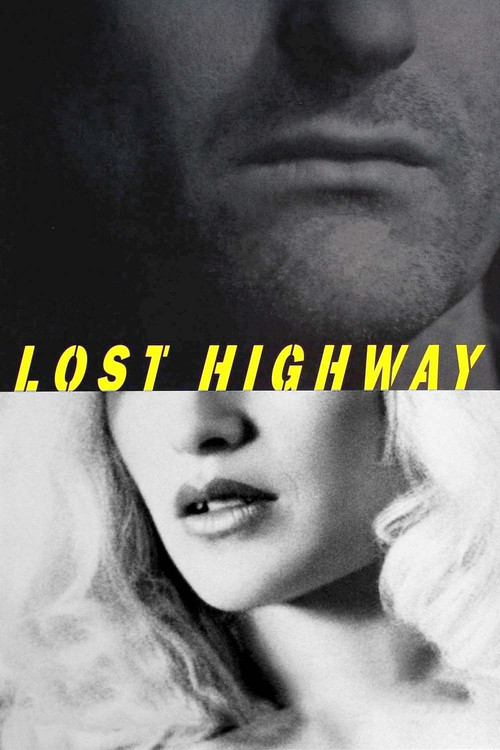
David Lynch returned to the edge of sanity in 1997 with Lost Highway, a film that traded traditional storytelling for a fever dream of jealousy and fractured identity. The $15 million production stars Bill Pullman as Fred Madison, a jazz saxophonist whose domestic life collapses after mysterious videotapes begin appearing on his television set. These recordings show footage of their own home filmed from inside the walls, suggesting an invisible voyeur watching their every move.
The narrative fractures further when Fred is arrested for murdering his wife Renee, played by Patricia Arquette. Before his execution can take place, he wakes up as Pete Dayton, a young car mechanic living a completely different life with a new girlfriend named Alice Wakefield. This second half of the film blurs the line between reality and hallucination as Pete navigates a surreal underworld of gangsters and enigmatic figures while struggling to reconcile his past crimes with his current innocence.
Availability and pricing can change. Confirm on the provider's site before purchasing.
Fred Madison lives in Los Angeles with his wife Renee, and their marriage is already strained by his growing paranoia and suspicion of infidelity. The tension spikes when Dick Laurent, a powerful gangster who recently returned to the city, becomes the focus of Fred's jealousy. Their quiet life shatters when they start receiving VHS tapes showing their home interior, captured by someone hiding within the walls. The footage includes intimate moments between Fred and Renee, creating a sense of violation that drives Fred further into erratic behavior.
Fred begins hearing strange noises and seeing shadowy figures throughout the house. One night, he encounters the Mystery Man, a man in a black suit with a white face who speaks in riddles about the nature of existence. The situation escalates when Fred discovers what appears to be proof of Renee's affair with Dick Laurent. In a fit of rage and confusion, Fred attacks Renee, leading to her death and his subsequent arrest. He is sentenced to death row, awaiting execution in a cold prison cell.
Before the execution takes place, Fred undergoes a bizarre metamorphosis. He wakes up not as himself but as Pete Dayton, a young car mechanic living in a new house with a new identity. Pete has a girlfriend named Alice Wakefield, who bears a striking resemblance to Renee and seems to know things about him that he shouldn't. As Pete tries to navigate this new existence, he finds himself entangled with Dick Laurent again, this time as a target rather than a rival.
The narrative shifts through a labyrinth of neon-lit streets, seedy motels, and underground clubs. Pete experiences flashbacks and memories that don't belong to him, forcing him to question whether he is truly Pete or still Fred trapped in a delusion. The story follows his attempts to understand his new identity while being pursued by the same gangsters and the enigmatic Mystery Man who seemed to orchestrate his transformation.
Surreal imagery dominates the experience, featuring distorted soundscapes, impossible geography, and characters who shift roles without explanation. The central conflict revolves around the nature of identity and the terrifying possibility that one's life might be a construct of another's nightmare. Pete's journey takes him deeper into a world where memory is unreliable and reality is fluid. The audience watches as the lines between Fred and Pete blur, leaving them to question what is real and what is a fabrication of a fractured mind.
The story builds toward its conclusion with a series of events that challenge the very fabric of the film's reality. Pete faces choices that seem to have no logical connection to his previous life, yet the emotional weight of those choices feels undeniable. The narrative structure itself becomes a character, refusing to offer easy answers or clear resolutions. Viewers are left to piece together the puzzle of two men who may be one person, separated by a highway that leads nowhere.
As the mystery deepens, the film explores themes of guilt, redemption, and the impossibility of escaping one's true nature. The surreal elements serve not just as visual flair but as manifestations of psychological trauma. Every scene adds layers to the understanding of what happened to Fred and why he became Pete. The audience must decide whether to accept the surface narrative or dig deeper into the subconscious motivations driving these transformations.
U.S. Re-Release Trailer
Lost Highway (Trailer)
Critical Consensus
Lost Highway stands as a visually stunning descent into the subconscious, showcasing David Lynch at his most surreal and uncompromising. Its fragmented narrative and ambiguous themes may alienate some viewers, yet its bold artistic vision and haunting performances make it a landmark of modern cinema. The film challenges audiences to engage with its mysteries on a deeper level.
“Lynch has created a film that is a puzzle, but the pieces don't fit together in any logical way. It's a nightmare, and it's beautiful.”
Roger Ebert
Chicago Sun-Times
“A dazzlingly strange and sometimes infuriating work, Lost Highway is a movie that demands to be experienced rather than understood.”
Janet Maslin
The New York Times
“Lynch has made a film that is both a masterpiece and a mess, a work of art that is as confusing as it is captivating.”
Peter Travers
Rolling Stone
“Lost Highway is a film that defies easy categorization, a work that is at once a thriller, a horror film, and a meditation on the nature of identity.”
Kenneth Turan
Los Angeles Times
“Lynch's latest is a film that is as much a visual poem as it is a narrative, a work that challenges the viewer to engage with its mysteries on a deeper level.”
A.O. Scott
The New York Times
Bill Pullman
Fred Madison / Pete Dayton
Patricia Arquette
Renee Madison / Alice Wakefield
Balthazar Getty
Pete Dayton
Robert Blake
The Mystery Man
Robert Loggia
Mr. Eddy / Dick Laurent
Michael Massee
Andy
Natasha Gregson Wagner
Sheila
Richard Pryor
Arnie
Gary Busey
Bill Dayton
Lucy Butler
Candace Dayton
Director
David Lynch
Writers
Barry Gifford, David Lynch
Composer
Angelo Badalamenti
Cinematographer
Peter Deming
Producers
Deepak Nayar, Mary Sweeney, Tom Sternberg
Cannes Film Festival (1997)
Palme d'Or: Nominated
Saturn Awards (1998)
Best Horror Film: Nominated
BAFTA Awards (1998)
Best Cinematography: Nominated
Independent Spirit Awards (1998)
Best Foreign Film: Won
National Society of Film Critics Awards (1997)
Best Cinematography: Won
Join the community
fans discussing