“It is a film that mistakes verbosity for profundity and intellectual debate for dramatic tension, ultimately leaving the viewer more confused than enlightened.”
A.O. Scott
The New York Times
 United States
"If you don't STAND for something, you might FALL for anything."
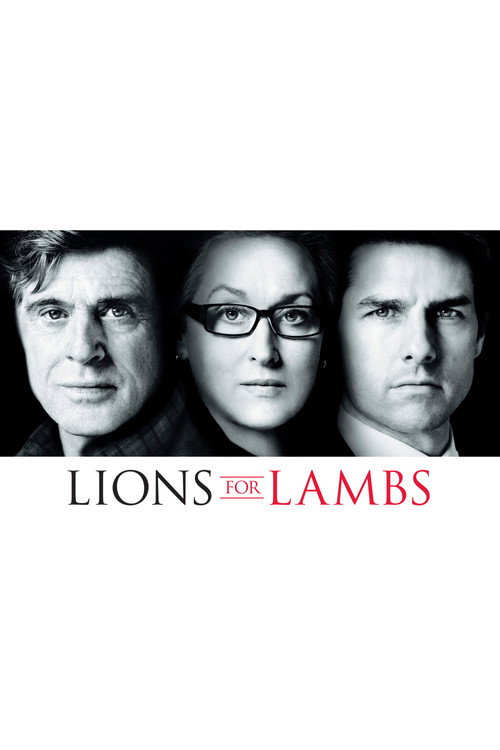
Robert Redford directs Lions for Lambs, a tightly wound political drama that unfolds in real time over ninety minutes. The film weaves together three distinct narratives set against the backdrop of the war on terror, moving between a high-stakes interview, a battlefield ambush, and a university classroom. Meryl Streep plays an idealistic professor trying to rekindle her student's passion, while Tom Cruise portrays a senator crafting a new strategy for Afghanistan.
The story operates as a theater of ideas, focusing on dialogue and ideological confrontation rather than traditional action sequences. Robert Redford steps in as the history professor at the center of the first story, with Andrew Garfield and Michael Peña rounding out the key cast. The production utilized soundstages for many interior scenes to maintain the claustrophobic feel of simultaneous events occurring across different locations.
Availability and pricing can change. Confirm on the provider's site before purchasing.
In a Washington D.C. office building, Senator Jasper Irving sits down for an interview with Janine Roth, a journalist for The New York Times. The senator argues that the war in Afghanistan is necessary to prevent terrorism and claims progress is being made despite high costs. Janine challenges his assertions, pressing him on the morality of the conflict and whether the sacrifice of soldiers is justified by potential benefits. Their conversation reveals a deep disconnect between political rhetoric and battlefield reality, with Irving becoming increasingly defensive as Janine exposes flaws in his logic. This segment highlights the struggle to find clear objectives in a complex geopolitical landscape.
Simultaneously, Dr. Stephen Malley attempts to rekindle the passion of his student, Arian Finch, who has become disillusioned with his education and the world. Malley, a retired history professor who served in Vietnam, tries to convince Arian that individual actions can have a profound impact on the future. The tension lies in Malley's desperate attempt to inspire a young man who feels powerless, contrasting the professor's belief in civic duty with the student's apathy. This storyline serves as a microcosm for the broader theme of generational responsibility and the struggle to find meaning in a chaotic world.
The third narrative shifts to the rugged mountains of Afghanistan, where two Army Rangers, Todd Hayes and Ernest Rodriguez, are part of a platoon led by Sergeant Wirey Pink. They are on a mission to retrieve a wounded soldier after their position is ambushed by Taliban forces. The situation quickly deteriorates into a desperate fight for survival as the soldiers face impossible choices: stay and die protecting their fallen comrades or retreat and leave them behind. The narrative focuses on the camaraderie between Todd and Ernest, their fear, and the brutal reality of modern warfare, which stands in stark contrast to the sterile debates happening back in Washington.
As the film progresses, these three threads intersect thematically rather than literally. The decisions made by the Senator in his office directly influence the fate of the soldiers in the field, while the Professor's lecture mirrors the internal struggle of the young soldier facing death. The central conflict is not just man versus man but the clash between abstract political strategies, personal ideals, and the visceral violence of war. The movie builds tension through escalating stakes in each timeline, leaving the audience to ponder the true cost of the war and the responsibility of those in power.
Official Trailer
Critical Consensus
Despite boasting an ensemble cast of Hollywood heavyweights, Lions for Lambs struggles to translate its ambitious political themes into a compelling narrative. Critics found the film to be overly didactic, resembling a series of disconnected lectures rather than a cohesive drama. While the performances are praised, the script's reliance on exposition and lack of emotional depth prevent the movie from achieving its intended impact, resulting in a disjointed experience that fails to engage audiences beyond its star power.
“It is a film that mistakes verbosity for profundity and intellectual debate for dramatic tension, ultimately leaving the viewer more confused than enlightened.”
A.O. Scott
The New York Times
“The movie is a failure of imagination. It tries to be a serious political drama but ends up being a pretentious exercise in self-congratulation.”
Roger Ebert
Chicago Sun-Times
“While the acting is top-notch, the screenplay is too talky and lacks the visual dynamism needed to sustain such a short runtime, making it feel like a staged reading.”
Todd McCarthy
Variety
“Redford and his stars are wasted on a script that feels like a lecture hall seminar gone wrong, lacking the heart and soul of a true war drama.”
Peter Travers
Rolling Stone
“The film's attempt to weave three stories together results in a fragmented narrative that never quite finds its footing, leaving the audience frustrated by its missed opportunities.”
Manohla Dargis
The New York Times
Director
Robert Redford
Writer
Matthew Michael Carnahan
Composer
Mark Isham
Cinematographer
Philippe Rousselot
Producers
Matthew Michael Carnahan, Tracy Falco, Andrew Hauptman, Robert Redford
Screen Actors Guild Awards (2008)
Outstanding Performance by a Cast in a Motion Picture: Nominated
Critics' Choice Movie Awards (2008)
Best Acting Ensemble: Nominated
Independent Spirit Awards (2008)
Best Supporting Male: Nominated
Satellite Awards (2008)
Best Original Screenplay: Nominated
Satellite Awards (2008)
Best Actor – Motion Picture Drama: Nominated
Join the community
fans discussing