 Spain
Spain“Almodóvar's films are like dreams... They are full of color and noise, but they also have a deep, underlying sadness that comes from the characters' inability to connect.”
Roger Ebert
Chicago Sun-Times
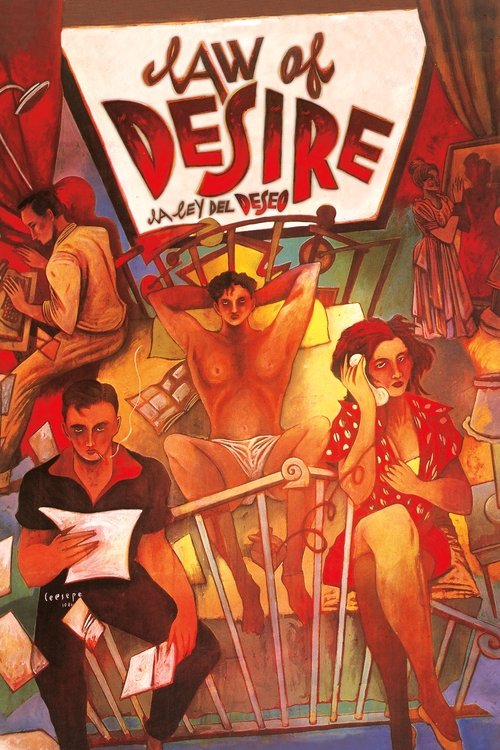
Pedro Almodóvar's Law of Desire launches in 1987 as a bold exploration of desire, identity, and the messy lines between art and life. The story centers on Pablo Quintero, played by Eusebio Poncela, a gay film director navigating a fractured relationship with his younger lover, Juan Bermúdez, portrayed by Miguel Molina. When their bond sours, Pablo turns his attention to a new project: a monologue written for his transgender sister, Tina, brought to life by Carmen Maura. The narrative takes a sharp turn when Antonio Benítez, an uptight young man played by Antonio Banderas, becomes obsessively infatuated with Pablo. His possessive love drives him toward dangerous extremes that threaten to unravel everything around him.
Produced on a modest budget of $600,000, the film grossed approximately $1.4 million at the box office, proving its commercial viability despite its controversial themes. Rated NC-17, the movie blends drama, romance, thriller elements, and dark comedy into a distinctively Spanish experience set against the backdrop of Madrid. With a runtime of just over an hour and forty minutes, the film moves quickly through its complex web of relationships. Critics and audiences have responded positively, giving it a solid 7.1 out of 10 rating based on hundreds of votes. This entry stands as a key chapter in Almodóvar's early career, showcasing his signature style before he gained wider international fame.
Availability and pricing can change. Confirm on the provider's site before purchasing.
The year is 1987 in Madrid, where filmmaker Pablo Quintero finds himself stuck in a creative rut while his personal life spirals out of control. He lives with Juan Bermúdez, a handsome but naive model he met through a classified ad. Their relationship has lost its spark; Juan feels neglected by Pablo's workaholic tendencies, while Pablo struggles to articulate his feelings or commit to a future with someone who seems so dependent on him. Tensions rise when Juan grows jealous of Pablo's interactions with others and begins to act possessive. Pablo tries to keep the peace by encouraging Juan to stay close, hoping to salvage their connection or perhaps mine the drama for his next script, but the situation only becomes more volatile.
Parallel to this romantic decay is Pablo's intense bond with his sister Tina, a transgender actress who plays a central role in his emotional world. Tina is preparing to perform a monologue titled The Tragedy of a Transsexual, which Pablo wrote specifically for her. Their history is steeped in shared trauma from their childhood and years of societal rejection, forging a loyalty that borders on the codependent. Tina is the only person Pablo trusts implicitly, serving as his anchor amidst the chaos of his career and relationships. She navigates her own past involving prostitution and acting roles that mirror her real life, finding strength in her brother's unwavering support.
The dynamic shifts dramatically with the arrival of Antonio Benítez, a police officer who works in a nearby precinct. Antonio sees Pablo on television and becomes instantly consumed by an obsessive fixation. Unlike Juan, whose affection was rooted in a desire for companionship, Antonio's feelings are driven by a pathological need to control and possess. He begins stalking Pablo, invading his privacy and making increasingly erratic appearances. His behavior escalates from awkward attempts at conversation to outright intimidation, creating a palpable sense of dread that permeates the atmosphere of the film.
As the summer progresses, these intersecting lives collide in a web of betrayal and longing. Pablo finds himself torn between his fading love for Juan, his protective instincts toward Tina, and the terrifying advances of Antonio. The vibrant, chaotic streets of 1980s Madrid provide a colorful backdrop to a story that masks a darker, more tragic undercurrent. The film weaves together themes of sexual fluidity, familial duty, and the destructive nature of unchecked desire. Each character pursues their own version of happiness, unaware that their actions are leading them toward a devastating climax where the consequences of their entangled relationships will finally come to a head.
The narrative builds tension through a series of confrontations and near-misses. Juan's jealousy boils over into violence, while Antonio's obsession pushes him further into the shadows. Pablo attempts to maintain order in his life, writing scripts and directing scenes that blur the line between fiction and reality. The audience watches as the characters' desires lead them down paths they cannot return from, setting the stage for a resolution that challenges the very nature of love and sacrifice. The film keeps viewers guessing about who will survive the storm and what price they will pay for their passions.
Almodóvar's LA LEY DEL DESEO / Law of Desire - HD Trailer
Critical Consensus
Critics praise Law of Desire for its audacious storytelling, vibrant visual style, and powerful performances. It is celebrated as a defining work of Almodóvar's early career, blending dark comedy, thriller elements, and melodrama into a unique cinematic experience that explores the complexities of human desire and identity.
“Almodóvar's films are like dreams... They are full of color and noise, but they also have a deep, underlying sadness that comes from the characters' inability to connect.”
Roger Ebert
Chicago Sun-Times
“A dazzling, disturbing, and ultimately tragic masterpiece that showcases Almodóvar's unique vision and the incredible talent of his cast.”
Variety Staff
Variety
“Almodóvar's most mature and complex film to date, a wild ride through the corridors of desire that is both hilarious and heartbreaking.”
Peter Bradshaw
The Guardian
Eusebio Poncela
Pablo Quintero
Carmen Maura
Tina Quintero
Antonio Banderas
Antonio Benítez
Miguel Molina
Juan Bermúdez
Fernando Guillén
Detective
Manuela Velasco
Ada
Director
Pedro Almodóvar
Writer
Pedro Almodóvar
Composer
Alberto Iglesias
Cinematographer
Ángel Luis Fernández
Producer
Agustín Almodóvar
San Sebastián International Film Festival (1987)
Best Director: Won
San Sebastián International Film Festival (1987)
Best Actor: Won
San Sebastián International Film Festival (1987)
Best Screenplay: Won
Goya Awards (1988)
Best Original Screenplay: Nominated
Goya Awards (1988)
Best Supporting Actress: Nominated
Cannes Film Festival (1988)
Palme d'Or: Nominated
Los Angeles Film Critics Association Awards (1988)
Best Foreign Language Film: Won
National Society of Film Critics Awards (1988)
Best Foreign Language Film: Won
Join the community
fans discussing