“L.A. Confidential is a movie that respects its audience, offering a complex narrative that rewards close attention and rewards the viewer with a satisfying conclusion.”
Roger Ebert
Chicago Sun-Times
 United States
"Everything is suspect... Everyone is for sale... And nothing is what it seems."
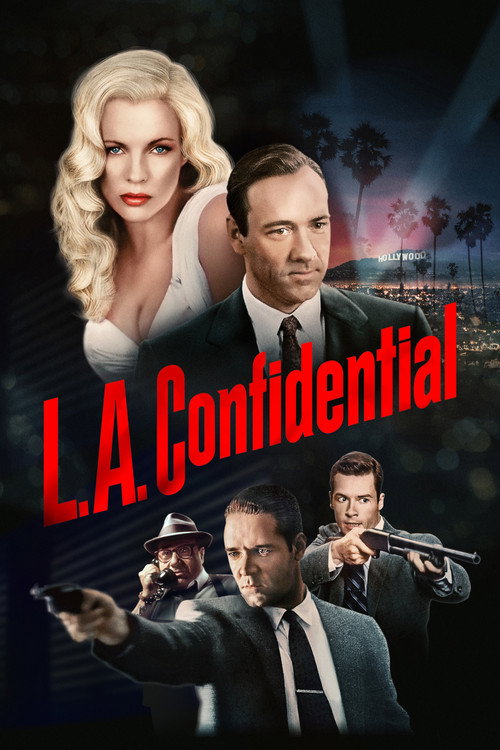
Three cops, three very different ideas about what the badge means, and one massacre at a coffee shop called the Nite Owl. Curtis Hanson's 1997 adaptation of James Ellroy's novel takes the bones of a whodunit and uses them to pry open 1950s Los Angeles, a city selling sunshine on the surface while running heroin underneath. The film opened on September 19, 1997, and arrived at the tail end of a decade that had already produced its share of neo-noir revivals. What set it apart was the density: nearly every scene plants something that pays off two reels later.
The casting raised eyebrows at the time. Russell Crowe and Guy Pearce were basically unknown to American audiences, and Hanson fought Warner Bros. to keep them, reportedly threatening to walk if either was replaced. Kim Basinger took a pay cut to play Lynn Bracken, the Veronica Lake lookalike at the center of a vice operation run by Pierce Patchett. The gamble worked. Basinger won the Academy Award for Best Supporting Actress, and Hanson and Brian Helgeland took Best Adapted Screenplay. The film was nominated for nine Oscars total, losing Best Picture to Titanic in the same ceremony where it won two.
What holds up on repeat viewing is the texture. Dante Spinotti's cinematography makes the Los Angeles of the film feel lit from below, and Jerry Goldsmith's score leans on muted brass instead of the saxophone cliché. The screenplay compresses Ellroy's sprawling novel, cutting whole subplots and characters, yet the thing still runs two hours and eighteen minutes and never drags. It is the rare prestige crime film where the mystery and the character study carry equal weight.
Availability and pricing can change. Confirm on the provider's site before purchasing.
A man named Buzz Meeks walks into a diner on Christmas Eve 1951 and gets his face pushed into a griddle. That is the first thing we see, and it sets a tone the film never lets go of. Two years later, on a night in 1953, a shotgun blast tears through the Nite Owl coffee shop on South Normandie. Six people are dead, including a former cop named Dick Stensland. The LAPD wants a simple story: a robbery gone wrong, maybe a Negro suspect, case closed by morning. Three officers are about to make that impossible.
Ed Exley is the first. A teetotaling, bespectacled detective who testifies against fellow officers in exchange for a promotion, he is despised by the rank and file and knows it. His father was a legendary LAPD captain, and Ed has spent his career trying to earn that name through procedure rather than violence. He gets his promotion to Detective Lieutenant, and with it a directive from Captain Dudley Smith: find the Nite Owl killers quietly, and do not embarrass the department. Ed sees a path to something bigger. He cuts a side deal with District Attorney Ellis Loew, who wants ammunition against Smith's power base.
Bud White is the second. A hulking enforcer who once yanked a wife-beater out of a window by his ankles, Bud works the kind of cases the department prefers handled off the books. His rage comes from somewhere specific: as a boy, he watched his father beat his mother to death. When he catches a domestic disturbance call, he does not arrest the husband. He beats him. That instinct lands him in the middle of the Nite Owl investigation after he recognizes Stensland's body and starts pulling threads nobody asked him to pull. His path crosses Lynn Bracken, a high-priced call girl styled to resemble Veronica Lake, who works for a man named Pierce Patchett. Patchett runs a service that surgically alters women to look like movie stars and sells them to men with money and specific tastes. Bud is supposed to lean on Lynn for information. He falls for her instead.
Jack Vincennes is the third. A narcotics detective who has parlayed his LAPD connections into a side gig as technical advisor on a television show called Badge of Honor, Jack also sells tips to Hush-Hush magazine, a scandal sheet run by Sid Hudgens. Jack busts movie stars on drug charges and tips Sid off in advance so the photographer can catch the perp mid-arrest. It is a clean arrangement until the Nite Owl massacre pulls Jack back into real police work, which he has spent years avoiding. A dying man's last words, whispered to Jack at the scene, send him looking for a missing heroin shipment and a man named Johnny Stompanato.
The three investigations braid together slowly. Ed discovers that the Nite Owl victims were not random: one of them, Susan Lefferts, was a Patchett girl, and her presence connects the massacre to a larger scheme. Bud, working his own angle, tails Patchett and finds a heroin operation being run through a chain of nightclubs. Jack, following the Stompanato lead, ends up dead in a motel room, shot by a man he trusted. Before he dies, Jack gives Ed a name: Dudley Smith.
Ed and Bud, who have spent most of the film at odds, realize they are chasing the same target from opposite directions. Smith has been running a heroin ring inside the LAPD, using the Nite Owl massacre to eliminate witnesses and frame Mickey Cohen's people for the crime. The film builds to a confrontation at a remote motel, where Smith and his men plan to tie off the last loose ends. What happens there, and what Ed does with the gun in his hand, is the part the studio marketing never showed you.
20th Anniversary Trailer
Original Theatrical Trailer
Critical Consensus
Critics almost universally praised the film's dense plotting, period detail, and the performances of its ensemble, particularly Kim Basinger and Russell Crowe. The screenplay's compression of James Ellroy's novel was singled out as a model of adaptation. A handful of reviewers found the ending too neat, but that view stayed in the minority. The film has only grown in estimation since 1997.
“L.A. Confidential is a movie that respects its audience, offering a complex narrative that rewards close attention and rewards the viewer with a satisfying conclusion.”
Roger Ebert
Chicago Sun-Times
“A dazzling, densely plotted thriller that manages to be both a homage to the classic noir films of the 1940s and a fresh, modern take on the genre.”
Janet Maslin
The New York Times
“This is a masterpiece of storytelling, with performances that are nothing short of extraordinary. Kevin Spacey and Russell Crowe deliver career-defining roles.”
Peter Travers
Rolling Stone
“A film that combines the best elements of the noir tradition with a modern sensibility, creating a work that is both timeless and timely.”
Kenneth Turan
Los Angeles Times
“L.A. Confidential is a triumph of style and substance, a film that proves that the old ways of storytelling can still captivate a modern audience.”
A.O. Scott
The New York Times
Director
Curtis Hanson
Writers
Curtis Hanson, Brian Helgeland, James Ellroy
Composer
Jerry Goldsmith
Cinematographer
Dante Spinotti
Producers
Michael G. Nathanson, Arnon Milchan, Curtis Hanson
Academy Awards (1998)
Best Supporting Actress: Won
Academy Awards (1998)
Best Adapted Screenplay: Won
Academy Awards (1998)
Best Picture: Nominated
Academy Awards (1998)
Best Director: Nominated
Academy Awards (1998)
Best Cinematography: Nominated
Academy Awards (1998)
Best Film Editing: Nominated
Academy Awards (1998)
Best Sound Mixing: Nominated
Academy Awards (1998)
Best Art Direction-Set Decoration: Nominated
Golden Globe Awards (1998)
Best Supporting Actress – Motion Picture: Won
Golden Globe Awards (1998)
Best Motion Picture – Drama: Nominated
Golden Globe Awards (1998)
Best Director – Motion Picture: Nominated
Golden Globe Awards (1998)
Best Screenplay – Motion Picture: Nominated
BAFTA Awards (1998)
Best Supporting Actor: Won
BAFTA Awards (1998)
Best Film: Nominated
BAFTA Awards (1998)
Best Adapted Screenplay: Nominated
BAFTA Awards (1998)
Best Cinematography: Nominated
BAFTA Awards (1998)
Best Costume Design: Nominated
Screen Actors Guild Awards (1998)
Outstanding Performance by a Female Actor in a Supporting Role: Won
Screen Actors Guild Awards (1998)
Outstanding Performance by a Male Actor in a Supporting Role: Nominated
Screen Actors Guild Awards (1998)
Outstanding Performance by a Cast in a Motion Picture: Nominated
Join the community
fans discussing