 United States
“The movie is so bad it's almost good, but not quite. The 3D effects are the only thing that keep you awake, and they're not worth the price of admission.”
Roger Ebert
Chicago Sun-Times
Part of the Jaws series
Series community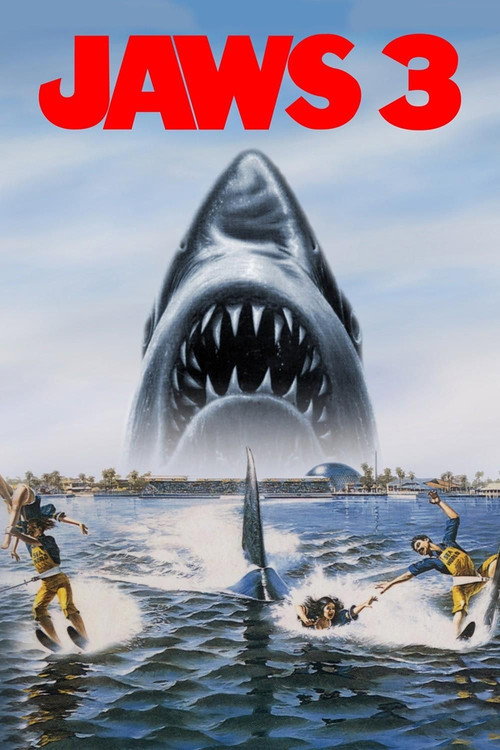
Part of a Collection
Jaws Collection
Dennis Quaid and John Putch play Mike and Sean Brody, the adult sons of the famous police chief from the original Jaws. Mike works as a marine park engineer at SeaWorld in Orlando, Florida, while Sean is a college student. When a massive great white shark, measuring 35 feet, gets trapped inside the park's lagoon, the brothers must figure out how to stop it before it kills more visitors. Joe Alves, the production designer on the first two Jaws films, made his directorial debut here. The movie was shot in 3D, capitalizing on the early 80s 3D revival. With a budget of $20.5 million, it grossed nearly $88 million worldwide, making it a commercial success despite poor reviews. The cast includes Bess Armstrong as a marine biologist, Simon MacCorkindale as a shark expert, and Louis Gossett Jr. as the park manager. This third installment leans into horror and thriller territory, with the added gimmick of 3D effects. It holds a low 4.5 out of 10 rating on IMDb from over 1,400 votes.
Stream
Availability and pricing can change. Confirm on the provider's site before purchasing.
Mike Brody has built a life far from Amity Island. He works as a senior engineer at SeaWorld Orlando, supervising the construction of a massive underwater viewing tunnel and a new water-ski show. His younger brother Sean arrives for spring break, still haunted by their father's legacy and the family's encounters with sharks. The park hums with activity, especially at the water-ski lagoon where Kelly Ann Bukowski performs stunts for tourists.
An unseen force creates chaos underwater during a show, but park manager Calvin Bouchard dismisses it as equipment failure. Mike's girlfriend, Dr. Kathryn Morgan, the park's marine biologist, notices the resident dolphins acting strangely, particularly a smart female named Cindy. Bouchard, focused on attendance numbers, ignores their concerns. Then a small great white shark enters the enclosed lagoon through a faulty gate.
Bouchard sees dollar signs and wants to capture and display the shark as a new attraction. Enter Philip FitzRoyce, a flamboyant British shark expert with cutting-edge gear and his own agenda. Mike and Kathryn argue for caution, but they are overruled. The dolphins grow more agitated, trying to warn the humans of something bigger. Kathryn suspects the captured shark is just a juvenile, meaning a larger parent may be nearby. Sean, eager to prove himself, volunteers for risky underwater tasks. As the park's commercial interests clash with safety, the team realizes the shark problem is far more complex than a single animal trapped in a man-made lagoon.
Critical Consensus
Jaws 3-D is widely regarded as a low point in the franchise, criticized for its weak script, wooden performances, and reliance on gimmicky 3D effects rather than genuine suspense. The film fails to capture the tension and character depth of the original, though its campy quality has earned it a cult following among fans of B-movie horror.
“The movie is so bad it's almost good, but not quite. The 3D effects are the only thing that keep you awake, and they're not worth the price of admission.”
Roger Ebert
Chicago Sun-Times
“The third time around, the shark is bigger, the water is deeper, and the movie is worse. The 3D gimmick is the only novelty, and it's not enough to salvage a tired formula.”
Janet Maslin
The New York Times
“Joe Alves' directorial debut is a competent but uninspired sequel that relies heavily on technical gimmickry. The performances are adequate, but the script lacks the wit and tension of the original.”
Variety Staff
Variety
“The film's 3D effects are occasionally impressive, but they can't compensate for a story that feels recycled and characters who are cardboard cutouts. Louis Gossett Jr. deserves better material.”
Kevin Thomas
Los Angeles Times
“The only dimension this movie truly explores is the third-rate. The shark looks like a rubber prop, and the actors look like they're waiting for their paychecks.”
Richard Schickel
Time Magazine
Dennis Quaid
Mike Brody
Bess Armstrong
Dr. Kathryn Morgan
Simon MacCorkindale
Philip FitzRoyce
Louis Gossett Jr.
Calvin Bouchard
John Putch
Sean Brody
Lea Thompson
Kelly Ann Bukowski
P.H. Moriarty
Jack Tate
Dan Blasko
Dan
Liz Morris
Liz
Lisa Maurer
Ethel
Harry Grant
Shelby Overman
Andy Hansen
Silver Bullet
Director
Joe Alves
Writers
Richard Matheson, Carl Gottlieb, Guerdon Trueblood, Peter Benchley
Composer
Alan Parker
Cinematographer
James A. Contner
Producer
Rupert Hitzig
Golden Raspberry Awards (1984)
Worst Picture: Nominated
Golden Raspberry Awards (1984)
Worst Director: Nominated
Golden Raspberry Awards (1984)
Worst Screenplay: Nominated
Golden Raspberry Awards (1984)
Worst Supporting Actor: Nominated
Saturn Awards (1984)
Best Horror Film: Nominated
Join the community
fans discussing