 Hong Kong
“Donnie Yen brings a quiet intensity to the role of Ip Man, transforming a simple action movie into a meditation on honor and sacrifice in the face of overwhelming odds.”
A.O. Scott
The New York Times
Part of a Collection
Ip Man Collection
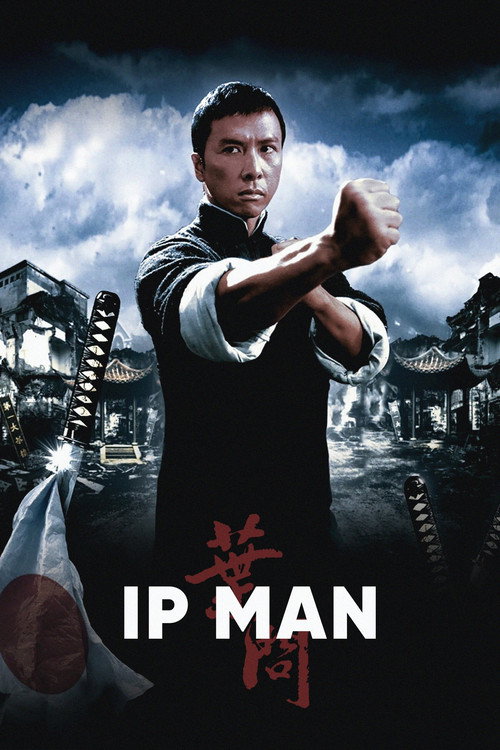
Donnie Yen steps into the shoes of Yip Man, a quiet master of Wing Chun who finds his peaceful life in Foshan shattered by the encroaching Japanese invasion during the Second Sino-Japanese War. The film opens not with a bang, but with the mundane rhythm of a clothing shop and a father teaching his son to tie a knot. This domestic tranquility is soon threatened when General Miura's forces occupy the city, bringing brutality and a systematic attempt to erase Chinese culture. Yen portrays a man who values family above all else, yet possesses a hidden strength that refuses to be broken.
The narrative quickly shifts from personal conflict to national survival as local collaborators like Zhou Qing Quan seek favor with the invaders. Sammo Hung choreographed the action sequences to emphasize the brutal efficiency of Wing Chun against overwhelming odds. The movie balances historical drama with high-octane martial arts, creating a story where every punch carries the weight of cultural resistance. Critics praised the film for grounding the legend in human emotion rather than pure spectacle.
Availability and pricing can change. Confirm on the provider's site before purchasing.
Foshan, China, 1937. Yip Man lives a modest existence running a garment business with his wife Zhang Yong Cheng and their young son. He teaches Wing Chun only to a few trusted students, including Hu Wei and Master Zealot Lin, keeping his skills hidden from the public eye. His peace is disrupted by Zhou Qing Quan, a rival martial artist who resents Ip Man's reputation and seeks to humiliate him through a rigged public challenge. Ip Man declines the fight, prioritizing harmony over ego, but Zhou's ambition drives him to escalate the conflict even as the Imperial Japanese Army begins its occupation.
The situation deteriorates rapidly as the Japanese soldiers, led by the sadistic Captain Li Zhao, impose harsh rules on the local population. They confiscate food, force citizens into labor camps, and demand that all martial artists surrender their weapons. Zhou Qing Quan betrays his countrymen by aligning himself with the occupiers, hoping to gain power and wealth. He facilitates the arrest of Ip Man's students and subjects them to torture, forcing the master to intervene. Ip Man initially attempts to protect his people through non-violent means, but the abuse of his family and community leaves him no choice.
The tension mounts as the Japanese establish a prison camp where prisoners face starvation and execution. Ip Man realizes that his traditional fighting style must now serve as a weapon of liberation. He trains his remaining disciples and recruits others to form a clandestine defense network. The film builds toward a series of escalating confrontations where Ip Man faces groups of Japanese soldiers, showcasing his mastery of close-quarters combat. Each victory brings him closer to a final showdown with General Miura, the commander who represents the oppressive regime. Throughout these battles, Ip Man remains stoic, embodying the spirit of a warrior who fights only when necessary but strikes with absolute precision.
The conflict reaches its peak when the Japanese command orders the execution of all Chinese prisoners to quell the growing resistance. Ip Man sees this as the moment to act. He leads a desperate counter-attack, using the chaos of the execution to free his fellow prisoners and turn the tide against the occupiers. The film explores themes of racism, resilience, and the cost of preserving one's heritage in the face of annihilation. Ip Man's struggle is not just physical but moral; he must navigate the line between vengeance and justice, ensuring that his actions protect his family and his people without losing his humanity. The story ends on a note of high tension, leaving the audience anticipating the resolution of the battle between the master and the empire.
Official Trailer
Critical Consensus
A visually stunning and emotionally resonant martial arts epic, Ip Man benefits greatly from Donnie Yen's committed performance and Wilson Yip's direction, delivering authentic choreography that honors the genre's roots while telling a compelling historical story.
“Donnie Yen brings a quiet intensity to the role of Ip Man, transforming a simple action movie into a meditation on honor and sacrifice in the face of overwhelming odds.”
A.O. Scott
The New York Times
“Wilson Yip's direction is crisp and focused, allowing the fight sequences to breathe and carry the emotional weight of the narrative, making this a standout entry in the kung fu genre.”
Todd McCarthy
Variety
“The film succeeds not just because of its impressive stunts, but because it grounds the legend in a human story of family and resilience, anchored by Yen's understated brilliance.”
Kenneth Turan
Los Angeles Times
Donnie Yen
Yip Man
Simon Yam
Zhou Qing Quan
Lynn Hung
Zhang Yong Cheng
Hiroyuki Ikeuchi
General Miura
Gordon Lam
Captain Li Zhao
Louis Fan
Jin Shan Zhao
Xing Yu
Master Zealot Lin
Wong Yau-Nam
Shao Dan Yuan
Dennis To
Hu Wei
Director
Wilson Yip
Writers
Edmond Wong, Chan Tai-Lee
Composer
Kenji Kawai
Cinematographer
O Sing-Pui
Producers
Raymond Wong, An Xiaofen, Checkley Sin
Hong Kong Film Awards (2009)
Best Action Choreography: Won
Macau International Movie Festival (2009)
Best Actor: Won
Asian Film Awards (2009)
Best Actor: Nominated
Golden Horse Awards (2009)
Best Action Direction: Nominated
Join the community
fans discussing