 United States
“Schoenbrun has crafted a film that is less a movie than a fever dream, a visceral experience that lingers long after the screen goes dark.”
A.O. Scott
The New York Times
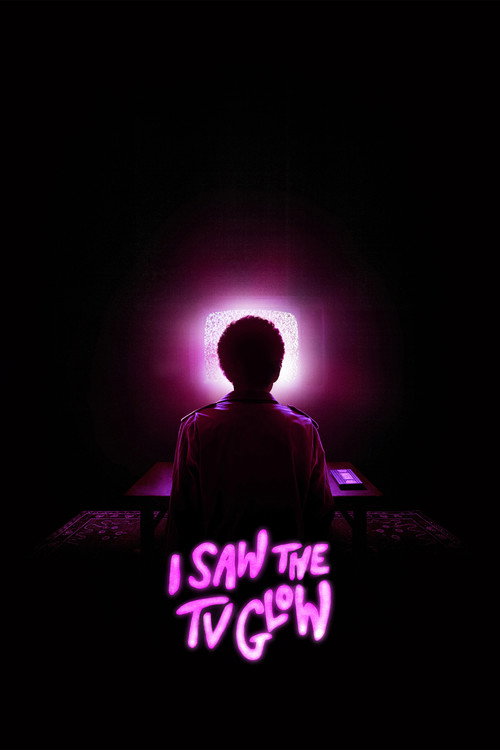
Jane Schoenbrun's second feature opens on a suburban sidewalk in 1996, where a boy named Owen watches a girl read a episode guide to a show he has never seen. That small moment, a stranger offering access to a world he did not know existed, is the whole movie in miniature. I Saw the TV Glow arrived in theaters on May 3, 2024, distributed by A24, and it does something rare for a horror film: it treats television not as a monster but as a lifeline, and then asks what happens when the lifeline gets cut.
Justice Smith plays Owen across roughly two decades, from an anxious ninth grader to a hollowed-out adult, and Jack Haven plays Maddy, the older classmate who hands him a VHS tape of a show called The Pink Opaque. What follows is less a haunted-house story than a study of what repression does to a person over time. Schoenbrun, who wrote the script, has spoken openly about drawing on their own experience of gender dysphoria, and the film's imagery, a planetarium, a buried coffin, a chest that might be cracking open, has been read by trans and queer viewers as one of the most direct depictions of that feeling ever put on screen.
The film cost about $10 million and grossed $5.4 million worldwide, a modest return that says little about its reach. On Rotten Tomatoes it holds an 89 percent critics score, and its audience score sits at 64 percent, a split that maps neatly onto the film's central divide: some viewers find it a revelation, others find it opaque. Both reactions are reasonable. The movie is not interested in explaining itself.
Availability and pricing can change. Confirm on the provider's site before purchasing.
Owen is fourteen when the story starts, living in a New Jersey suburb with his parents and counting down the minutes until he can be alone in his room. He has asthma, a nebulizer, and a habit of disappearing into the background. At a school fair, he sees Maddy reading an episode guide for a show called The Pink Opaque, and something in him clicks. She is older, sharper, and she does not care what anyone thinks. When she invites him to watch the show at her house, he lies to his mother about a sleepover and goes.
The Pink Opaque airs Saturday nights on the Young Adult Network, and it is a strange beast: two girls, Isabel and Tara, psychically linked, fighting a villain called Mr. Melancholy, who has buried one of them alive. The show is shot on grainy video, scored with synths, and structured like a mythology. Owen has never seen anything like it. Maddy has seen every episode. They start watching together every week, and the ritual becomes the spine of Owen's life. He tapes episodes when he cannot watch live. He memorizes lines. He starts to feel that the show knows something about him that he does not know about himself.
Then Maddy disappears. One night she is there, the next she is gone, and the show goes off the air. Owen is left with a stack of VHS tapes and a question he cannot answer. Years pass. He graduates, gets a job at a family fun center, moves through the motions of an adulthood that never quite fits. The film jumps forward in time, from the late nineties into the 2000s, and Owen's life narrows rather than expands. He still lives near his parents. He still has the tapes. He still does not know what happened to Maddy.
When Maddy reappears, she is not the same person. She tells Owen a story that rewrites everything: that the show was real, that she and Owen are Isabel and Tara, that Mr. Melancholy buried them alive in a place called the Midnight Realm, and that the suburban world they have been living in is a lie constructed to keep them docile. She has come back to get him out. She asks him to leave with her, to dig up the truth, to choose the version of himself that the show promised. Owen hesitates. He has a life, however small. He has a mother who needs him. He has a fear that has been with him so long it feels like a personality.
The film's middle section becomes a study in that hesitation. Maddy leaves again, and Owen stays. He goes to work. He goes to the doctor. He watches the show alone and finds that it has changed, or that he has. The colors are dimmer. The magic is harder to locate. At one point he tries to talk to someone about it and cannot find the words. The movie keeps returning to the image of a television glowing in a dark room, and to Owen's face lit by that glow, and to the question of whether he is being saved or sedated.
By the time the story reaches its final act, Owen has spent decades inside a life that does not fit. The film has been building toward a confrontation with that fact, and it does not flinch from how ugly that confrontation can be. What happens next is best discovered rather than described, but it involves a bathroom, a crowd of strangers, and a scream that has been waiting a very long time to come out.
Official Trailer
Critical Consensus
Critics largely embraced Schoenbrun's follow-up to We're All Going to the World's Fair as a formally daring, emotionally punishing work, with Justice Smith's performance singled out as a career best. Audiences were more divided, and the gap between the two scores reflects a film that withholds conventional scares and resolutions in favor of atmosphere and ambiguity.
“Schoenbrun has crafted a film that is less a movie than a fever dream, a visceral experience that lingers long after the screen goes dark.”
A.O. Scott
The New York Times
“A masterpiece of anxiety and longing, I Saw the TV Glow is a film that understands the terror of becoming someone you never wanted to be.”
David Ehrlich
IndieWire
“Schoenbrun's direction is nothing short of visionary, turning a simple premise into a complex meditation on the cost of denying one's true self.”
Peter Debruge
Variety
“This is horror for the soul, a film that cuts deep into the heart of what it means to be alive and unaccepted.”
Mark Kermode
The Guardian
Justice Smith
Owen
Jack Haven
Maddy
Ian Foreman
Young Owen
Helena Howard
Isabel
Lindsey Jordan
Tara
Danielle Deadwyler
Brenda
Fred Durst
Frank
Conner O'Malley
Dave
Emma Portner
Amanda / Mr. Melancholy / Marco / Evil Clown
Madaline Riley
Polo
Amber Benson
Johnny Link's Mom
Albert Birney
Mr. Sprinkly
Director
Jane Schoenbrun
Writer
Jane Schoenbrun
Composer
Alex G
Cinematographer
Eric K. Yue
Producers
Luca Intili, Dave McCary, Emma Stone, Ali Herting, Sarah Winshall
Sundance Film Festival (2024)
Official Selection, Midnight Section: Nominated
Toronto International Film Festival (2024)
Special Presentation: Nominated
Sitges Film Festival (2024)
Best Film: Nominated
Hugo Awards (2025)
Best Dramatic Presentation, Long Form: Nominated
Critics' Choice Movie Awards (2025)
Best Original Screenplay: Nominated
Join the community
fans discussing