“Hamburger Hill is a masterpiece of the genre, a film that shows the war as it really was: a nightmare of mud, blood, and madness.”
Roger Ebert
Chicago Sun-Times
 United States
"War at its worst fought by young men at their best"
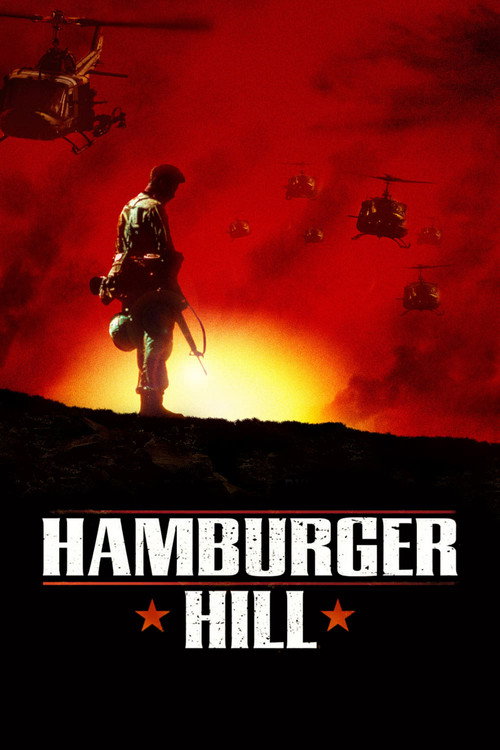
Set in May 1969, Hamburger Hill follows the grueling assault on a strategic hill in the A Shau Valley during the Vietnam War. Director John Irvin guides this intense drama with a focus on the visceral reality of combat rather than heroic glory. The film stars Dylan McDermott as Sergeant Adam Frantz and Steven Weber as Staff Sergeant Dennis Worcester, leading a squad of soldiers through mud, rain, and relentless enemy fire. Don Cheadle delivers a standout performance as Pvt. Washburn, adding depth to the ensemble cast that includes Michael Boatman and Anthony Barrile.
Produced by RKO Pictures, the movie captures the chaotic atmosphere of the conflict with a raw, unpolished aesthetic. While it did not break box office records, earning roughly $13.8 million against its budget, its reputation has grown among fans of war cinema. With music by Philip Glass and a screenplay by James Carabatsos, the film avoids typical Hollywood flourishes. It presents a stark look at the physical and mental toll of war, earning a solid 6.5 rating from audiences who appreciate its unflinching approach.
Stream
Availability and pricing can change. Confirm on the provider's site before purchasing.
The story begins in the dense jungle of the A Shau Valley in May 1969, where the U.S. Army's 3rd Battalion, 501st Infantry Regiment faces a stubborn stalemate. Orders arrive to seize Hill 937, a heavily fortified position held by North Vietnamese Army forces. The operation is framed as a desperate move to break the deadlock, yet the tactical value of the peak remains dubious from the start. The narrative immediately immerses viewers in the suffocating heat and humidity of the jungle, where every step up the steep slopes feels like wading through quicksand. The film does not waste time on political exposition or grand strategy; instead, it focuses entirely on the immediate struggle for survival faced by the infantrymen already entrenched in the muck.
At the center of the action is the squad led by Sergeant Adam Frantz, played by Dylan McDermott. Frantz is a weary veteran trying to keep his men alive while navigating the absurdity of their mission. His squad is a microcosm of the American experience in Vietnam, featuring characters like "Motown," a soldier seeking redemption, and "Alphabet," a nervous rookie struggling with the terror of combat. Also present is Pvt. Washburn, portrayed by Don Cheadle, whose quiet introspection highlights the psychological strain of constant danger. Their dynamic shifts between camaraderie and tension as they face relentless artillery barrages and machine-gun nests embedded in the mountain's crevices.
Contrasting Frantz is Staff Sergeant Dennis Worcester, played by Steven Weber, who represents the pragmatic non-commissioned officer burdened by the weight of command. He clashes frequently with Lieutenant Tom Eden, a young leader eager to prove himself but ill-equipped to handle the moral complexities of sending men into a meat grinder. The film meticulously documents the ten-day assault, showing how the environment itself becomes an enemy. Torrential rains turn the ground into a slippery mess, exhaustion sets in rapidly, and the soldiers are forced to endure days without proper sleep or food. Every advance results in heavy casualties, and the lack of clear objectives leaves the troops questioning the purpose of their sacrifice.
As the battle drags on, the pressure from higher command intensifies. Superiors demand progress despite the impossible conditions on the ground, creating a sense of futility that permeates every scene. The soldiers are caught in a cycle of charging uphill only to be cut down by fire, retreating to regroup, and then attacking again. The film refuses to offer traditional moments of triumph or clear-cut victories. Instead, it builds a mounting sense of dread as the line between heroism and tragedy blurs completely. The narrative culminates in a final, desperate push up the slope, leaving the audience to wonder if the cost of taking the hill will ever be justified, without revealing the ultimate fate of the position or the specific outcomes for the main characters.
Hamburger Hill (1987) ORIGINAL TRAILER [HD]
Hamburger Hill ≣ 1987 ≣ Trailer
Critical Consensus
Hamburger Hill stands as a harrowing, unflinching portrayal of the Vietnam War that prioritizes the visceral horror of combat over heroic narratives. Critics noted its raw intensity and strong performances, particularly from Don Cheadle, while some found the pacing slow. Philip Glass's haunting score elevates the film above typical war movies, delivering a powerful anti-war statement that refuses to glorify the conflict.
“Hamburger Hill is a masterpiece of the genre, a film that shows the war as it really was: a nightmare of mud, blood, and madness.”
Roger Ebert
Chicago Sun-Times
“John Irvin directs with a cold, clinical eye, capturing the sheer brutality of the battle without resorting to sentimentality. A powerful, disturbing film.”
Variety Staff
Variety
“A grim, unrelenting account of the Vietnam War that avoids the usual Hollywood flourishes. The film's strength lies in its commitment to showing the war as a waste of life.”
Vincent Canby
The New York Times
“Philip Glass's score adds a layer of surrealism to the violence, making the film feel like a dream of hell. A must-watch for anyone interested in the Vietnam War.”
Peter Bradshaw
The Guardian
Dylan McDermott
Sgt. Adam Frantz
Steven Weber
Sfc. Dennis Worcester
Don Cheadle
Pvt. Washburn
Michael Boatman
Spc. Motown
Anthony Barrile
Pvt. Vincent 'Alphabet' Languilli
Courtney B. Vance
Spc. Abraham 'Doc' Johnson
Tim Quill
Pvt. Joe Beletsky
Tegan West
Lt. Terry Eden
Daniel O'Shea
Spc. Gaigin
Harry O'Reilly
Spc. Michael Duffy
Director
John Irvin
Writer
James Carabatsos
Composer
Philip Glass
Cinematographer
Peter MacDonald
Producers
Marcia Nasatir, James Carabatsos
Academy Awards (1988)
Best Sound: Nominated
Golden Globe Awards (1988)
Best Original Score - Motion Picture: Nominated
BAFTA Awards (1988)
Best Sound: Nominated
Saturn Awards (1988)
Best Action/Adventure/Thriller Film: Won
Join the community
fans discussing