“A sweet-natured, well-acted family film that earns its tears.”
Peter Bradshaw
The Guardian
 United States
"He waited because waiting was how he loved."
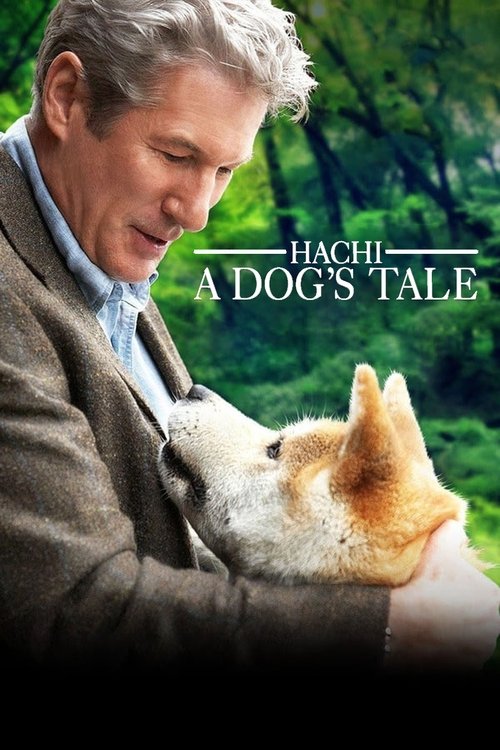
Lasse Hallström's Hachi: A Dog's Tale arrived in 2009 with a modest $16 million budget and a premise that could fit on a postcard: a college professor adopts a lost Akita puppy, and the dog spends the rest of his life waiting for him at the train station. Richard Gere plays Parker Wilson, the professor, and Joan Allen is his wife Cate, who objects to the dog before she doesn't. Sarah Roemer appears as their daughter Andy. The film runs 93 minutes, carries a G rating, and was released in the United States on June 8, 2009, though it had already opened theatrically in Japan under the title HACHI 約束の犬.
The source material is unusually layered. The real Hachikō, an Akita born in Ōdate in 1923, waited at Shibuya Station in Tokyo for nearly a decade after his owner died in 1925. Kaneto Shindō turned that story into a Japanese film in 1987, and Stephen P. Lindsey's screenplay for this version moves the action to a small Rhode Island town called Bedridge. The station sequences were shot at the former Westerly, Rhode Island train station, with additional work in Bristol and Woonsocket. Jan A. P. Kaczmarek composed the score, and Ron Fortunato handled cinematography.
The film never received a wide American theatrical push, but it found an audience anyway. Worldwide box office reached roughly $46.8 million, and it became a durable streaming and home-video title, particularly in Asia and Europe. On IMDb it holds an 8.0 rating from more than 7,000 votes. Critics were split in a predictable way: most found it sentimental but effective, and a few found it sentimental and nothing more. Hallström keeps the camera close to faces and paws, and the film's emotional force comes from repetition rather than speeches. The tagline, "He waited because waiting was how he loved," is a fair summary of the method.
Rent
Free with ads
Availability and pricing can change. Confirm on the provider's site before purchasing.
A present-day classroom opens the film. A teacher named Michael asks his students to name a hero, and a boy offers his grandfather's dog as an answer. That prompts the flashback that occupies most of the running time.
Parker Wilson (Richard Gere) teaches music at a college in a quiet Rhode Island town and commutes by train every day. One snowy evening a small Akita puppy, shipped from Japan and lost in transit, wanders onto the platform. Parker takes him home intending to find the owner. No one claims him. His wife Cate (Joan Allen) is firmly against keeping a dog. Their daughter Andy (Sarah Roemer) is charmed almost immediately, and Parker, though he will not quite say so, is smitten.
The film's first act is a gentle domestic comedy. Parker tries to hide the puppy from Cate, the dog destroys a shed and a pair of shoes, and Parker consults his colleague Ken Fujiyoshi (Cary-Hiroyuki Tagawa), a Japanese professor who explains the Akita's standing in Japanese culture and translates the tag on the dog's collar. Parker names the dog Hachi, from the Japanese word for eight, after noticing that the puppy's paw markings resemble that character. The station vendors, Carl (Jason Alexander), Jasjeet (Erick Avari), Mary Anne (Davenia McFadden) and Teddy (Robert Degnan), become the dog's informal chorus, feeding him scraps and narrating his habits to anyone who will listen. Cate eventually relents when she sees how attached Parker and Andy have become.
Once the household settles, the film shifts to routine. Every morning Hachi walks Parker to the station and sees him off. Every afternoon at five o'clock he returns to meet the train. Hallström establishes this ritual in patient, repetitive detail: the same walk, the same platform, the same reunion. The dog's life is organized entirely around his master's schedule. Hachi is devoted, obedient and slightly mischievous. Parker teaches, Cate runs the home, Andy grows up, and the dog is the thread that ties their days together.
The film is more interested in daily ritual than in dramatic speeches. The camera stays close to faces and paws, and the score does much of the emotional work. A subplot involving a newspaper reporter who notices the dog's daily vigil begins to take shape, but the synopsis stops here, before the story's central turn.
Hatchi: A Dog's Tale - HD Trailer - Coming Soon
Critical Consensus
Critics found the film sentimental and manipulative but effective, with most agreeing that Hallström's restraint and Gere's warmth elevate familiar material. The Tomatometer sits around 64 percent, while audiences were considerably warmer, scoring it in the high 80s. It is a tearjerker that knows exactly what it is doing.
“A sweet-natured, well-acted family film that earns its tears.”
Peter Bradshaw
The Guardian
“Gere brings an unforced, avuncular charm to the role, though the film lays on the sentiment with a trowel.”
Variety Staff
Variety
“A sturdy, old-fashioned weepie that knows precisely which buttons to push.”
The Hollywood Reporter Staff
The Hollywood Reporter
“The film works on its own modest terms, provided you accept those terms going in.”
RogerEbert.com Staff
RogerEbert.com
Richard Gere
Parker Wilson
Joan Allen
Cate Wilson
Sarah Roemer
Andy Wilson
Cary-Hiroyuki Tagawa
Ken Fujiyoshi
Erick Avari
Jasjeet
Jason Alexander
Carl Bojen
Davenia McFadden
Mary Anne
Robbie Sublett
Michael
Kevin DeCoste
Ronnie (age 11)
Robert Degnan
Teddy Barnes
Tora Hallström
Heather
Donna Sorbello
Myra
Director
Lasse Hallström
Writers
Stephen P. Lindsey, Jason Mayoh, Kaneto Shindō
Composer
Jan A. P. Kaczmarek
Cinematographer
Ron Fortunato
Producers
Bill Johnson, Shin Torisawa, Richard Gere, Vicki Shigekuni Wong
Join the community
fans discussing