“Groundhog Day is a movie that works on so many levels. It is a comedy, a romance, a fantasy, and a philosophical treatise. Bill Murray gives the performance of his life.”
Roger Ebert
Chicago Sun-Times

 United States
"He's living the worst day of his life... Over and over again."
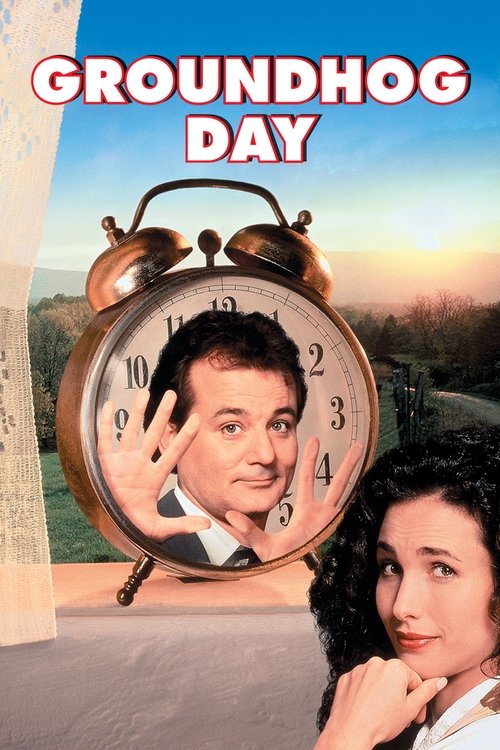
Bill Murray stars as Phil Connors, a cynical Chicago weatherman who views his assignment to cover the annual Groundhog Day festival in Punxsutawney, Pennsylvania, as a tedious detour from his real career. Accompanied by idealistic producer Rita Hanson and sardonic cameraman Larry, Phil arrives expecting a quick two-day gig before returning to the big city. Instead, he finds himself trapped in a surreal time loop where February 2nd repeats endlessly.
Harold Ramis directed this 1993 release, blending romance, fantasy, and comedy into a unique package that ran 1 hour and 41 minutes. The film explores how a selfish man learns to appreciate life through forced repetition, transforming a simple premise into a profound meditation on human existence. Critics universally praised Murray's performance for balancing humor with deep emotional resonance.
Stream
Availability and pricing can change. Confirm on the provider's site before purchasing.
Phil Connors wakes up to the sound of "I Got You Babe" playing on his radio in the Gobbler's Knob hotel room in Punxsutawney, Pennsylvania. He is there to cover the annual Groundhog Day festival alongside his producer Rita Hanson and cameraman Larry. Phil mocks the local traditions and treats the townspeople with disdain, viewing them as obstacles rather than people. After a chaotic night involving excessive drinking and a rude encounter with insurance salesman Ned Ryerson, Phil and his team prepare to leave town the next morning.
The following day, February 2nd, begins exactly like the previous one. When Phil tries to leave town, his car breaks down or gets stuck in traffic. He attempts to escape by train but fails. Realizing something is wrong, he tries to warn Rita and Larry, but they dismiss him. The day resets at 6:00 AM, trapping Phil in an endless cycle. Initially confused and terrified, Phil soon realizes that death offers no escape since he always wakes up back in his bed.
Once he accepts his situation, Phil descends into a period of nihilistic hedonism. He uses his foreknowledge to steal money, break laws, and seduce women without consequence. He spends weeks, months, or perhaps years indulging in every vice available to him. The boredom eventually leads him to attempt suicide repeatedly, only to wake up again the next morning. This phase highlights his complete loss of hope and moral compass.
Despair sets in as Phil realizes he cannot escape through force or flight. In a darker phase of the loop, he stops trying to change the world and instead focuses entirely on self-improvement. He begins to learn piano, ice sculpture, French, and poetry, spending thousands of loops perfecting his skills. His goal shifts from mere survival to becoming the perfect man for Rita, hoping that if he can impress her enough, she might love him and break the curse. Despite his growing competence and charm, Rita remains unaware of the loop and often rebuffs his advances because she senses something is fundamentally wrong with him.
As Phil spends more time in the loop, his interactions with the townspeople evolve from mockery to genuine connection. He learns the names and stories of the residents, helping them in ways no one else ever has. He saves a boy from falling out of a tree, prevents a bus crash, and helps Ned Ryerson avoid bankruptcy. He becomes a beloved figure in Punxsutawney, known for his kindness and generosity. The narrative builds tension around whether Phil can achieve true redemption and whether Rita will ever see the man he has become. The story explores themes of existentialism, personal growth, and the transformative power of altruism, culminating in a moment where Phil must decide if he can truly let go of his ego to find peace.
Official Trailer
Critical Consensus
Critics universally praise Bill Murray's career-defining performance and Harold Ramis's direction, calling it a perfect blend of comedy, philosophy, and romance. The film is celebrated for its clever script, emotional depth, and the way it transforms a simple premise into a profound meditation on human existence.
“Groundhog Day is a movie that works on so many levels. It is a comedy, a romance, a fantasy, and a philosophical treatise. Bill Murray gives the performance of his life.”
Roger Ebert
Chicago Sun-Times
“Mr. Murray has never been better... He plays Phil Connors with a mix of cynicism and vulnerability that makes the character's transformation utterly believable and deeply moving.”
Janet Maslin
The New York Times
“A brilliant, funny, and surprisingly touching film. Harold Ramis directs with a light touch, allowing the story's deeper meanings to shine through the comedy.”
Peter Travers
Rolling Stone
“Groundhog Day is a rare beast: a comedy that makes you think. It's a masterclass in storytelling and acting, with Bill Murray delivering a tour-de-force performance.”
Kenneth Turan
Los Angeles Times
Bill Murray
Phil Connors
Andie MacDowell
Rita Hanson
Chris Elliott
Larry
Stephen Tobolowsky
Ned Ryerson
Brian Doyle-Murray
Buster Green
Marita Geraghty
Nancy Taylor
Angela Paton
Mme Lancaster
Rick Ducommun
Gus
Rick Overton
Ralph
Robin Duke
Doris the Waitress
Willie Garson
Kenny
Director
Harold Ramis
Writers
Danny Rubin, Harold Ramis
Composer
George Fenton
Cinematographer
John Bailey
Producers
Trevor Albert, Harold Ramis
Academy Awards (1994)
Best Original Screenplay: Nominated
BAFTA Awards (1994)
Best Original Screenplay: Won
Golden Globe Awards (1994)
Best Motion Picture – Musical or Comedy: Nominated
Golden Globe Awards (1994)
Best Actor – Motion Picture Musical or Comedy: Nominated
Saturn Awards (1994)
Best Fantasy Film: Won
Saturn Awards (1994)
Best Actor: Won
National Society of Film Critics (1993)
Best Screenplay: Won
Join the community
fans discussing