 Germany
“In this moving period drama, a German gay man repeatedly declares his independence in a country that criminalizes his desire and his identity.”
Manohla Dargis
The New York Times
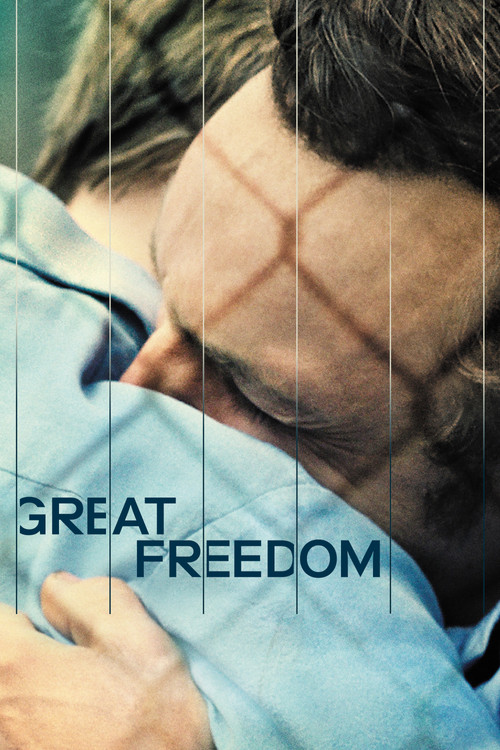
Sebastian Meise's Great Freedom opens in 1945 as Allied forces liberate a concentration camp, but for Hans Hoffmann, played by Franz Rogowski, the nightmare is far from over. Within months he is back behind bars, this time under Paragraph 175, the German law that criminalized homosexuality. The film tracks Hans across three decades, from the late 1940s to the late 1960s, as he cycles in and out of prison, forming an unlikely bond with his cellmate Viktor, a hardened convict played by Georg Friedrich.
Meise, who co-wrote the script with Thomas Reider, shoots with a restrained, observational style. The camera, handled by Crystel Fournier, lingers on faces and hands, letting silence carry as much weight as dialogue. The supporting cast includes Anton von Lucke as Leo Giese and Thomas Prenn as Oskar, two men who drift through Hans's life at different points. The film is a co-production between Austria and Germany, made by FreibeuterFilm and Rohfilm, and it earned just over $218,000 at the box office, a modest figure that reflects its niche appeal.
Genre-wise, Great Freedom blends drama, romance, and crime without ever tipping into melodrama. It is not a franchise entry or a star vehicle; it is a chamber piece anchored by Rogowski's quiet, physical performance. A 7.3 rating from over 8,000 votes on IMDb suggests a dedicated following. The film played festivals and won awards on the circuit, including the Un Certain Regard Jury Prize at Cannes, though its reach remained limited to arthouse crowds until it found a wider audience on MUBI.
Stream
Rent
Apple TV
Amazon Prime Video
Availability and pricing can change. Confirm on the provider's site before purchasing.
The film begins in 1945 with the liberation of a concentration camp. Hans Hoffmann, a gay man imprisoned not for his politics but for his sexuality, is freed by Allied soldiers. His relief is short-lived. Within months, the new authorities arrest him again, this time under Paragraph 175, the German statute that criminalizes sex between men. The bitter irony of liberation delivering him straight back into custody sets the film's structure: Meise moves non-chronologically across three decades, from the late 1940s through 1957 to the late 1960s, tracing Hans's cycles of imprisonment and brief release.
Each stint behind bars brings him back into the orbit of Viktor, a hardened, initially hostile career criminal convicted of murder. They are repeatedly celled together. Their relationship begins in mutual contempt. Viktor's crude heterosexuality and criminal pragmatism clash with Hans's defiant, unapologetic queerness. Over the years, the hostility wears down into something the film refuses to name simply. It is not quite friendship, not quite romance, but a bond forged by proximity and shared survival.
In the late 1940s, Hans is released and tries to build a life outside. He visits a bar, seeks out men, and attempts to reconnect with Leo, a lover from his pre-war life. Leo's fate haunts him. The film fragments these moments, showing Hans's attempts at intimacy thwarted by fear, surveillance, and the internalized shame that prison has instilled. He is caught again, and returned to Viktor's cell.
The 1957 segment finds Hans more hardened, more resigned. He has learned to navigate the prison's unspoken rules. Viktor, meanwhile, has grown more dependent on Hans's presence, though he would never admit it. A younger man, Oskar, enters the prison and catches Hans's eye. The dynamic shifts. Viktor becomes jealous, possessive, though he lacks the language to express it. Hans, for his part, sees in Oskar a reminder of the youth and freedom he lost.
By the late 1960s, the outside world is changing. The student protests, the sexual revolution, and the growing gay rights movement are reshaping Germany. Inside the prison, time moves differently. Hans and Viktor have settled into a routine that resembles domesticity. They share meals, argue, and care for each other in small, unspoken ways. The film's central conflict is structural rather than personal: the state's determination to criminalize Hans's desire versus his refusal to be reformed, cured, or shamed.
Meise and cinematographer Crystel Fournier shoot in a restrained, observational register. Long takes, close-ups of faces and hands, and a sparse soundscape carry the emotional weight. The score by Peter Brötzmann and Nils Petter Molvær blends free jazz and ambient trumpet, used as texture rather than melody. The film builds toward the 1969 liberalization of Paragraph 175, which decriminalized homosexuality between men over 21. It is a chamber piece about intimacy surviving inside an institution designed to erase it, and it stops short of resolving whether Hans's freedom, when it comes, will be the one he wanted.
Official International Trailer #2
Official International Trailer
Trailer
Critical Consensus
A formally rigorous, emotionally devastating prison drama anchored by a career-best Franz Rogowski performance, praised for refusing melodrama while making the bureaucratic cruelty of Paragraph 175 visceral. Some critics found its fractured timeline and reticence emotionally withholding.
“In this moving period drama, a German gay man repeatedly declares his independence in a country that criminalizes his desire and his identity.”
Manohla Dargis
The New York Times
“Great Freedom is a formidably intelligent and well-acted prison movie and also a love story, or perhaps a paradoxically platonic bromance.”
Peter Bradshaw
The Guardian
Franz Rogowski
Hans Hoffmann
Georg Friedrich
Viktor
Anton von Lucke
Leo Giese
Thomas Prenn
Oskar
Thomas Stecher
Guard 1968
Alfred Hartung
Guard 1945
Thomas Wehling
Guard 1957
Mex Schlüpfer
Viktor's buddy
David Burnell IV
Ally
Fabian Stumm
Police Officer
Joachim Schönfeld
Guard
Klaus Huhle
Judge
Director
Sebastian Meise
Writers
Sebastian Meise, Thomas Reider
Composers
Peter Brötzmann, Nils Petter Molvær
Cinematographer
Crystel Fournier
Producers
Benny Drechsel, Sabine Moser, Oliver Neumann
Cannes Film Festival (2021)
Un Certain Regard Jury Prize: Won
European Film Awards (2021)
Best Actor (Franz Rogowski): Nominated
European Film Awards (2021)
Best Screenwriter: Nominated
Austrian Film Award (2022)
Best Feature Film: Won
Austrian Film Award (2022)
Best Director: Won
Austrian Film Award (2022)
Best Actor (Franz Rogowski): Won
German Film Award (2022)
Best Feature Film: Nominated
German Film Award (2022)
Best Actor (Franz Rogowski): Nominated
Join the community
fans discussing