 Japan
Part of a Collection
いわい しゅんじ Collection
Overview
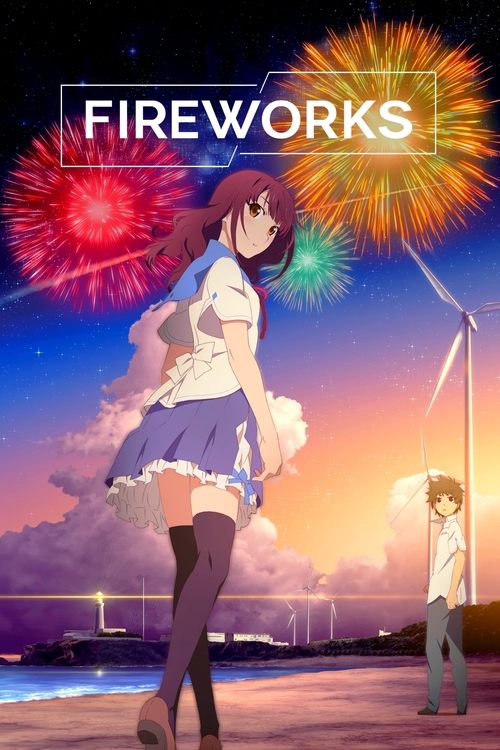
A quiet summer evening in the coastal town of Moshima becomes the setting for a story that blends slice-of-life realism with supernatural wonder. The narrative begins when a group of schoolboys gathers to debate whether fireworks appear round or flat depending on the angle they view them from. That simple philosophical question pulls them toward a festival where a magical encounter changes everything. Director Nobuyuki Takeuchi helms this animated feature, bringing a distinct visual style to the screen through his work at SHAFT. The film features voices from Suzu Hirose as Nazuna Oikawa and Masaki Suda as Norimichi Shimada, who anchor the emotional core of the tale. Mamoru Miyano also lends his voice to the mysterious Yūsuke Azumi, adding depth to the unfolding mystery.
Produced by Aniplex and TOHO, the project cost an estimated budget typical for mid-tier anime releases but managed to gross over $26 million worldwide. Critics gave it a solid rating of 6.579 out of 10 based on user votes, signaling a reception that appreciated its unique approach to time travel themes. The movie stands as part of the Shunji Iwai collection, reflecting the writer's signature blend of romance and drama. It explores how memory distorts reality and how we hold onto moments we wish never ended.
PlotSpoiler-free
The story opens on a sweltering afternoon in Moshima, Japan, where Norimichi Shimada, a junior high student feeling disconnected from his family and friends, finds himself drawn into a conversation with his classmates about the shape of fireworks. They argue endlessly over whether the explosions look like perfect spheres or flattened disks when seen from different perspectives. This debate serves as the catalyst for the day's events. After school, Norimichi heads to the beach where he encounters Nazuna Oikawa, a new transfer student known for her vibrant personality and a habit of wearing a red swimsuit under her clothes. She is rumored to be special, having once saved a boy named Yusuke Azumi from drowning years ago, creating a bond that seems to follow her.
Nazuna reveals she plans to run away with Yusuke to escape her current life, which includes a strained relationship with her mother and a fiancé she does not love. Norimichi, harboring unspoken feelings for Nazuna, decides to join their escape. He recruits his friend Jun'ichi and another classmate, Kazuhiro, to help them evade capture. Their journey takes them through various locations around the town, including a train station, a lighthouse, and a festival ground. As they travel, time begins to behave strangely. Scenes repeat, and reality appears to loop, creating a surreal atmosphere where the characters seem stuck in a cycle of the same evening.
The group encounters Yusuke, who acts as a guardian figure, guiding them through what feels like a series of parallel timelines. The central conflict revolves around Nazuna's desire to break free from her constraints and the boys' struggle to understand the nature of their reality. As the sun sets and the sky fills with the promise of the annual fireworks display, the mystery deepens. The characters are caught in a surreal loop where they must relive the same night over and over, each iteration bringing them closer to understanding the truth about Nazuna's existence and the magical properties of the fireworks that light up the sky. The story builds toward a climax where the distinction between memory, dream, and reality blurs completely, forcing Norimichi to make a choice that will determine the fate of his relationship with Nazuna and the very fabric of their shared summer.
Throughout their adventure, the animation shifts styles to reflect the changing perception of time and space. The visual effects become more abstract as the loop tightens, mirroring the characters' confusion and desperation. The soundtrack by Satoru Kosaki enhances the hypnotic quality of the repetition, blending orchestral and electronic elements to create a melancholic yet hopeful tone. The film uses the imagery of the firework shells floating in reverse to symbolize the possibility of undoing past mistakes, even if only in a fleeting moment. As the night progresses, the stakes feel higher, though the exact nature of the danger remains ambiguous until the final moments.
The journey through the town feels both familiar and alien, with landmarks appearing slightly distorted or out of place. The characters interact with each other in ways that suggest they have lived this day before, yet they cannot recall the details. Norimichi's internal monologue provides insight into his longing for connection and his fear of losing the chance to express his feelings. The tension builds as the fireworks preparation begins, signaling the approaching end of the loop. The group reaches the lighthouse, a key location where the magic of the fireworks seems most potent. Here, the boundaries between the real world and the magical realm thin further, leading to a confrontation with the truth about Nazuna's fate.
Ending ExplainedSpoilers
Trailers
GKIDS Official Subtitled Trailer
Madman Official Trailer
Critical Reception
Critical Consensus
Fireworks delivers a visually stunning experience with a unique art style that distinguishes it from standard anime fare. While some viewers found the non-linear narrative confusing or overly abstract, the film is widely praised for its breathtaking animation, atmospheric sound design, and its tender exploration of first love and loss. It stands as a beautiful, if slightly opaque, tribute to the fleeting nature of summer memories.
Top Cast
Suzu Hirose
Nazuna Oikawa (voice)
Masaki Suda
Norimichi Shimada (voice)
Mamoru Miyano
Yūsuke Azumi (voice)
Shintaro Asanuma
Jun'ichi (voice)
Toshiyuki Toyonaga
Kazuhiro (voice)
Yuki Kaji
Minoru (voice)
Shin-ichiro Miki
Nazuna's Mother's Fiancé (voice)
Kana Hanazawa
Teacher Miura (voice)
Takahiro Sakurai
Teacher Mitsuishi (voice)
Michiko Neya
Norimichi's Mother (voice)
Nobuo Tobita
Norimichi's Father (voice)
Mitsuru Miyamoto
Yūsuke's Father (voice)
Crew
Directors
Nobuyuki Takeuchi, Akiyuki Shinbo
Writers
Hitoshi One, Shunji Iwai
Composer
Satoru Kosaki
Cinematographers
Takayuki Aizu, Rei Egami, Tasuku Ozu
Producers
Junnosuke Ito, Akiko Yodo, Genki Kawamura
Keywords
Sources
Facts
- Status
- Released
- Original Language
- JA
- Revenue
- $26,617,621
- Director
- Nobuyuki Takeuchi
- Production
- SHAFT, Aniplex, jeki, Lawson Entertainment, TOHO, TOY'S FACTORY, LINE, KADOKAWA
Join the community
fans discussing