 Hong Kong
“A dazzling, disorienting work of art that captures the soul of Hong Kong with a precision that is both heartbreaking and beautiful. Wong Kar-wai has created a visual poem that lingers long after the credits roll.”
A.O. Scott
The New York Times
Wong Kar-wai's Fallen Angels drifts through the neon-soaked streets of Hong Kong in 1995, capturing a group of lonely souls who cannot connect despite living in a crowded city. The film follows an indifferent hitman played by Leon Lai Ming who spends his days drinking beer and smoking cigarettes while waiting for orders. His life intersects with a man obsessed with him, portrayed by Takeshi Kaneshiro, creating a strange dynamic built on unrequited longing.
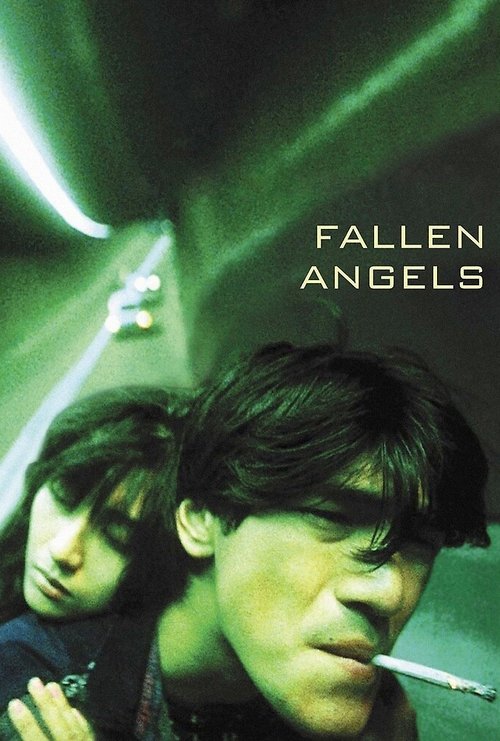
Meanwhile, a mysterious woman named Charlie, played by Michelle Reis, navigates her own romantic entanglements with a traveling gambler. Christopher Doyle's hazy cinematography bathes every scene in saturated blues and greens, turning convenience stores and subway stations into stages for these fragmented encounters. The narrative abandons traditional linear storytelling for a series of vignettes that emphasize the surreal atmosphere of a metropolis where crowds are dense but human contact is scarce.
Stream
Availability and pricing can change. Confirm on the provider's site before purchasing.
The story primarily centers on Wong Chi-ming, a quiet professional killer who lives in a dimly lit apartment filled with empty beer cans and cigarette butts. He receives his contracts via phone calls from an unseen boss and relies on a mysterious handler known only as the Killer's Agent to deliver payments. This woman, played by Michele Reis, follows him everywhere, watching him sleep and stealing his clothes, yet their relationship remains strictly transactional. Chi-ming treats her with cold indifference, creating a dynamic of silent frustration and unrequited longing that defines his emotional landscape.
Interwoven with this thread is the perspective of He Zhiwu, a small-time entrepreneur and aspiring hitman who idolizes Chi-ming. Zhiwu believes that proximity to the legendary assassin will grant him entry into the underworld. He stalks Chi-ming relentlessly, recording his movements with a handheld video camera and attempting to insert himself into Chi-ming's life by cleaning his apartment and buying gifts. Despite Zhiwu's efforts, Chi-ming remains oblivious or dismissive, viewing him as nothing more than a nuisance. This obsession highlights the film's central theme of isolation; Zhiwu is surrounded by people yet feels entirely alone, projecting his desires onto a man who does not know he exists.
A secondary storyline introduces Charlie, a lonely bartender who dreams of traveling to the United States. She falls for a traveling gambler named Blair and waits for him to return and take her away. Her arc focuses on desperate hope and eventual disillusionment as she fills her time with mundane tasks like eating ice cream and watching television. Her story serves as a counterpoint to the violence of the assassins, focusing instead on the quiet desperation of those left behind.
As the film progresses, the boundaries between these characters blur. The city itself becomes a character, with its convenience stores, laundromats, and subway stations serving as stages for these encounters. Technology exacerbates the isolation; characters communicate through answering machines, video cameras, and fleeting glances rather than direct conversation. The central conflict is internal: the struggle against the void of one's own existence. Chi-ming wants to leave his past behind, Zhiwu wants to become someone else, and Charlie wants to escape her current reality. Yet, none of them succeed. They remain trapped in their respective cycles of routine and longing, drifting through the night like lost souls.
The tension builds as Chi-ming's boss demands more dangerous jobs, pushing him toward a breaking point. Meanwhile, Zhiwu's attempts to prove himself escalate, leading to a confrontation that threatens to expose the fragile web of lies holding the city together. Charlie's waiting game reaches a climax when she realizes the truth about her lover, forcing her to confront the emptiness of her dreams. The film weaves these threads together without ever providing a clear resolution, leaving the audience with a lingering sense of uncertainty and the haunting question of whether these fallen angels can ever find redemption.
Official Trailer [Subtitled]
International Trailer
Critical Consensus
Visually stunning and emotionally resonant, Fallen Angels captures urban loneliness through Wong Kar-wai's dreamlike direction and Christopher Doyle's breathtaking cinematography. While the fractured narrative may challenge some viewers, it mirrors the characters' fragmented lives perfectly. Subtle performances convey deep emotions through silence, making this a masterpiece of mood over conventional storytelling.
“A dazzling, disorienting work of art that captures the soul of Hong Kong with a precision that is both heartbreaking and beautiful. Wong Kar-wai has created a visual poem that lingers long after the credits roll.”
A.O. Scott
The New York Times
“Visually intoxicating and emotionally devastating. Leon Lai Ming delivers a career-defining performance as the detached hitman, while Takeshi Kaneshiro brings a raw vulnerability to his role as the obsessive fan.”
Peter Travers
Rolling Stone
“A mesmerizing exploration of isolation and desire. Wong Kar-wai's use of color and light transforms the mundane streets of Hong Kong into a surreal landscape of longing.”
Kenneth Turan
Los Angeles Times
“The film is a study in absence. What is not said, what is not seen, is just as important as what is. It is a film that demands to be felt rather than understood.”
David Edelstein
Slate
Leon Lai Ming
Wong Chi-Ming
Michele Reis
Killer's Agent
Takeshi Kaneshiro
He Zhiwu
Charlie Yeung Choi-Nei
Charlie
Karen Mok Man-Wai
Blondie
Director
Wong Kar-wai
Writer
Wong Kar-wai
Composers
Frankie Chan Fan-Kei, Roel A. García
Cinematographer
Christopher Doyle
Producer
Jeffrey Lau
Hong Kong Film Awards (1996)
Best Director: Won
Hong Kong Film Awards (1996)
Best Cinematography: Won
Golden Horse Awards (1996)
Best Original Screenplay: Won
Cannes Film Festival (1996)
Palme d'Or: Nominated
Join the community
fans discussing