“Moore has made a film that is both a work of journalism and a work of art, a film that is both an indictment of the Bush administration and a celebration of the American people.”
A.O. Scott
The New York Times
 United States
"Fear sold the war, truth broke the silence."
User Score
160000 votes
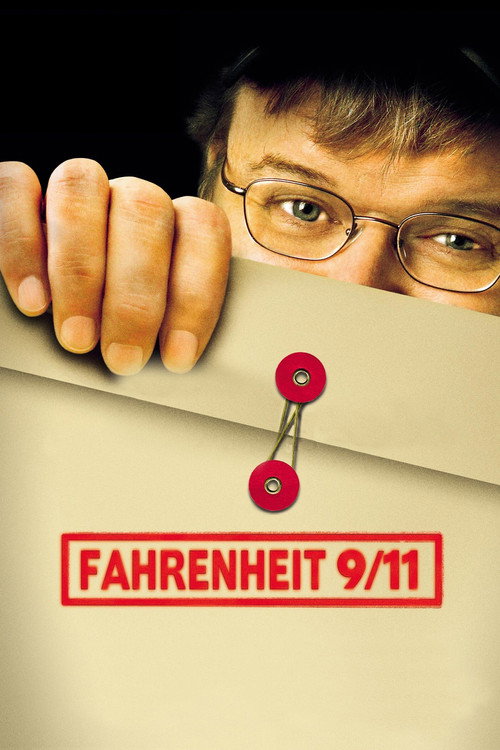
Michael Moore's Fahrenheit 9/11 arrives in June 2004 as a sharp political critique of the George W. Bush administration's handling of the September 11 attacks and the subsequent War on Terror. The documentary opens by contrasting the immediate grief following the terrorist strikes with the rapid political maneuvering that followed. Moore argues that the administration used national fear to push through agendas for wars in Afghanistan and Iraq while neglecting domestic crises like healthcare and economic inequality.
This film cost just $6 million to produce yet became one of the highest-grossing documentaries ever made, earning over $222 million worldwide. Moore serves as both writer and narrator, guiding viewers through interviews with ordinary citizens, politicians, and military families. The movie sparked intense debate across the United States and remains a significant cultural touchstone for its bold stance against government secrecy and media manipulation.
Stream
Availability and pricing can change. Confirm on the provider's site before purchasing.
The narrative begins by establishing a stark contrast between the chaos of the 9/11 aftermath and the calm demeanor of President George W. Bush reading to children at an elementary school in Florida. Moore uses this imagery to question the administration's priorities and emotional connection to the tragedy. He introduces Abdul Henderson, a former Marine whose recruitment story highlights the disconnect between military promises and the reality faced by soldiers. This personal anecdote sets the stage for a broader investigation into how the government prepared the public for conflict.
Moore travels across the United States to interview figures like Representative John Conyers, who discusses the lack of congressional oversight regarding war powers. Author Craig Unger provides evidence linking members of the Bush family to Saudi Arabia and intelligence failures before the attacks. The documentary juxtaposes archival footage of the president with scenes of the chaotic response to the invasion of Iraq. Moore visits Flint, Michigan, to show the decline of American manufacturing and corporate outsourcing, contrasting this domestic decay with the booming profits of defense contractors.
As the film progresses, it scrutinizes the media's role in shaping public opinion. Moore presents clips of news anchors repeating administration talking points about weapons of mass destruction without verification. He questions the timeline of events, asking why the government pushed for war so quickly when no concrete link between Saddam Hussein and the attacks was proven. The narrative also touches on the Patriot Act, framing it as a tool for suppressing civil liberties rather than ensuring security.
Moore visits the homes of soldiers killed in Iraq, interviewing grieving parents to humanize the cost of the war. Throughout these segments, he uses humor and irony to underscore what he perceives as the absurdity of the administration's policies. The story builds toward a climax involving the justification for the war, presenting a montage of pundits repeating claims without scrutiny. The documentary leaves viewers with a sense of urgency and a series of disturbing questions about the true motivations behind the conflict.
Official Trailer
Teaser Trailer
Critical Consensus
Michael Moore's Fahrenheit 9/11 is a polarizing yet undeniably powerful documentary that uses sharp wit and investigative rigor to expose the Bush administration's manipulation of post-9/11 fears. While critics praise its boldness and emotional impact, some note its heavy-handed approach and selective editing, resulting in a film that is as much a political manifesto as it is a historical record.
“Moore has made a film that is both a work of journalism and a work of art, a film that is both an indictment of the Bush administration and a celebration of the American people.”
A.O. Scott
The New York Times
“Fahrenheit 9/11 is a movie that will make you angry, and it should. It is a movie that will make you think, and it should. It is a movie that will make you want to do something, and it should.”
Roger Ebert
Chicago Sun-Times
“Moore's film is a masterful piece of political filmmaking that combines humor, anger, and a deep sense of moral outrage to create a powerful and unforgettable experience.”
Kenneth Turan
Los Angeles Times
Michael Moore
Self / Narrator
John Conyers
Self
Abdul Henderson
Self
George W. Bush
Self (Archive Footage)
Saddam Hussein
Self (Archive Footage)
Osama bin Laden
Self (Archive Footage)
Director
Michael Moore
Writer
Michael Moore
Cinematographer
Timothy Hutton
Producers
Michael Moore, Jim Czarnecki, Kathleen Glynn
Palme d'Or (2004)
Best Film: Won
Academy Awards (2005)
Best Documentary Feature: Nominated
BAFTA Awards (2005)
Best Documentary: Nominated
Golden Globe Awards (2005)
Best Documentary Feature: Nominated
Critics' Choice Movie Awards (2005)
Best Documentary: Won
Join the community
fans discussing