“Bruce Lee is not merely an acrobat or a stuntman; he is an artist, and his art is the martial arts. The movie is a triumph of style over substance, but what style!”
Roger Ebert
Chicago Sun-Times
 United States
"Their deadly mission: to crack the forbidden island of Han!"
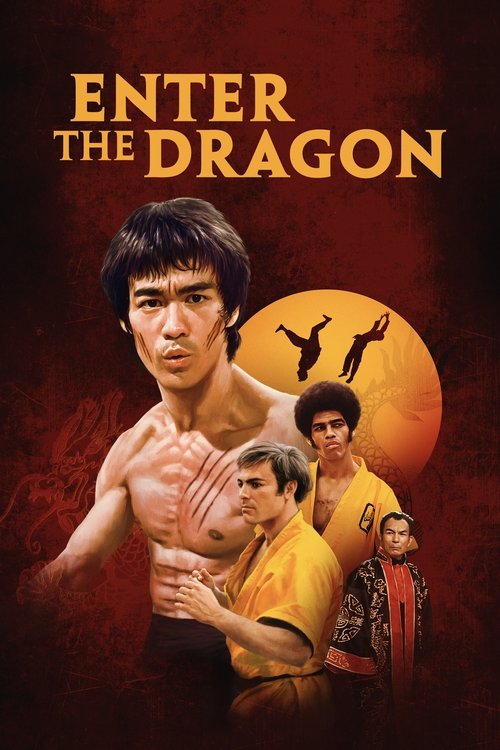
Released six days after Bruce Lee's death on July 20, 1973, Enter the Dragon became the film that introduced martial arts cinema to mainstream Western audiences. Lee plays Lee, a Shaolin monk recruited by British intelligence to infiltrate the island fortress of Han, a former Shaolin student turned crime lord who runs a drug and prostitution empire from a private island. The film's premise is straightforward: a martial arts tournament serves as cover for espionage, personal vengeance, and a clash between Eastern discipline and Western corruption.
Produced on a budget of $850,000, the film grossed over $21 million domestically and an estimated $90 million worldwide when adjusted for inflation, making it one of the most profitable films ever relative to its cost. Director Robert Clouse, working from a script by Michael Allin, framed Lee's phenomenal physical abilities within a narrative that balanced tournament structure with spy thriller elements. The cast includes John Saxon as Roper, a cynical American fighter chasing prize money, and Jim Kelly as Williams, an African American martial artist fleeing racial persecution. Sek Kin plays Han, whose prosthetic hand fitted with blades becomes one of cinema's most memorable weapons.
Lalo Schifrin's score blends funk, jazz, and traditional Chinese instruments, reflecting the film's East-meets-West sensibility. The hall of mirrors climax, inspired by Orson Welles' The Lady from Shanghai, required three weeks to construct and precise choreography to avoid revealing cameras in the reflective surfaces. Enter the Dragon was inducted into the National Film Registry in 2004, recognized by the Library of Congress as culturally and historically significant.
Stream
Availability and pricing can change. Confirm on the provider's site before purchasing.
At a Shaolin temple in southern China, a young monk named Lee undergoes rigorous martial arts training under the watchful eye of the abbot. Lee's sister, Su Lin, has recently died by suicide after being assaulted by men working for Han, a former Shaolin student who now runs a criminal empire from a private island fortress. Han lost his hand in a past confrontation and wears a prosthetic fitted with deadly blades. Every three years, he hosts an elite martial arts tournament to recruit the world's top fighters for his drug trafficking and prostitution operations.
British intelligence approaches Lee and asks him to attend the tournament as a spy. His mission: gather evidence of Han's criminal activities and bring him to justice. Lee accepts, driven by both duty and personal vengeance. He travels to Han's island, a sprawling compound of luxury villas, armed guards, and hidden underground facilities. The tournament brings together fighters from around the world, each with their own motivations.
Among the competitors are Roper, an American martial artist carrying gambling debts who enters for the $10,000 prize money, and Williams, an African American fighter who left the United States to escape racial persecution. The three men form an uneasy alliance as they navigate the tournament's elimination rounds. Lee uses his position to secretly explore the island's underground tunnels, discovering laboratories where Han's men manufacture drugs, weapon caches, and a prison holding captives. He also encounters Mei Ling, an undercover British agent working as a servant on the island.
Han's chief enforcer, Oharra, a former American soldier with a personal grudge against Lee, grows suspicious of Lee's movements. Tensions escalate as the tournament narrows to its final competitors. Lee, Roper, and Williams must decide whether to cooperate or pursue their individual goals. The film builds toward a confrontation that will determine not only the tournament's winner but the fate of Han's criminal enterprise and the lives of everyone on the island.
4K Restoration Official Trailer
4K Official Trailer
Original Theatrical Trailer
Critical Consensus
While its plot follows familiar genre conventions, Enter the Dragon showcases Bruce Lee's extraordinary physical prowess and charisma in a role that balances philosophical depth with explosive action. The innovative fight choreography and Lee's magnetic screen presence elevate it to iconic status, making it the definitive martial arts film.
“Bruce Lee is not merely an acrobat or a stuntman; he is an artist, and his art is the martial arts. The movie is a triumph of style over substance, but what style!”
Roger Ebert
Chicago Sun-Times
“The film is a curious mixture of the absurd and the sublime, but when Bruce Lee is on screen, it is sublime. He moves with the speed of light and the grace of a dancer.”
Vincent Canby
The New York Times
“Bruce Lee's final completed film is a stunning showcase for his phenomenal martial arts abilities. The fight sequences are choreographed with breathtaking precision and energy.”
Variety Staff
Variety
“What makes Enter the Dragon work is Bruce Lee's absolute commitment to his art. He doesn't just fight; he expresses himself through combat.”
Gene Siskel
Chicago Tribune
“Lee was a genuine movie star, and this film, though flawed in its plotting and dialogue, captures the essence of his appeal: the warrior as philosopher, the athlete as artist.”
Richard Corliss
Time Magazine
Bruce Lee
Lee
John Saxon
Roper
Jim Kelly
Williams
Sek Kin
Han
Ahna Capri
Tania
Robert Wall
Oharra
Angela Mao Ying
Su Lin
Betty Chung
Mei Ling
Bolo Yeung
Bolo
Geoffrey Weeks
Braithwaite
Roy Chiao
Shaolin Abbott
Director
Robert Clouse
Writer
Michael Allin
Composer
Lalo Schifrin
Cinematographer
Gil Hubbs
Producers
Paul M. Heller, Bruce Lee, Fred Weintraub
National Film Registry (2004)
Preservation: Inducted
Golden Globe Awards (1974)
Best Motion Picture – Foreign: Nominated
Join the community
fans discussing