“This is a movie that makes you hungry for life as well as food. It is a celebration of the ordinary moments that make up our days.”
Roger Ebert
Chicago Sun-Times
 United States
"A comedy to arouse your appetite."
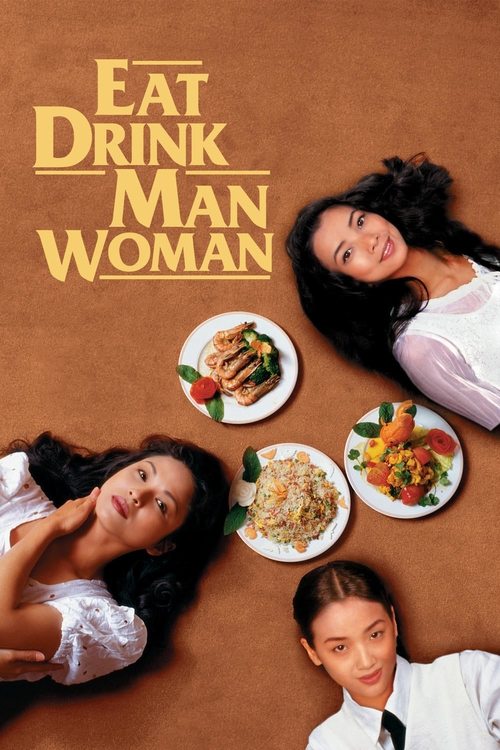
Ang Lee directs a warm, witty exploration of family dynamics in Eat Drink Man Woman, set against the bustling backdrop of modern Taipei. The story centers on Chu Sheng-chen, a retired master chef whose culinary skills once defined his life, now living with his three adult daughters who have yet to settle down. As each daughter navigates her own romantic entanglements, the household undergoes a quiet but profound transformation that challenges their long-held routines.
Every Sunday, the family gathers for an elaborate feast prepared by Chu, only to scatter immediately afterward. These dinners serve as the film's structural heartbeat, revealing the unspoken tensions and hidden desires beneath the surface of polite conversation. The loss of taste becomes a metaphor for the patriarch's emotional isolation, forcing him to rely on others to judge his creations while he waits for his own life to find flavor again.
Stream
Rent
Availability and pricing can change. Confirm on the provider's site before purchasing.
In the vibrant streets of Taipei, Chu Sheng-chen wakes up before dawn to begin his daily ritual. He moves through his kitchen with practiced precision, chopping vegetables and steaming dumplings with a rhythm that has defined his existence for decades. Despite his mastery over flavors, the man himself cannot taste what he cooks anymore. This sensory loss mirrors his emotional distance from the chaotic lives unfolding around him. His home is filled with the sounds of three adult daughters who are all trying to escape the very nest he built for them.
Jia-Jen, the eldest daughter, plays the role of the dutiful caretaker perfectly. She teaches music at a high school and maintains a rigid engagement to Li Kai, a wealthy businessman who represents stability rather than passion. Her father disapproves of the match, sensing a lack of genuine love, but she clings to the arrangement out of a sense of duty to her late mother. Meanwhile, Jia-Chien, the spirited middle sister, hides a secret affair with an older married baker named Guo Lun. She dances aerobics during the day but spends her nights navigating the dangers of a forbidden romance that defies social norms.
The youngest daughter, Jia-Ning, brings a different kind of energy to the household. A tomboyish college student, she recently fell for Raymond, a fellow athlete who seems too immature to handle her intensity. When her ex-boyfriend returns to the picture, she finds herself torn between two worlds. Each woman carries a burden that threatens to shatter the fragile equilibrium of their shared home. They leave the Sunday table abruptly, often without eating much, unable to confront the truths they keep from one another.
The narrative tension builds as these private struggles collide with the public expectations of family life. Jia-Chien's pregnancy forces her into a marriage she never planned, creating a rift with her father who feels betrayed. Jia-Ning faces heartbreak when Raymond proves unwilling to commit to a future together. Jia-Jen begins to question whether her engagement to Li Kai is truly the right path after her father reveals his own unexpected interest in Mrs. Lin, a former colleague.
Food preparation scenes dominate the visual landscape, serving as a language the characters struggle to speak fluently. Chu relies on his daughters to taste his food, symbolizing his need to trust them and let go of control. As the weeks pass, the daughters' personal crises escalate, threatening to dissolve the family unit entirely. The film explores the difficulty of maintaining tradition in a rapidly modernizing society where individual happiness often clashes with collective duty.
The climax approaches as the family faces the prospect of dispersal. Each daughter makes decisions that will fundamentally alter the status quo of their shared home. Jia-Chien announces her marriage, Jia-Ning breaks up with her boyfriend, and Jia-Jen considers ending her engagement. The house, once a sanctuary of routine, stands empty of its usual occupants. The story culminates in a moment of profound realization for Chu, forcing him to confront his own loneliness and the necessity of embracing change. He realizes that holding on too tightly may be the very thing keeping everyone apart.
The resolution redefines what it means to be a family. The daughters move forward with their own lives, finding happiness outside the confines of the parental home. Chu steps into a new chapter, no longer defined solely by his role as a provider or a widower. The final scenes show the family breaking free from the constraints of tradition to embrace their individual paths. It suggests that true family love is not about holding on but about letting go and supporting one another's evolution.
Eat Drink Man Woman Official Trailer #1 - Sihung Lung Movie (1994) HD
Critical Consensus
A masterpiece of domestic drama, Eat Drink Man Woman blends humor and poignancy with stunning visual storytelling. Ang Lee crafts a tender exploration of family dynamics, using food as a universal language to bridge generational divides. The performances are uniformly excellent, particularly Sihung Lung, delivering a nuanced portrayal of a man rediscovering his humanity.
“This is a movie that makes you hungry for life as well as food. It is a celebration of the ordinary moments that make up our days.”
Roger Ebert
Chicago Sun-Times
“Ang Lee has created a film that is both deeply specific to its culture and universally relatable. The food is delicious, the acting is superb, and the story is a delight.”
Janet Maslin
The New York Times
“A richly layered comedy-drama that proves Ang Lee is a master of the human condition. The film is a feast for the senses and the soul.”
Peter Travers
Rolling Stone
“A warm, witty, and visually stunning film that captures the essence of family life in modern Taipei. Ang Lee's direction is impeccable, and the script is a model of subtlety and depth.”
Variety Staff
Variety
Sihung Lung
Mr. Chu
Yang Kuei-mei
Jia-Jen
Jacklyn Wu Chien-Lien
Jia-Chien
Wang Yu-wen
Jia-Ning
Sylvia Chang
Jin-Rong
Winston Chao
Li Kai
Chen Chao-jung
Guo Lun
Lester Chan Chit-Man
Raymond
Gua Ah-leh
Mrs. Lin
Director
Ang Lee
Writers
Ang Lee, James Schamus, Wang Huiling
Composer
Peter Mader
Cinematographer
Jong Lin
Producer
Hsu Li-Kong
Academy Awards (1995)
Best Foreign Language Film: Nominated
Golden Globe Awards (1995)
Best Foreign Language Film: Nominated
BAFTA Awards (1995)
Best Film Not in the English Language: Nominated
Cannes Film Festival (1994)
FIPRESCI Prize: Won
National Society of Film Critics Awards (1994)
Best Director: Won
New York Film Critics Circle (1994)
Best Director: Won
Los Angeles Film Critics Association (1994)
Best Picture: Won
Join the community
fans discussing