 Japan
Japan“A spacious, deeply felt film about the secrets we keep and the burdens we carry.”
David Ehrlich
IndieWire
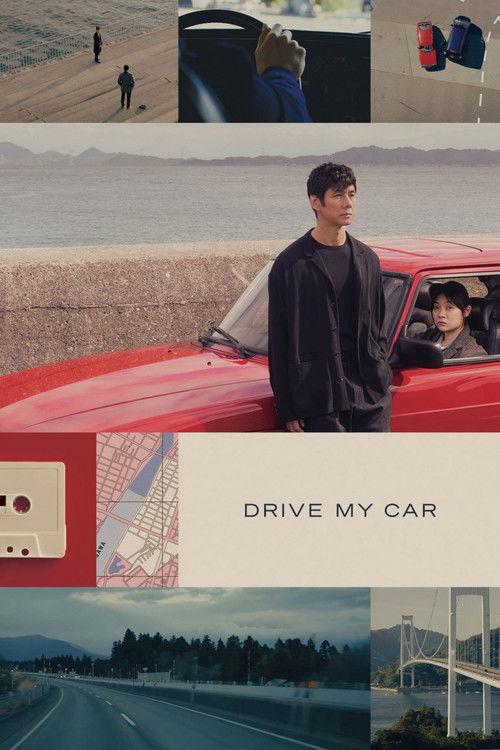
Ryusuke Hamaguchi's Drive My Car, adapted from Haruki Murakami's short story, is a quietly devastating drama that explores grief, infidelity, and the slow, painful process of human connection. The film follows Yusuke Kafuku, a stage actor and director still haunted by his wife Oto's sudden death two years earlier. When he accepts a residency in Hiroshima to direct a multilingual production of Chekhov's Uncle Vanya, he is assigned a stoic young chauffeur, Misaki Watari. What begins as an awkward arrangement transforms into a shared journey of emotional reckoning.
Hamaguchi expands Murakami's story into a three-hour epic, adding layers of theatrical performance and cross-cultural communication. The film's deliberate pacing and intimate scenes create space for its characters to reveal their wounds gradually. Premiering at the 2021 Cannes Film Festival, where it won Best Screenplay, Drive My Car went on to receive four Academy Award nominations, including Best Picture, and won Best International Feature Film. It was the first Japanese film ever nominated for the top Oscar.
Stream
Max
Hulu
Rent
Amazon Prime Video
Availability and pricing can change. Confirm on the provider's site before purchasing.
Yusuke Kafuku is a celebrated stage actor and director living in Tokyo with his wife Oto, a screenwriter with a peculiar creative process. She invents story ideas during sex, then recounts them to Yusuke the next morning. Their marriage is loving and collaborative, but Yusuke discovers Oto has been having affairs. He confronts her but does not expose what he knows. Before they can resolve anything, Oto dies suddenly from a brain hemorrhage.
Two years later, Yusuke is still consumed by grief and unanswered questions. He accepts a residency at a theater festival in Hiroshima to direct Uncle Vanya. Festival rules require all participants to be chauffeured, so he is assigned Misaki Watari, a quiet young woman with a troubled past. Yusuke initially resents the arrangement, preferring to drive himself in his red Saab 900 while listening to a cassette of Oto's voice. But Misaki's calm, precise driving gradually earns his trust.
Yusuke casts actors from multiple countries, including Lee Yoo-na, a mute Korean actress who performs in sign language, and Koji Takatsuki, a popular but scandal-ridden actor who was one of Oto's lovers. The multilingual production becomes a metaphor for the difficulty of genuine communication. As rehearsals progress, Yusuke and Misaki share long drives, slowly opening up about their losses. Misaki reveals that her mother died in a landslide, and that she blames herself. Their conversations are sparse but profound, each revelation chipping away at their emotional armor.
The film interweaves Yusuke's past with his present, showing flashbacks of his marriage and the night he discovered Oto's infidelity. He also forms a tense bond with Takatsuki, who offers him a perspective on Oto that complicates his memories. The rehearsals for Uncle Vanya mirror the characters' internal struggles, as they confront their own versions of the play's themes: regret, longing, and the search for meaning. The narrative builds toward the festival performance, where Yusuke must finally face his grief head-on.
Official Trailer
Official US Trailer
Trailer
Critical Consensus
Ryusuke Hamaguchi's Drive My Car is a richly rewarding, profoundly moving adaptation that masterfully navigates themes of grief, loss, and connection through its compelling characters and deliberate pacing.
“A spacious, deeply felt film about the secrets we keep and the burdens we carry.”
David Ehrlich
IndieWire
“This is a film that finds its way into your heart and mind slowly, but surely, and stays there.”
Brian Tallerico
RogerEbert.com
“It's a masterfully crafted film, a rich, rewarding, and ultimately hopeful exploration of what it means to connect with another human being.”
Katie Walsh
Los Angeles Times
“The film is a profound, patient, and generous meditation on grief, regret, and the slow, arduous process of healing.”
Justin Chang
Los Angeles Times
Hidetoshi Nishijima
Yūsuke Kafuku
Toko Miura
Misaki Watari
Masaki Okada
Kōshi Takatsuki
Reika Kirishima
Oto Kafuku
Park Yu-rim
Lee Yoo-na
Jin Dae-yeon
Gong Yoon-su
Sonia Yuan
Janice Chang
Ahn Hwi-tae
Ryu Jong-ui
Perry Dizon
Roy Rossello
Satoko Abe
Yuzuhara
Director
Ryusuke Hamaguchi
Writers
Ryusuke Hamaguchi, Takamasa Oe, Haruki Murakami
Composers
Eiko Ishibashi, Yoshitaka Fujimoto
Cinematographers
Hidetoshi Shinomiya, Lee Tae-hun
Producer
Teruhisa Yamamoto
Academy Award for Best International Feature Film (2022)
Best International Feature Film: Won
Cannes Film Festival Best Screenplay (2021)
Best Screenplay: Won
Golden Globe Award for Best Foreign Language Film (2022)
Best Foreign Language Film: Won
National Society of Film Critics Award for Best Film (2022)
Best Film: Won
Academy Award for Best Picture (2022)
Best Picture: Nominated
Join the community
fans discussing