“Mr. Wilder has made a film which moves with the speed and menace of an express train. It is a taut, tense, and exciting picture, and it is also a highly intelligent one.”
Bosley Crowther
The New York Times
 United States
"A dead man's policy, a live woman's kiss."
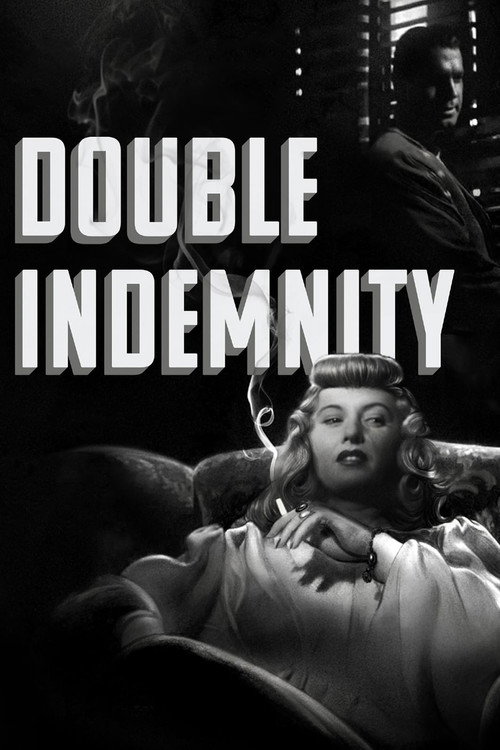
Double Indemnity, released in 1944, is a cornerstone of film noir directed by Billy Wilder. The story follows Walter Neff, an insurance salesman played by Fred MacMurray, who gets entangled with the seductive Phyllis Dietrichson, portrayed by Barbara Stanwyck. Together, they plot to kill her husband and claim a double indemnity insurance payout. The scheme draws the attention of Neff's colleague and friend, claims investigator Barton Keyes, played by Edward G. Robinson. With a budget of just under a million dollars, the film grossed two and a half million at the box office, a solid hit.
Wilder co-wrote the script with novelist Raymond Chandler, adapting James M. Cain's 1943 novella. The collaboration was famously fraught: Chandler, a heavy drinker, often arrived late and drunk, and Wilder later called the experience a nightmare. Yet the resulting screenplay is razor-sharp, filled with hard-boiled dialogue that has become legendary. The film's shadowy cinematography by John F. Seitz and Miklós Rózsa's tense score set the template for the genre.
Double Indemnity pushed the boundaries of the Hays Code with its overt sexual tension and repeated use of the word murder. The ending was altered from Cain's original to satisfy censors. The film received seven Academy Award nominations, including Best Director, Best Actress, and Best Screenplay. In 1992, it was inducted into the National Film Registry. It holds an 8.1 rating on our site, reflecting its enduring status as a classic.
Stream
Availability and pricing can change. Confirm on the provider's site before purchasing.
Walter Neff, an insurance salesman, stumbles into his Los Angeles office late at night, bleeding from a gunshot wound. He begins dictating a confession into his Dictaphone, and the story flashes back several months. Neff is a confident, smooth-talking professional who prides himself on his knowledge of insurance law. During a routine call to renew an automobile policy, he meets Phyllis Dietrichson, a blonde woman who answers the door in only a towel. The attraction is immediate.
Phyllis is trapped in a loveless marriage to her older, wealthy husband, Mr. Dietrichson. She subtly probes Neff about life insurance, specifically the double indemnity clause that pays double the face value if the insured dies accidentally. Neff recognizes the implication but is drawn in by her beauty and audacity. They begin an affair, and soon Phyllis proposes murder: kill her husband, make it look like a train accident, and collect the double indemnity.
Neff, despite knowing the risks, agrees. He devises an elaborate scheme using his expertise to bypass the scrutiny of his own company's claims department, headed by his friend and mentor Barton Keyes. Keyes is a brilliant, intuitive claims investigator who can detect fraud instinctively. Neff and Phyllis execute the murder on a train, staging Mr. Dietrichson's death as a fall from the observation platform. The plan seems flawless.
But complications arise almost immediately. Keyes becomes suspicious of the claim, sensing something wrong without hard evidence. He begins investigating, and Neff must work closely with him while hiding his guilt. Meanwhile, Phyllis's stepdaughter Lola becomes a problem. She despises her stepmother and suspects her of having an affair. Lola confides in Neff, telling him about her boyfriend Nino Zachetti, who she fears is being manipulated by Phyllis. Neff finds himself entangled in a web of lies, and the relationship with Phyllis begins to fray under the pressure of Keyes's investigation and mounting paranoia. The central conflict becomes a battle of wits between Neff and Keyes, with Neff racing to keep his crime hidden while Keyes closes in, all while Neff realizes he may not have been the one in control all along.
Trailer
Critical Consensus
Double Indemnity is widely regarded as the quintessential film noir, a masterclass in tension, dialogue, and shadowy visual style. Billy Wilder's direction, combined with Raymond Chandler's razor-sharp script and John F. Seitz's expressionistic cinematography, creates a dark, seductive world of moral decay. The performances, especially Stanwyck's cold, calculating femme fatale and MacMurray's doomed everyman, are iconic. The film's influence on the crime genre is immeasurable.
“Mr. Wilder has made a film which moves with the speed and menace of an express train. It is a taut, tense, and exciting picture, and it is also a highly intelligent one.”
Bosley Crowther
The New York Times
“Double Indemnity is a film of pure style, from the opening shot of a car speeding along a dark street to the final, ironic fadeout. It is the film that defined film noir.”
Roger Ebert
Chicago Sun-Times
“A triumph of slick, hard-boiled storytelling. Stanwyck's Phyllis is the definitive femme fatale, all platinum hair, anklet, and murderous intent.”
Pauline Kael
The New Yorker
“Billy Wilder has turned out a socko melodrama. The story is told with a hard, unrelenting realism that makes it stand out among crime pictures.”
Variety Staff
Variety
“The film is a perfect machine, like the insurance policies it dissects. Every scene, every line of dialogue, every shadow is calculated to maximum effect. It is Wilder's masterpiece.”
David Thomson
The Guardian
Fred MacMurray
Walter Neff
Barbara Stanwyck
Phyllis Dietrichson
Edward G. Robinson
Barton Keyes
Porter Hall
Mr. Jackson
Jean Heather
Lola Dietrichson
Tom Powers
Mr. Dietrichson
Byron Barr
Nino Zachetti
Richard Gaines
Edward S. Norton Jr.
Fortunio Bonanova
Sam Garlopis
John Philliber
Joe Pete
Director
Billy Wilder
Writers
Raymond Chandler, James M. Cain, Billy Wilder
Composer
Miklós Rózsa
Cinematographer
John F. Seitz
Producer
Joseph Sistrom
Academy Awards (1945)
Best Director: Nominated
Academy Awards (1945)
Best Actress: Nominated
Academy Awards (1945)
Best Screenplay: Nominated
Academy Awards (1945)
Best Cinematography, Black-and-White: Nominated
Academy Awards (1945)
Best Music, Scoring of a Dramatic or Comedy Picture: Nominated
Academy Awards (1945)
Best Sound Recording: Nominated
National Film Registry (1992)
Preserved: Inducted
Join the community
fans discussing