 United States
“The film creates a world that feels lived-in and authentic, with Washington delivering a performance that anchors the entire narrative.”
Roger Ebert
Chicago Sun-Times
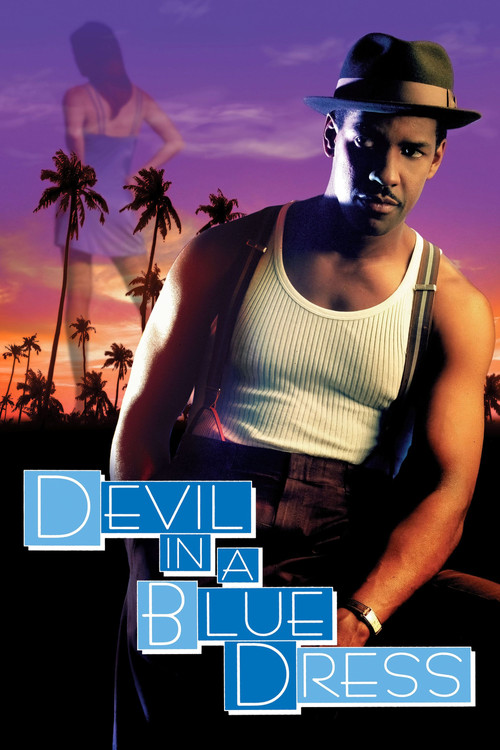
Set against the simmering racial tensions of late 1940s Los Angeles, Devil in a Blue Dress follows Easy Rawlins, an unemployed World War II veteran struggling to make ends meet. When a mysterious white man named DeWitt Albright approaches him at a jazz club with a lucrative offer to find a missing woman, Easy sees a chance to pay his bills. The film transforms this noir setup into a tense journey through the city's segregated underbelly, where the line between friend and foe blurs quickly.
Director Carl Franklin guides the story with a steady hand, drawing strong performances from Denzel Washington as the reluctant private eye and Tom Sizemore as the slick manipulator who hires him. Jennifer Beals brings a haunting presence to the role of Daphne Monet, while Don Cheadle shines as Mouse Alexander, a volatile bodyguard who becomes central to the mystery. Produced on a $27 million budget by TriStar Pictures, the movie earned just over $16 million at the box office, finding its audience among fans of crime dramas rather than blockbuster crowds. Critics noted the film's gritty atmosphere and sharp dialogue, giving it a solid rating that reflects its status as a well-crafted genre piece.
Stream
Rent
Availability and pricing can change. Confirm on the provider's site before purchasing.
Los Angeles, 1948. Ezekiel "Easy" Rawlins wakes up in a house he barely owns after losing his job at a defense plant during the postwar economic shift. As a Black veteran returning from Europe, he faces a reality where his service earned him no respect or security. He needs money fast to keep his home, and the only way forward seems to be through the shadows of the city's jazz scene. That evening at Club Deluxe, DeWitt Albright corners him with a proposition that sounds too good to be true: locate a missing woman named Daphne Monet for a fee of $1,000, a sum that would solve all his financial worries instantly.
Albright warns Easy that Daphne is white-passing and frequents Black neighborhoods, a detail that immediately raises the stakes. The assignment pulls Easy away from his quiet life and into a world of corrupt politicians, wealthy industrialists, and violent gangsters. He starts by visiting Joppy, a bartender who knows everyone, and reconnects with Mouse Alexander, a former soldier turned enforcer whose charm masks a terrifying capacity for violence. Together they navigate a maze of lies where every clue leads to another dead end or a new threat.
The investigation reveals that Daphne is not just any runaway; she is tied to powerful men like Matthew Terell and mayoral candidate Todd Carter. Her disappearance is not a simple case of a woman running away but a calculated effort to silence her. As Easy digs deeper, he finds himself framed for crimes he did not commit and hunted by men who will stop at nothing to protect their secrets. The city itself feels like a character, with its strict racial boundaries dictating who can walk where and who holds the power.
Easy's journey takes him from the smoky rooms of South Central jazz clubs to the manicured lawns of white enclaves, forcing him to confront the harsh realities of race and class in America. Each step closer to the truth brings more danger, with friends turning hostile and allies disappearing. The tension builds as Easy realizes that solving this mystery might cost him everything he has left, including his life. He must rely on his wits, his past training, and the unpredictable loyalty of Mouse to survive the web of deception spun around Daphne Monet.
The narrative thickens as the stakes rise from a simple missing person case to a conspiracy involving high-level political corruption and murder. Easy finds himself trapped between the forces of white supremacy and the criminal underworld, forced to make impossible choices about who to trust and how far to go to uncover the truth. The clock ticks down as the killer closes in, and Easy must decide if the price of the truth is worth paying when the system is rigged against him from the start.
Official Trailer
Critical Consensus
Critics praised Devil in a Blue Dress for its stylish direction, atmospheric setting, and strong performances, particularly from Denzel Washington and Don Cheadle. The film successfully revitalizes the neo-noir genre by centering on a Black protagonist and exploring complex themes of race and power in 1940s Los Angeles. While it faced commercial challenges upon release, its reputation has grown significantly over time.
“The film creates a world that feels lived-in and authentic, with Washington delivering a performance that anchors the entire narrative.”
Roger Ebert
Chicago Sun-Times
“A handsome, atmospheric adaptation that captures the novel's seductive period detail and sharp eye for racial politics.”
Janet Maslin
The New York Times
“Richly textured noir with a superb performance by Washington and assured direction that avoids cliché.”
Todd McCarthy
Variety
“Doesn't just imitate the noir tradition but reinvigorates it with a Black protagonist's perspective and intelligence.”
Kenneth Turan
Los Angeles Times
Denzel Washington
Ezekiel "Easy" Rawlins
Tom Sizemore
DeWitt Albright
Jennifer Beals
Daphne Monet
Don Cheadle
Mouse Alexander
Maury Chaykin
Matthew Terell
Terry Kinney
Todd Carter
Mel Winkler
Joppy
Director
Carl Franklin
Writers
Carl Franklin, Walter Mosley
Composer
Elmer Bernstein
Cinematographer
Tak Fujimoto
Producers
Gary Goetzman, Jesse Beaton
NAACP Image Awards (1996)
Outstanding Motion Picture: Nominated
Los Angeles Film Critics Association (1995)
Best Supporting Actor: Won (Don Cheadle)
National Society of Film Critics (1995)
Best Supporting Actor: Nominated (Don Cheadle)
Join the community
fans discussing