“Days of Heaven is above all one of the most beautiful films ever made. Malick's purpose is not to tell a story of melodrama, but one of loss. His tone is elegiac, his images are sublime.”
Roger Ebert
RogerEbert.com
 United States
"One woman. Two men. A summer that changed everything."
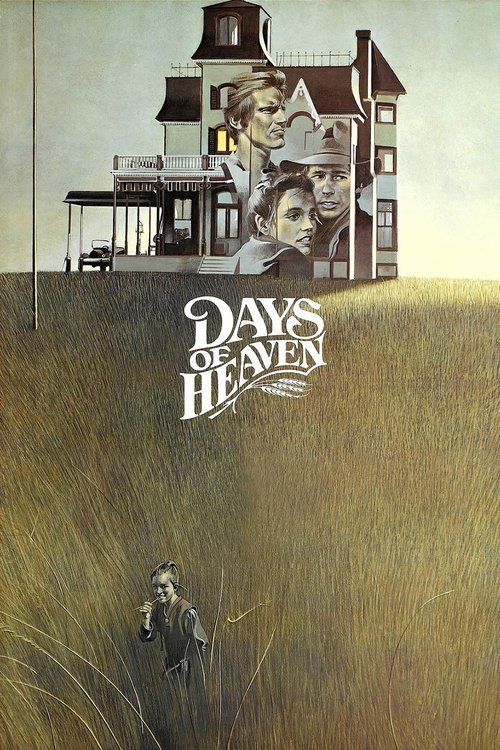
In the summer of 1916, a Chicago steelworker named Bill kills his foreman in a fit of rage and flees the city with his girlfriend Abby and his younger sister Linda. They hop a freight train south, eventually landing as seasonal laborers on a vast wheat farm in the Texas Panhandle. The farm belongs to a wealthy, terminally ill farmer, played by Sam Shepard, who lives alone in a grand Victorian house overlooking the endless fields. What follows is a quiet, devastating love triangle that unfolds against the most breathtaking natural light ever captured on film.
Terrence Malick's second feature is a visual poem. Cinematographer Néstor Almendros shot almost entirely during the golden hours of dawn and dusk, giving the film an ethereal, painterly quality. The score by Ennio Morricone adds a layer of melancholy, and Linda Manz's improvised voice-over narration provides a child's-eye view that is both naive and profound. The film was notoriously difficult to make, taking nearly two years to shoot, with Malick waiting hours for the perfect light. It won the Academy Award for Best Cinematography and remains a touchstone of 1970s American cinema.
Made on a modest budget of $3 million, Days of Heaven grossed only about $3.7 million at the box office, but its reputation has only grown. Roger Ebert called it one of the most beautiful films ever made, and Quentin Tarantino described it as a moving painting. The film's 4K restoration in 2023 introduced it to a new generation, reaffirming its status as a masterpiece.
Free with ads
Availability and pricing can change. Confirm on the provider's site before purchasing.
In 1916, Bill works in a Chicago steel mill, but his temper gets the better of him. After a violent confrontation with his foreman, he kills the man and flees with his girlfriend Abby and his younger sister Linda. They hop a freight train and head south, eventually finding work as seasonal laborers on a vast wheat farm in the Texas Panhandle. The farm is owned by a wealthy, terminally ill farmer who lives alone in a grand house. Bill, Abby, and Linda join the crew of harvest hands, working under the blazing sun.
The farmer, played by Sam Shepard, is quiet and observant. He notices Abby's gentle beauty and begins to court her. Bill, seeing an opportunity, convinces Abby to marry the dying farmer, reasoning that when he dies, they will inherit his fortune. Abby reluctantly agrees, despite her genuine feelings for Bill and her unease about the deception. The marriage takes place, and Abby moves into the farmer's house, while Bill remains on the farm as a laborer, watching from a distance as his girlfriend plays the role of devoted wife.
As the seasons turn, the situation grows increasingly fraught. The farmer, who seemed frail, becomes more vibrant and alive than anyone expected. His love for Abby gives him renewed purpose, and he showers her with gifts and attention. Abby, caught between her loyalty to Bill and her growing affection for the man who genuinely loves her, finds herself in an impossible emotional bind. Bill, meanwhile, grows increasingly jealous and restless.
Linda, the young narrator, observes the adults' deceptions with a child's mixture of innocence and hard-won cynicism. Her voice-over commentary, delivered in a rambling, poetic monologue, provides a running commentary on the beauty of the landscape and the fragility of human relationships. The tension ratchets up as the farmer begins to suspect the truth about Bill and Abby's relationship, setting the stage for a devastating confrontation.
The film's first half builds this delicate, quietly devastating love triangle against the backdrop of the American heartland. Malick's camera captures the sublime beauty of the natural world: locusts swarming, wheat swaying in the wind, the vast prairie sky. The human drama unfolds in hushed, elliptical scenes, with dialogue sparse and meaning conveyed through gesture and glance. The idyllic farm becomes a pressure cooker, and the tension threatens to boil over, leading to a climax that will change all their lives forever.
Official 4K Restoration Trailer
AFS Presents: Days of Heaven
Days of Heaven - Trailer
Critical Consensus
Days of Heaven is widely regarded as one of the most visually stunning films ever made, with Terrence Malick's lyrical direction, Néstor Almendros's revolutionary natural-light cinematography, and Ennio Morricone's haunting score combining to create a transcendent meditation on love, class, and the passage of time. The film's elliptical narrative and Linda Manz's unforgettable narration have made it a cornerstone of 1970s American cinema, though its slow pacing and ambiguous storytelling may not appeal to all viewers.
“Days of Heaven is above all one of the most beautiful films ever made. Malick's purpose is not to tell a story of melodrama, but one of loss. His tone is elegiac, his images are sublime.”
Roger Ebert
RogerEbert.com
“Tarantino called the film a 'moving painting,' praising its visual poetry and its status as a pinnacle of 1970s filmmaking.”
Quentin Tarantino
Collider
“The film is so much about the beauty of the natural world and the fragility of human life. Malick's method was to wait for the light, to let the moment happen, and that patience is visible in every frame.”
Brooke Adams
The Film Stage
“Days of Heaven, one of Malick's most memorable films, is religiously shot in natural light. It is from a time when Hollywood had transitioned away from the studio-bound productions of the classical era toward a more naturalistic, location-based aesthetic.”
No Film School
No Film School
Richard Gere
Bill
Brooke Adams
Abby
Sam Shepard
The Farmer
Linda Manz
Linda
Robert J. Wilke
The Farm Foreman
Jackie Shultis
Linda's Friend
Stuart Margolin
Mill Foreman
Timothy Scott
Harvest Hand
Gene Bell
Dancer
Doug Kershaw
Fiddler
Richard Libertini
Vaudeville Leader
Frenchie Lemond
Vaudeville Wrestler
Director
Terrence Malick
Writer
Terrence Malick
Composer
Ennio Morricone
Cinematographer
Néstor Almendros
Producers
Bert Schneider, Harold Schneider
Academy Award (1979)
Best Cinematography: Won
Academy Award (1979)
Best Original Score: Nominated
Academy Award (1979)
Best Costume Design: Nominated
Cannes Film Festival (1979)
Best Director: Won
Cannes Film Festival (1979)
Palme d'Or: Nominated
National Society of Film Critics Award (1979)
Best Cinematography: Won
Kansas City Film Critics Circle Award (1979)
Best Film: Won
Join the community
fans discussing