“Mr. Bogart and Miss Bacall make a handsome pair of fugitives from justice, and their performances are as slick as the film's direction.”
Bosley Crowther
The New York Times
 United States
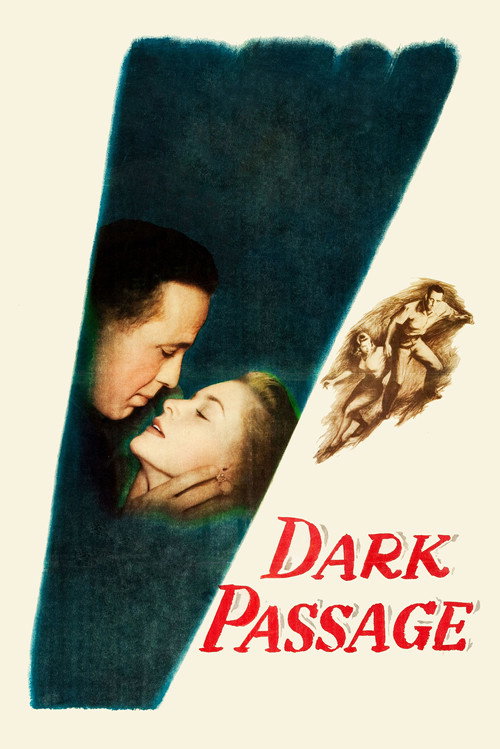
"A man with no face, a woman with no fear."
Dark Passage, released in 1947, is a film noir thriller directed by Delmer Daves, starring the iconic duo Humphrey Bogart and Lauren Bacall. Bogart plays Vincent Parry, a man wrongly convicted of murdering his wife who escapes from San Quentin prison. Bacall is Irene Jansen, a sympathetic woman who helps him evade capture and prove his innocence. The film also features Agnes Moorehead as the menacing Madge Rapf, Bruce Bennett as Irene's friend Bob, and Tom D'Andrea as a friendly cabby. Produced by Warner Bros. on a budget of $1.68 million, it earned $3.43 million at the box office, a solid return.
The story unfolds in San Francisco, using innovative first-person camera work to show Parry's perspective before his bandages come off. With a score by Franz Waxman and cinematography by Sidney Hickox, the film captures the shadowy, paranoid mood of post-war noir. It holds a rating of 7.3 out of 10 on IMDb, reflecting its enduring appeal among classic cinema fans.
Availability and pricing can change. Confirm on the provider's site before purchasing.
Vincent Parry, a man convicted of murdering his wealthy wife, escapes from San Quentin State Prison by hiding in the back of a truck. The film opens with a daring first-person camera perspective, letting audiences see everything through Parry's eyes for the first thirty minutes. His face remains hidden until later. After the truck stops, he is discovered by Irene Jansen, a young artist who recognizes him from newspaper coverage. Irene, whose own father was wrongfully executed for murder, decides to help Parry evade the law.
She hides him in her San Francisco apartment, where he learns that the police, led by Detective Kennedy, are actively searching for him. Meanwhile, Madge Rapf, a wealthy and obsessive friend of Parry's late wife, seems determined to see him recaptured. Parry decides he needs to change his appearance to avoid capture. He contacts Dr. Walter Coley, a skilled plastic surgeon who agrees to perform facial reconstruction surgery in a secret procedure. The operation is successful, but Parry must wear bandages for weeks, leaving him vulnerable.
During his recovery, he befriends Sam, a talkative cab driver who becomes an unlikely ally. As the bandages come off, revealing Bogart's face for the first time, Parry begins investigating his wife's murder. He discovers that the real killer may be someone close to him. Irene's friend Bob grows suspicious of her involvement with a fugitive. Madge intensifies her pursuit, threatening to expose Parry unless he does her bidding. The story builds toward a confrontation where Parry must clear his name while navigating a web of deceit, betrayal, and romantic tension with Irene.
Dark Passage (1947) ORIGINAL TRAILER [HD 1080p]
Dark Passage - Trailer
Critical Consensus
Dark Passage is a stylish and suspenseful film noir that benefits from the electric chemistry between Bogart and Bacall, though its first-person camera gimmick sometimes feels more distracting than immersive. The San Francisco locations and Franz Waxman's score create a tense atmosphere that compensates for a somewhat predictable plot.
“Mr. Bogart and Miss Bacall make a handsome pair of fugitives from justice, and their performances are as slick as the film's direction.”
Bosley Crowther
The New York Times
“The first-person camera technique is an interesting experiment that gives the film a unique visual identity, even if it occasionally strains credibility.”
Variety Staff
Variety
“Delmer Daves directs with a sure hand, using San Francisco locations to create a palpable sense of paranoia and isolation.”
Dave Kehr
Chicago Reader
“Bogart and Bacall have never been more appealing, but the film's reliance on coincidence and convenient plot devices undermines its noir credibility.”
Pauline Kael
The New Yorker
“Dark Passage is a minor but enjoyable entry in the Bogart-Bacall canon, notable for its experimental opening and the easy rapport between its stars.”
Roger Ebert
Chicago Sun-Times
Humphrey Bogart
Vincent Parry
Lauren Bacall
Irene Jansen
Bruce Bennett
Bob
Agnes Moorehead
Madge Rapf
Tom D'Andrea
Cabby (Sam)
Clifton Young
Baker
Douglas Kennedy
Detective Kennedy
Rory Mallinson
George Fellsinger
Houseley Stevenson
Dr. Walter Coley
Mary Field
Aunt Mary at Bus Station (uncredited)
John Arledge
Lonely Man at Bus Station (uncredited)
Vince Edwards
Cop at Tollbooth (uncredited)
Director
Delmer Daves
Writers
Delmer Daves, David Goodis
Composer
Franz Waxman
Cinematographer
Sidney Hickox
Producer
Jerry Wald
Edgar Allan Poe Awards (1948)
Best Motion Picture: Nominated
Join the community
fans discussing