 United States
“A cold, precise and often thrilling examination of modern love, directed with the timing of a fencing master.”
A.O. Scott
The New York Times
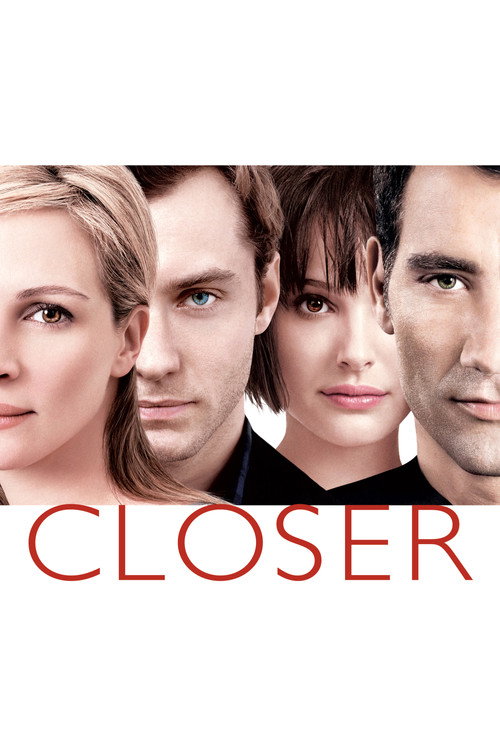
Mike Nichols directed Closer, a 2004 drama that tracks four Londoners as they fall into and out of love with each other. The film stars Jude Law as Dan, a failed novelist turned obituary writer; Natalie Portman as Alice, an American stripper newly arrived in the city; Julia Roberts as Anna, a portrait photographer; and Clive Owen as Larry, a dermatologist. Their lives intersect through chance meetings and deliberate betrayals, and the story keeps its focus on the conversations that pull them together and tear them apart.
Nichols adapted Patrick Marber's play with Marber himself writing the screenplay, and the result keeps the stage version's sharp, confrontational dialogue while opening it up to London streets, studios, and hospital rooms. The production cost about $27 million and grossed $115.5 million worldwide, a strong return for a talk-heavy adult drama. Stephen Goldblatt's cinematography favors close-ups and natural light, letting faces carry the weight of what is said and unsaid.
The film earned a 7.2 rating on IMDb from roughly 240,000 votes, and it drew attention for its unromantic view of romance. It is not a love story in the conventional sense but a study of desire, honesty, and the damage people do when they confuse the two.
Availability and pricing can change. Confirm on the provider's site before purchasing.
A crowded London street, and Alice is walking. She is young, American, newly arrived, and she locks eyes with a stranger for perhaps two seconds before a taxi knocks her down. Dan, an obituary writer with a novel he cannot finish, rushes to help. In the hospital waiting room their first exchange is a flirtatious duel of words, a small performance on both sides. She says her name is Alice. He says he is a writer. She is a stripper. He is not quite lying, but he is not quite telling the truth either. By the end of the scene they are together, and she has moved into his flat. The film has announced its terms: intimacy here is a contest of wit and self-invention, and nearly everyone is playing a version of themselves.
Months later Dan visits a photographer's studio to have his author portrait taken. Anna is a successful portrait photographer, guarded and precise, and the attraction between them is immediate and mutual. Anna resists. She has a rule about not getting involved with her subjects, and she keeps it, at first. Dan cannot let it go. Unable to accept her refusal, he engineers a prank of unusual cruelty: in an internet chat room he poses as Anna and arranges a meeting with Larry, a dermatologist, who arrives at the aquarium expecting a woman. When Larry discovers the deception he is furious, but the encounter leads him to Anna, and the two begin a relationship. Four lives are now knotted together, and the film follows the fallout across years.
What follows is not a plot of events so much as a series of negotiations. Couples form and break, partners swap, and each reunion and betrayal is worked out in long, exacting conversations. Dan and Anna eventually leave their partners for each other. Alice and Larry are left to deal with the wreckage. The film's central conflict is not whether these people love each other but whether they can ever be honest with each other, and whether honesty, when it finally arrives, is something love can survive. The story stops short of a conventional resolution, favoring a clear-eyed, unresolved look at what remains after the lies.
Marber's screenplay preserves much of the stage play's verbal combat while opening the action to London locations: the street where Alice is struck, the photographer's studio, the aquarium, the hospital. Nichols directs with a discipline that lets the words carry the weight, and the four leads play against the grain of their usual screen images. Roberts is deliberately unglamorous as Anna, Portman plays Alice as a woman who uses performance as armor, Law makes Dan's charm curdle into something needy and cruel, and Owen gives Larry a blunt, volatile force that turns the film's later scenes into something close to a interrogation.
Closer (2004) Original Trailer [FHD]
Critical Consensus
Critics were divided but largely admiring of Closer's ferocious intelligence and its refusal to sentimentalize romance. Reviewers praised the four leads, particularly Clive Owen and Natalie Portman, and Nichols's disciplined, close-up-driven direction, while some found the characters too cold and the dialogue too stagebound to fully embrace. The consensus: a sharp, bruising, beautifully acted anatomy of intimacy and deceit.
“A cold, precise and often thrilling examination of modern love, directed with the timing of a fencing master.”
A.O. Scott
The New York Times
“A film about people who use honesty as a weapon, and it refuses to offer easy comfort.”
Roger Ebert
Chicago Sun-Times
“A bracing, emotionally bruising experience, with Clive Owen's performance as its volatile engine.”
Todd McCarthy
Variety
“Merciless in its examination of the lies lovers tell, with an ensemble delivering razor-sharp work.”
Kirk Honeycutt
The Hollywood Reporter
“Savagely funny and painfully sad, turning emotional cruelty into something close to art.”
Peter Bradshaw
The Guardian
Jude Law
Dan
Natalie Portman
Alice
Julia Roberts
Anna
Clive Owen
Larry
Colin Stinton
Customs Officer
Nick Hobbs
Taxi Driver
Director
Mike Nichols
Writer
Patrick Marber
Cinematographer
Stephen Goldblatt
Producers
Cary Brokaw, Mike Nichols, John Calley
Academy Awards (2005)
Best Supporting Actor (Clive Owen): Nominated
Academy Awards (2005)
Best Supporting Actress (Natalie Portman): Nominated
Golden Globe Awards (2005)
Best Supporting Actor (Clive Owen): Won
Golden Globe Awards (2005)
Best Supporting Actress (Natalie Portman): Won
BAFTA Awards (2005)
Best Supporting Actor (Clive Owen): Won
Join the community
fans discussing