“Close Encounters of the Third Kind is a work of inspired filmmaking that is as much about the wonder of childhood as it is about extraterrestrial life.”
Vincent Canby
The New York Times
 United States
"We are not alone."
User Score
4,659 votes
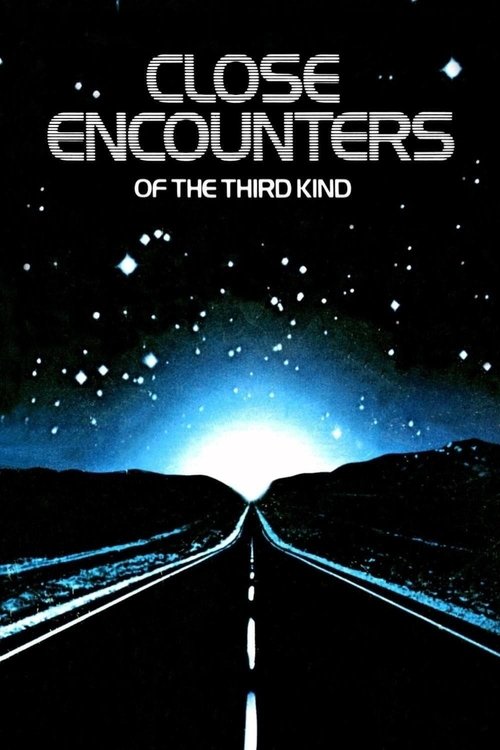
Close Encounters of the Third Kind, released in 1977, is a science-fiction film directed by Steven Spielberg that redefined how cinema imagined extraterrestrial contact. Instead of invasion and conflict, Spielberg offered wonder, curiosity, and a spiritual sense of communion. The film follows Roy Neary, an Indiana electrical lineman whose life unravels after a close encounter with a UFO, and a parallel story of French scientist Claude Lacombe investigating global phenomena linked to an imminent alien visitation.
Shot on a budget of $20 million, the film was a technical marvel for its time, with visual effects by Douglas Trumbull that used miniatures, matte paintings, and optical compositing to create a luminous, awe-inspiring mother ship. John Williams composed the score, whose five-note musical motif became instantly iconic. The film was a commercial success, grossing over $306 million worldwide, and received eight Academy Award nominations, winning two for Best Cinematography and Best Visual Effects.
The film's optimistic tone stood in stark contrast to the dystopian science fiction of the 1970s. By centering on human emotion and the mystery of the unknown, Spielberg crafted a story that resonated with audiences seeking hope and transcendence. In 2007, the Library of Congress selected Close Encounters of the Third Kind for preservation in the National Film Registry for its cultural, historical, and aesthetic significance.
Availability and pricing can change. Confirm on the provider's site before purchasing.
Roy Neary, an electrical lineman in Muncie, Indiana, is called out during a massive power outage one night. While driving his truck, he encounters a strange, glowing object that streaks overhead, bathing him in bright light. The encounter leaves him with a sunburn, a sudden compulsion to draw, and a growing obsession. He begins sketching and sculpting a mysterious mountain-like shape, unable to explain why.
Meanwhile, in the Sonoran Desert, a team led by French scientist Claude Lacombe and his American interpreter David Laughlin discovers a squadron of World War II-era fighter planes perfectly preserved in the sand, with no sign of their pilots. Lacombe, a calm and intellectual figure, begins tracking similar events worldwide: a strange five-note musical sequence, reports of missing people returning with unexplained burns, and sightings of unidentified flying objects. The team realizes that something is trying to communicate.
Roy's obsession strains his marriage to Ronnie, who cannot understand his behavior. He neglects his job and his children, covering the house with drawings and clay models of the shape. Ronnie eventually leaves, taking the children. Roy, now alone, continues his quest, driven by a force he cannot name. Elsewhere, Jillian Guiler, a single mother, experiences a terrifying encounter at her rural home when a UFO abducts her young son Barry. She too begins seeing the same mountain shape in her mind.
Government and military agencies orchestrate a cover-up, staging a fake chemical spill to evacuate the area around Devil's Tower in Wyoming, which matches the shape in Roy and Jillian's visions. Lacombe's team, aware of the cover-up, works with the military to prepare for contact. They establish a landing zone and a communication system using light and sound signals. Roy, Jillian, and other individuals who have had similar experiences find their way to Devil's Tower, determined to reach the site despite the barriers. Roy's personal journey of loss and obsession converges with the larger scientific effort, setting the stage for a monumental event.
Close Encounters of the Third Kind (1977) - Trailer HD 1080p
Official Trailer
Critical Consensus
Close Encounters of the Third Kind is a landmark achievement in science-fiction cinema that replaces typical alien-invasion tropes with a sense of wonder, childlike curiosity, and spiritual awe. Spielberg's masterful direction, Vilmos Zsigmond's luminous cinematography, and John Williams' iconic score combine to create an experience that remains emotionally resonant and visually breathtaking decades later.
“Close Encounters of the Third Kind is a work of inspired filmmaking that is as much about the wonder of childhood as it is about extraterrestrial life.”
Vincent Canby
The New York Times
“The movie is not about special effects but about people, and it's one of the most emotionally satisfying science-fiction films ever made.”
Roger Ebert
Chicago Sun-Times
“Spielberg has made a film that is pure, unashamed, and rapturous. It's a celebration of the possibility of contact, and it leaves you feeling exhilarated.”
Pauline Kael
The New Yorker
“Close Encounters of the Third Kind is a triumph of imagination and technical skill, a film that redefines the science-fiction genre with its optimism and humanity.”
Variety Staff
Variety
“Spielberg's film is a stunning visual and emotional experience that captures the awe and mystery of the unknown, with Richard Dreyfuss delivering a career-defining performance.”
The Hollywood Reporter
The Hollywood Reporter
Richard Dreyfuss
Roy Neary
François Truffaut
Claude Lacombe
Teri Garr
Ronnie Neary
Melinda Dillon
Jillian Guiler
Bob Balaban
David Laughlin
J. Patrick McNamara
Project Leader
Warren J. Kemmerling
Wild Bill
Roberts Blossom
Farmer
Phil Dodds
ARP Musician
Cary Guffey
Barry Guiler
Shawn Bishop
Brad Neary
Adrienne Campbell
Sylvia Neary
Director
Steven Spielberg
Writer
Steven Spielberg
Composer
John Williams
Cinematographer
Vilmos Zsigmond
Producers
Clark L. Paylow, Julia Phillips, Michael Phillips
Academy Awards (1978)
Best Cinematography: Won
Academy Awards (1978)
Best Visual Effects: Won
Academy Awards (1978)
Best Director: Nominated
Academy Awards (1978)
Best Supporting Actress: Nominated
Academy Awards (1978)
Best Film Editing: Nominated
Academy Awards (1978)
Best Art Direction: Nominated
Academy Awards (1978)
Best Original Score: Nominated
Academy Awards (1978)
Best Sound: Nominated
Golden Globe Awards (1978)
Best Original Score: Won
Golden Globe Awards (1978)
Best Motion Picture – Drama: Nominated
Golden Globe Awards (1978)
Best Director: Nominated
Golden Globe Awards (1978)
Best Screenplay: Nominated
BAFTA Awards (1978)
Best Production Design: Won
BAFTA Awards (1978)
Best Cinematography: Nominated
BAFTA Awards (1978)
Best Film Editing: Nominated
BAFTA Awards (1978)
Best Sound: Nominated
Saturn Awards (1978)
Best Science Fiction Film: Won
Saturn Awards (1978)
Best Director: Won
Saturn Awards (1978)
Best Writing: Won
Saturn Awards (1978)
Best Special Effects: Won
Saturn Awards (1978)
Best Music: Won
Join the community
fans discussing