“Dempsey brings a likable vulnerability to the role of Ronald, making his journey from outcast to popular kid both believable and endearing.”
Todd McCarthy
Variety
 United States
"He bought a month of popularity. Now he needs to sell his soul."
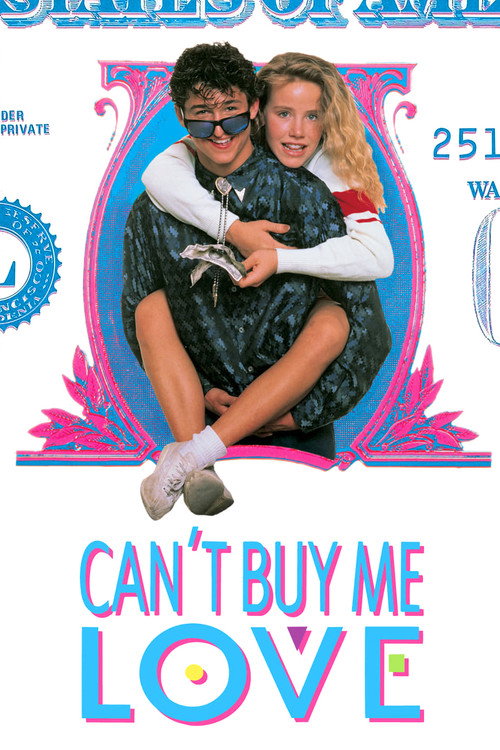
Ronald Miller is a quiet high school senior who stumbles into an unlikely arrangement after saving cheerleader Cindy Mancini from her mother's wrath. The deal seems simple enough: Ronald covers the cost of a destroyed designer outfit in exchange for Cindy pretending to be his girlfriend for thirty days. This premise sets the stage for Can't Buy Me Love, a 1987 teen comedy directed by Steve Rash that captures the specific anxieties and social hierarchies of American high schools during the late eighties.
Patrick Dempsey stars as the awkward but kind-hearted Ronald, while Amanda Peterson brings energy to the role of Cindy. Supporting turns from Seth Green as Ronald's brother Chuckie and Courtney Gains as the bully Kenneth Wurman ground the film in a recognizable reality. Produced on a modest budget of $1.8 million, the movie struck a chord with audiences, grossing over $31 million worldwide. Despite its small scale, the film achieved a solid rating of nearly 6.9 out of 10, proving that stories about friendship and authenticity resonated deeply with viewers at the time.
Stream
Availability and pricing can change. Confirm on the provider's site before purchasing.
Ronald Miller lives a life defined by invisibility at his suburban California high school. As the younger brother of Chuckie Miller, a charismatic but dim-witted star quarterback played by Seth Green, Ronald exists in the shadows of the school's rigid social hierarchy. He faces constant bullying from Kenneth Wurman, a feared jock portrayed by Courtney Gains, and finds no solace among his peers. His only escape is a secret, unrequited admiration for Cindy Mancini, the most beautiful and popular cheerleader in school. Cindy remains completely out of his league, treating him as if he were invisible even when they cross paths.
The narrative shifts when Ronald witnesses Cindy accidentally destroying her mother's expensive designer dress while trying to escape a confrontation with her overprotective parent. Seeing an opportunity to help and perhaps bridge the gap between them, Ronald intervenes. He pays for the dress to be cleaned or replaced, effectively saving Cindy from severe punishment. In return for this act of kindness, Cindy proposes a bizarre arrangement: she will pretend to be Ronald's girlfriend for one month if he pays her $1,000. Desperate for social acceptance and terrified of spending his life as an outcast, Ronald agrees to the deal, draining his life savings to buy his way into the upper echelon of high school society.
The transformation is immediate and dramatic. As Cindy poses as his girlfriend, Ronald is suddenly swept up in a whirlwind of attention. He is invited to parties, treated with respect by teachers, and even gains the begrudging respect of Kenneth Wurman, who initially mocks him but eventually joins their circle. Ronald begins to enjoy the perks of popularity, dancing with Cindy and attending prom while feeling like a real person for the first time. However, the facade begins to crack under the weight of its own artificiality. Ronald struggles to maintain the charade, often feeling like an imposter among his new friends. He finds himself unable to express his true feelings to Cindy, who is beginning to see the real man behind the awkward exterior rather than just the wealthy boyfriend.
As the month draws to a close, the central conflict deepens. Ronald realizes that while he has bought popularity, he hasn't bought love or genuine friendship. The relationship becomes strained as Cindy starts to fall for the authentic Ronald, not the persona he is projecting. Meanwhile, the pressure of the lie threatens to explode, particularly when Cindy's mother discovers the truth about the dress and the payment. The story builds toward a climax where Ronald must decide whether to continue the deception to keep his status or reveal the truth and risk losing everything, including the girl he genuinely loves. The narrative explores themes of authenticity, the superficial nature of teenage social hierarchies, and the realization that self-worth cannot be purchased.
Official Trailer
Teaser
Critical Consensus
While Can't Buy Me Love suffers from a predictable plot and occasional clichés common to the teen comedy genre of the late 1980s, it is elevated by Patrick Dempsey's charming performance and Amanda Peterson's spirited portrayal. The film captures the essence of high school social dynamics with a nostalgic warmth, offering a heartfelt message about authenticity that resonates despite its formulaic structure.
“Dempsey brings a likable vulnerability to the role of Ronald, making his journey from outcast to popular kid both believable and endearing.”
Todd McCarthy
Variety
“A modest budget doesn't stop Can't Buy Me Love from delivering a solid teen drama with a surprisingly mature message about self-worth.”
Raymond Benson
The Hollywood Reporter
“While the premise is familiar, the execution is fresh enough to keep audiences engaged, thanks to strong performances and a genuine emotional core.”
Roger Ebert
RogerEbert.com
Patrick Dempsey
Ronald Miller
Amanda Peterson
Cindy Mancini
Courtney Gains
Kenneth Wurman
Seth Green
Chuckie Miller
Sharon Farrell
Mrs. Mancini
Tina Caspary
Barbara
Dennis Dugan
David Miller
Director
Steve Rash
Writer
Michael Swerdlick
Composer
Robert Folk
Cinematographer
Peter Lyons Collister
Producer
Thom Mount
Young Artist Awards (1988)
Best Young Actor Supporting Role in a Motion Picture: Nominated
Young Artist Awards (1988)
Best Young Actress Supporting Role in a Motion Picture: Nominated
Saturn Awards (1988)
Best Science Fiction Film: Nominated
Join the community
fans discussing